


Your regional hospital network manages multiple locations, each operating its own social media channels. Every location follows different approval processes, involves different decision-makers, and interprets compliance requirements in its own way. This decentralization often leads to confusion and inconsistent execution.
Hospital social media managers frequently face approval delays that prevent timely publishing, while limited oversight increases compliance risks. Marketing leaders at headquarters aim to protect HIPAA compliance and maintain brand consistency. Meanwhile, local administrators need flexibility to address community-specific needs, and frontline teams want to engage patients without long approval cycles.
This dynamic creates constant tension. If approvals are too restrictive, local teams may bypass the process to move faster. If controls are too relaxed, the risk of compliance violations increases. Many hospitals only recognize these gaps after an unauthorized post goes live or when regulatory concerns arise.
Healthcare organizations often struggle to manage content approval across distributed teams due to strict regulatory requirements and complex internal structures. When workflows are unclear, inconsistencies and compliance issues become more likely.
This blog explores how to design scalable approval workflows for multi-location hospitals. You’ll learn the key elements of an effective system, how to balance centralized oversight with local autonomy, and how to streamline approvals while maintaining compliance across every location.
Why Multi-Location Approval Workflows Fail?
Healthcare organizations rarely fail due to a lack of effort. Approval bottlenecks emerge from predictable structural problems. Understanding these root causes helps hospitals implement solutions that actually work.
1. Undefined Approval Authority Creates Paralysis
Nobody knows who can actually approve content because authority paths remain unclear or overlap across departments. Does the marketing director approve all posts? Do local hospital administrators have authority? Can department heads approve their own content? When responsibility is diffused across multiple people with unclear decision boundaries, everything is delayed while stakeholders wait for clarification.
Email threads become approval purgatory. A post request bounces between marketing, compliance, and legal, with each department assuming someone else will make the decision. This is why cross-functional social media collaboration fails. Three days pass while the optimal posting window closes. Frustrated social media managers resubmit. The cycle continues, training teams to bypass approval entirely.
2. Excessive Centralization Kills Local Responsiveness
Requiring corporate approval for every local post, even routine community updates, creates delays that make social media irrelevant to frontline teams. A local hospital administrator wants to post about a community health fair happening in three days. The request travels to headquarters, gets lost in email, and comes back after the event passes. Local teams learn that social media approval is broken and stop requesting permission. Over time, frontline content dies in approval bottlenecks.
Centralized approval makes sense for brand consistency, but taken too far, it becomes a blocker rather than an enabler. Local teams understand their communities better than corporate strategists. Requiring corporate review of every post wastes executive attention on routine matters while killing the agility that makes social media valuable.
3. Inconsistent Approval Standards Confuse Teams
Different people apply different standards to approval decisions, leaving teams confused about what will actually pass review. Marketing approves one type of patient story while compliance rejects another similar post for unclear reasons. Local administrators apply different standards than corporate teams. This inconsistency trains people to guess at requirements rather than understand them.
Without documented standards, approval becomes subjective and unpredictable. Teams cannot learn from rejections because the logic remains unstated. New employees have no framework to understand approval expectations. Standards drift over time as different people interpret requirements differently.
4. Disconnected Tools Create Process Friction
Approval requests get buried in email, shared drives, and messaging apps because no system was designed specifically for multi-location content workflows. Email approval means checking dozens of inboxes. Shared drives hide the submission and status. Messaging apps create approval trails that disappear. Nobody knows what’s pending, what’s approved, or what’s rejected.
When approval processes require excessive clicks or navigation through unfamiliar systems, compliance drops. Frontline staff find approval too difficult and either delay publishing or skip approval entirely. The process becomes something to work around rather than a system that protects and enables.
5. Audit Trails Disappear Into Organizational Chaos
Hospital compliance officers cannot demonstrate that proper approval occurred because records remain scattered across email, chat, and spreadsheets. An audit arrives and compliance staff cannot produce evidence that a specific post received appropriate review. Documentation exists somewhere, but finding it takes hours of excavation through digital rubble.
This creates risk beyond just inconvenience. HIPAA audits require demonstrating that social media follows defined processes. When approval records are impossible to locate, hospitals cannot prove compliance. Regulatory agencies view missing documentation the same as missing approval entirely. This gap is why social media audits frequently fail.
These problems interact and compound. Unclear authority leads to excessive centralization, which drives teams to bypass approval, which creates audit trail gaps. Each problem makes the others worse, ultimately leaving hospitals with either compliance chaos or social media gridlock.
Coordinate Approval Workflows Across Your Hospital Locations
ContentBridge centralizes your approval processes across every team and region. Local teams receive clear authority while compliance maintains complete visibility.
The Real Cost of Broken Approval Workflows
Approval failures create consequences that extend far beyond frustration with slow processes. The cumulative cost to healthcare organizations is substantial and measurable.
1. Compliance Violations Accumulate Quietly
Hospitals without clear approval workflows face elevated HIPAA violation risk. An employee posts a patient photo without proper authorization. Another shares a recovery story with identifying details. A third mentions a patient by name in community engagement. These violations occur not from malice but from unclear standards and a lack of systematic review.
Healthcare experienced 725 reported data breaches in 2024, with social media-related incidents representing 12% of breaches. Many of these incidents originated from approval process failures rather than sophisticated attacks. Poor oversight enables accidental compliance violations.
Regulators respond seriously. OCR (Office for Civil Rights) enforcement actions for social media HIPAA violations now include penalties ranging from $100 to $1.5 million per violation, depending on negligence severity. A single unreviewed post could expose your organization to six-figure penalties.
2. Brand Damage Multiplies Across Locations
Inconsistent or inappropriate posts visible across 15 locations multiply reputation damage. A patient sees her doctor’s hospital posting contradictory information across different location accounts. Another patient notices one location highlighting superior technology while another location claims better outcomes. Customers notice these inconsistencies and question which hospital actually delivers quality care.
Negative patient experiences magnified across multiple locations train customers to distrust your entire network. One location’s social media mistake becomes a network-wide credibility problem. Reputation repair takes months, while lasting damage may never fully recover. Preventing this requires a comprehensive framework for hospital brand consistency that connects every location under shared standards, not just shared guidelines.
3. Social Media Becomes Irrelevant to Operations
Without effective approval workflows, social media transitions from business tool to corporate burden. Local administrators stop requesting approvals because the process takes too long. Staff stops suggesting content ideas because nobody responds. Social media channels continue posting, but become corporate announcements rather than community engagement tools.
When local teams disconnect from social media, your hospital loses the competitive advantage that social presence should provide. Competitors with effective approval workflows engage communities while your hospital broadcasts one-way messages. Our healthcare social media management guide covers what effective coordination looks like. Patient engagement metrics decline while more agile competitors capture attention and build patient loyalty.
4. Staff Compliance Culture Erodes
Confusing approval processes teach staff to disregard compliance altogether. When requested approvals take weeks for unclear reasons, staff learn that compliance processes are broken and assume rules don’t really matter. This erosion leads to uncontrolled employee content creating brand risk. This mentality spreads beyond social media into other compliance areas.
Creating a compliance culture requires showing that compliance processes actually work and serve organizational interests. When approval workflows demonstrate clear benefits and predictable timelines, staff participation increases. When processes remain opaque and frustrating, compliance becomes something to avoid rather than embrace.
End Approval Workflow Chaos with ContentBridge
ContentBridge provides centralized approval systems designed for hospitals managing multiple locations. Every location stays synchronized with role-based permissions and instant notifications.
How to Build Approval Workflows That Scale
Effective multi-location approval requires rethinking how hospitals coordinate content authorization. The right approach combines clear policies, role-based decision authority, and purpose-built systems.
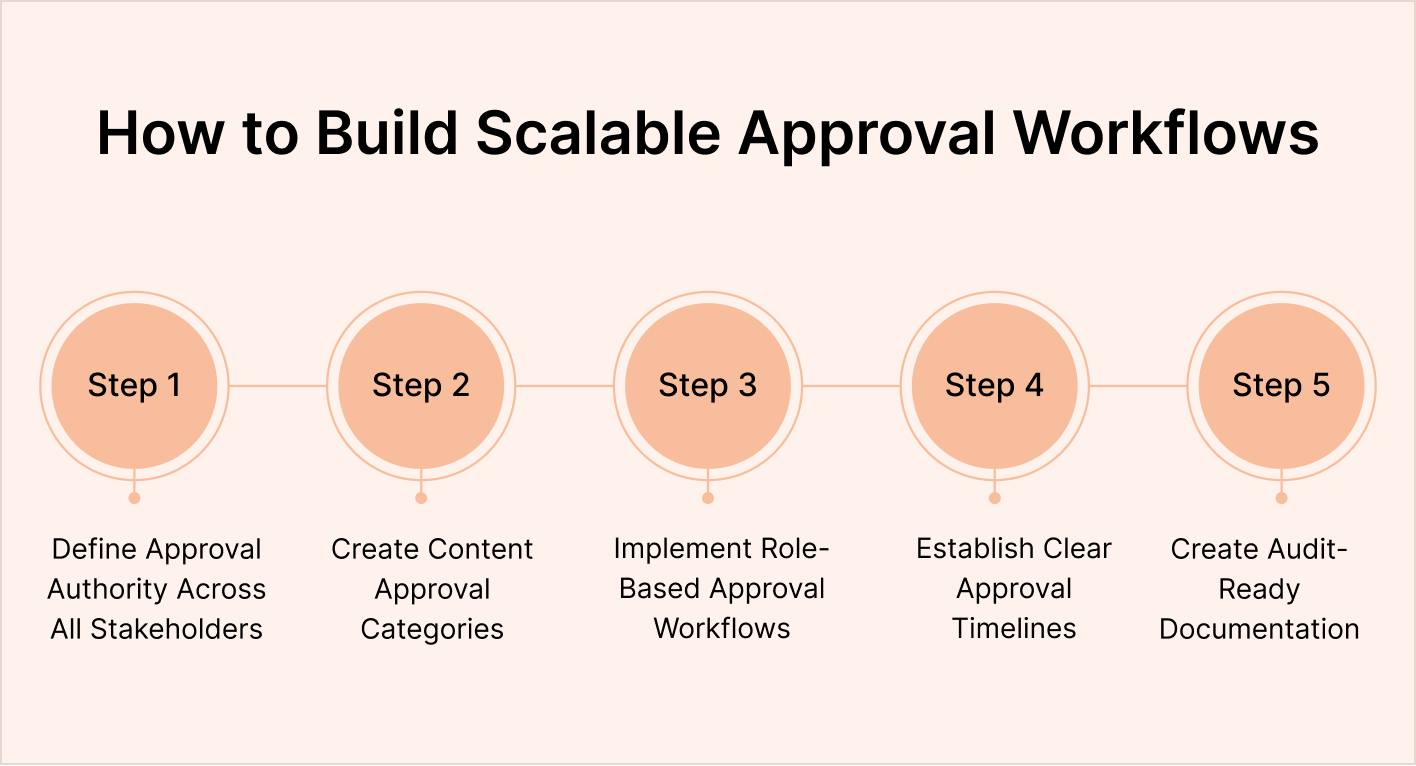
1. Define Approval Authority Across All Stakeholders
Start by mapping exactly who can approve different types of content at every organizational level. The corporation might approve all patient stories and regulatory statements. Regional hospital administrators approve community event posts. Department heads approve departmental announcements. Create a documented matrix showing approval authority by content type and organizational role.
This documentation serves multiple purposes. It teaches staff what they can expect. It prevents duplicate approvals and redundant stakeholder involvement. It creates accountability by identifying exactly who has decision authority. Most importantly, it gives compliance officers documentation showing that proper approval authority exists.
Make approval authority visible to everyone. Create simple graphics showing the approval chain for different content types. Include this in onboarding materials. Post it on your intranet. Reference it in approval requests. Visible authority structures train people to understand requirements.
2. Create Content Approval Categories
Not all content requires the same level of review. Categorize social content by risk level and establish approval requirements accordingly. High-risk content like patient stories, regulatory claims, or healthcare advice requires careful compliance review. Medium-risk content like community event announcements might need local administrator approval, but skip legal review. Low-risk content like staff recognition or facility images might need only a visual brand check.
This tiering prevents approval bottlenecks on routine posts while maintaining careful oversight of high-risk content. When teams understand which content requires detailed review and which requires only basic confirmation, approval flows faster and more predictably.
Document each category with examples. Show the specific approval chain required for each category. Make it clear what happens if someone submits patient content in the “routine post” category (it gets reclassified and sent through proper compliance review).
3. Implement Role-Based Approval Workflows
Assign approval permissions based on job role rather than individual names. A “Content Reviewer” role can approve community posts. A “Compliance Officer” role must review patient-related content. A “Marketing Director” role oversees brand consistency. When staff transitions between roles, permissions change automatically with the role assignment.
Role-based systems prevent chaos from staff turnover. Approval authority doesn’t disappear when key people leave. New staff automatically inherit appropriate permissions when assigned to a role. Authority remains consistent regardless of who holds the position. To make this work at scale, the employee content submission process that feeds multi-location approval must be equally structured, with clear intake steps before content reaches any role-based reviewer.
Using a healthcare-focused social media management tool like ContentBridge helps streamline social media approval workflows for healthcare teams. Such tools are purpose-built to healthcare compliance requirements, ensuring no unapproved content goes live.
4. Establish Clear Approval Timelines
Set specific turnaround times for each approval category. High-risk content like patient stories gets 48-hour review windows. Medium-risk community posts get 24-hour windows. Low-risk posts get 4-hour windows. Publish automatically if approvers don’t respond within the window.
Guaranteed timelines change everything. Teams can plan content publication around known approval windows. Delays become predictable exceptions rather than random frustrations. Approvers understand they must respond within the commitment window or approve automatically. Pairing defined timelines with real-time visibility into approval status across hospital locations removes the guesswork entirely, so teams always know where a post stands without chasing approvers.
Document exceptions clearly. What happens if approvers are unavailable? Who acts as backup? Do emergency approvals follow different timelines? Make these exceptions explicit so teams know what to do when standard workflows cannot apply.
5. Create Audit-Ready Documentation
Document every approval decision automatically with timestamps, approver identity, and approval justification. Regulatory auditors must see evidence that proper review occurred. When records are scattered across email and spreadsheets, compliance officers cannot demonstrate oversight.
Centralized approval systems create the audit documentation that regulators require. OCR audits require showing that HIPAA training occurred, approval processes existed, and content received appropriate review. Automated documentation makes audit preparation straightforward rather than an archaeological expedition through corporate records.
Streamline Approvals Across Your Hospital Network
ContentBridge automates social media approval workflows with approval routing, compliance tracking, and location-level reporting. Know exactly how each location participates in your social media strategy.
Common Approval Workflow Mistakes to Avoid & How to Overcome
Healthcare organizations implementing approval workflows often make predictable mistakes. Learning from others’ failures accelerates your implementation.
Mistake 1: Creating Unnecessary Approval Layers
Some hospitals require approval from marketing, compliance, legal, and local administration for every post. This creates exponential delays. Every stakeholder waits for the previous approvers to complete their review. Approval timelines stretch to weeks for routine posts.
How to Overcome:
- Establish clear authority so that only necessary stakeholders review each content type.
- Let local administrators approve community event posts without routing through legal.
- Trust marketing to approve brand consistency without legal review.
- Concentrate legal review on patient-related content that actually requires expert evaluation.
Mistake 2: Centralizing Decisions That Should Be Local
Corporate offices demand approval for all posts, including routine local updates that corporate teams cannot evaluate effectively. Local hospital administrators understand their communities’ information needs better than corporate strategists. Requiring corporate approval for local content kills responsiveness.
How to Overcome:
- Delegate community-focused content approvals to local administrators.
- Assign corporate oversight to brand-wide campaigns and messaging.
- Establish clear boundaries between local and corporate authority.
- Maintain visibility through reporting rather than micromanagement.
Mistake 3: Lacking Clear Rejection Criteria
Content gets rejected, but staff never understand why. Approvers say posts need “adjustment” or “revision” without explaining required changes. Teams resubmit and face rejection again with different feedback. Approval becomes a guessing game.
How to Overcome:
- Document clear approval and rejection guidelines.
- Share examples of compliant and non-compliant content.
- Provide specific, actionable feedback for revisions.
- Train approvers to communicate policy-based reasoning clearly.
Mistake 4: Ignoring Mobile-First Approval
Approval systems designed for desktop computers fail with mobile frontline staff. Community engagement coordinators work from smartphones. Approval workflows requiring computer access prevent them from participating. This is why traditional tools fail frontline teams. Frontline teams abandon processes they cannot use from their devices.
How to Overcome:
- Design workflows optimized for mobile access.
- Enable review, comments, and approvals from smartphones.
- Simplify user interfaces to reduce friction.
- Test approval processes across devices before full rollout.
Mistake 5: Forgetting to Train All Stakeholders
Approval systems launch, but staff don’t understand how to use them. New employees never learn the approval process. Existing staff forget training after six months. Confusion creates delays and non-compliance.
How to Overcome:
- Make approval training mandatory for all affected staff.
- Include training in onboarding materials.
- Conduct refresher training quarterly.
- Create simple visual guides showing approval workflows.
Build Hospital Social Media Approval Workflows That Enable Compliance
ContentBridge provides enterprise-grade approval systems specifically designed for healthcare organizations managing multiple locations.
How to Manage Social Media Approval with ContentBridge
Multi-location hospital approval challenges require solutions designed specifically for healthcare complexity. The organizations winning in social media management share a common characteristic: they use platforms built for distributed team coordination, not generic social tools adapted for enterprise use.
ContentBridge is a frontline-first social media management platform. The platform automatically routes content for approval based on predefined role-based workflows. Compliance officers receive patient-related content for review. Local administrators approve community announcements. Marketing directors oversee brand consistency. The system enforces approval requirements without creating bottlenecks.
Centralized approval authority becomes an enabler rather than a blocker when workflows are clearly defined. Local teams know exactly what requires approval and who can authorize it. Approval timelines are guaranteed so teams can plan content publication confidently. Compliance officers maintain complete visibility while enabling faster decisions through clear delegation.
Frequently Asked Questions
How long should approval workflows take?
Approval timelines depend on content risk level. Routine community updates should receive approval within 4-24 hours. Patient story content requires 24-48 hours for compliance review. Emergency health announcements might receive expedited 2-hour review. Establish clear timelines by content category and communicate them consistently. Missing timelines frustrates staff and encourages bypassing approval entirely.
Who should have final approval authority?
Authority assignment depends on the content type. Compliance officers should approve patient-related content to ensure HIPAA compliance. Marketing directors should oversee brand consistency. Local administrators should approve community-specific content. Create a documented matrix showing authority by content type and stick to it consistently. This clarity prevents bottlenecks from unclear decision boundaries.
How do we handle approval for time-sensitive content?
Establish expedited approval pathways for time-sensitive posts like emergency health announcements or crisis responses. Designated staff should be available to review and approve urgent content within 30-60 minutes. Pre-approve templates for common emergency scenarios so posts can go live immediately without individual review. Balance speed with the compliance oversight that healthcare requires.
How many approval levels are too many?
More than three approval levels typically create bottlenecks. Most posts should require review from one or two stakeholders at maximum. High-risk patient content might require two levels (local administrator and compliance officer). Routine community posts might need only a visual brand check. Excessive approval layers slow processes without a meaningful added benefit.
What happens if an approver is unavailable?
Establish backup approvers for each role. If the primary approver is unavailable for 24 hours, authority automatically escalates to the backup. Make backup authority explicit and train backup approvers on their responsibilities. Without clear escalation paths, missing approvers create content publication gridlock.