

For Government
Social Media Management for Government
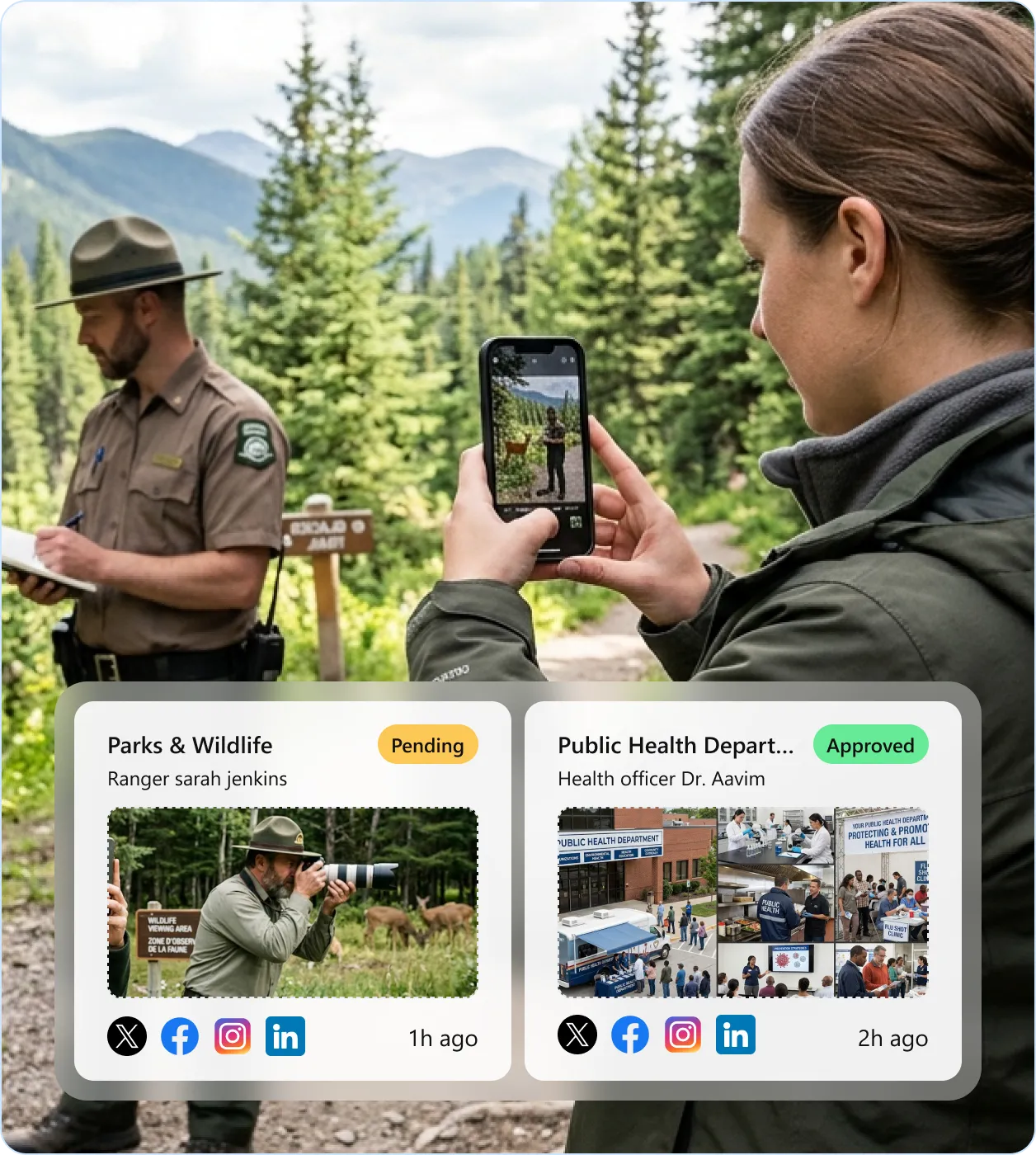
Your agency employs hundreds of frontline workers across dozens of departments, but a small communications team manages every social media post. Park rangers, transit workers, public health inspectors, and highway maintenance crews witness content-worthy moments every shift with no way to submit them. ContentBridge is a social media management platform built for frontline workers in government agencies. Unlimited approval levels enforce ATIA record-keeping, Official Languages Act bilingual requirements, and Treasury Board directives before anything goes live. No shared passwords. No rogue posts. Full audit trail on every action.
367,000+
federal public servants
<18 hrs
submission to publish
Every post
reviewed before publish
Why Government Social Media Stalls at Scale
Government agencies at every level hit the same three walls when they try to scale social media beyond a single communications desk. If any of these sound familiar, the problem is structural, not creative.

Your frontline workers have no path from the field to official accounts
An estimated 80% of the global workforce are deskless or frontline workers. In government, social media is often a collateral duty for field staff. At the National Park Service, park rangers manage social media alongside primary duties: after giving a tour or working the desk, they snap a photo and post it. Parks Canada maintains separate English and French Instagram accounts, with 629,000 followers on the English account alone. The City of Toronto employs over 43,000 people across dozens of departments. One communications team cannot photograph a trail closure in Banff and a transit expansion in Toronto on the same day.

One unreviewed post triggers an investigation, a records request, or both
In January 2017, a former employee used an old password to hijack the Badlands National Park Twitter account, posting climate data that went viral and spawning over 100 rogue government accounts within days (NBC News). In Philadelphia, 72 police officers were placed on desk duty after an investigation uncovered racist and violence-celebrating social media posts (NPR). In July 2025, GO Transit’s X account responded to a customer complaint with a dismissive AI-generated reply that referenced upgrades scheduled through “20321,” forcing Metrolinx to ban all AI use in social media replies (CP24). Without pre-publication review, every account with credentials is a source of risk.

Your social media records fail ATIA timelines and bilingual requirements
Federal institutions processed 13.7 million pages for access to information requests in 2024-2025, up 33.1% from the prior year. Of 33,928 requests received, only 64.5% were closed within legislated timelines (Treasury Board Statistical Report). Social media content falls under the same recordkeeping obligations as emails and official documents, yet screenshots lack the metadata, timestamps, and digital signatures required for compliance. Separately, the Commissioner of Official Languages received 847 admissible complaints in 2023-2024, with growing concerns about digital and social media non-compliance.
From the Field to Official Government Accounts in Three Steps
Every post follows a controlled, auditable path from the field to your agency’s official social accounts. Here is the approval chain for a typical multi-department government organization.
Frontline workers create
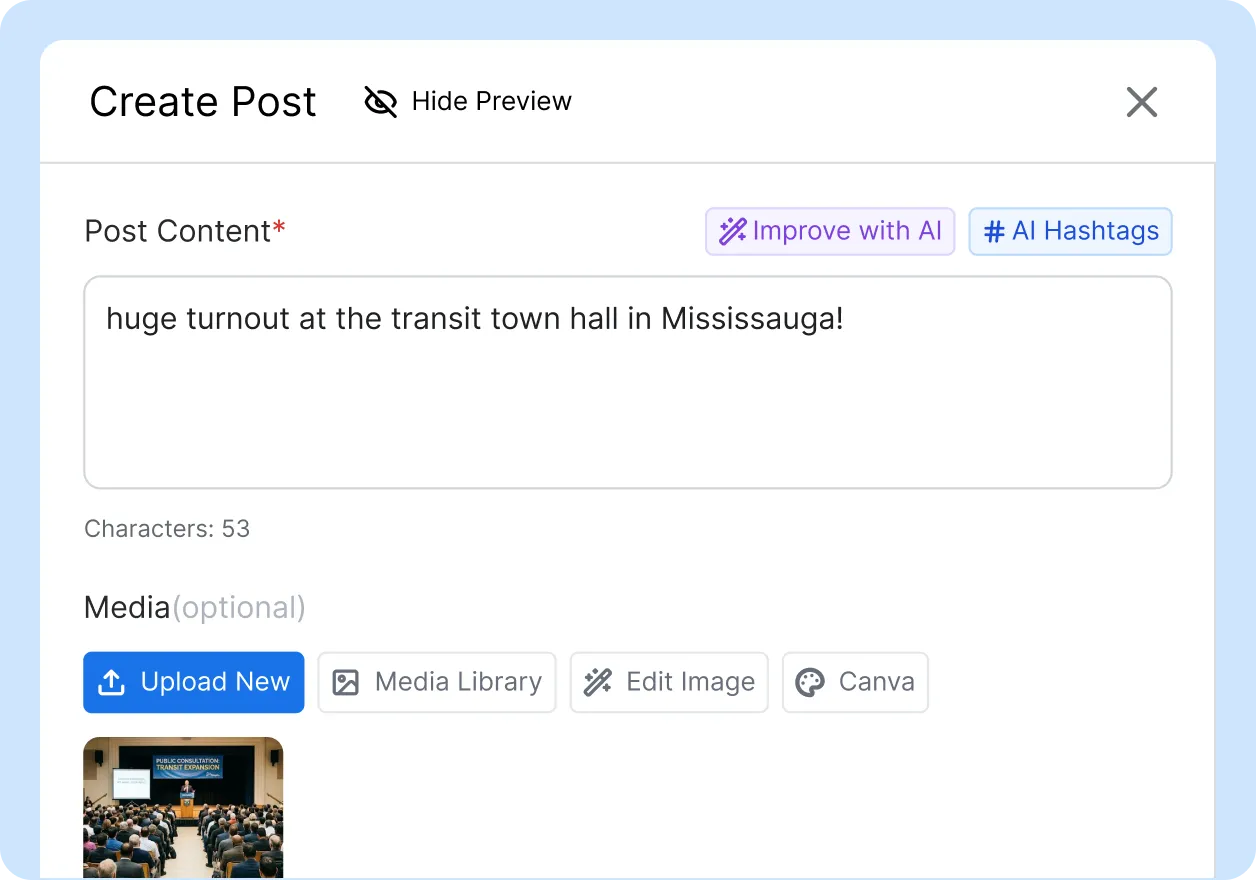
A park ranger at a conservation site, a transit mechanic at a maintenance bay, or a public health inspector in the field captures a photo and drafts a social media post from their phone. They select target platforms, add a caption, and submit for review. They never see or touch your agency’s social media credentials.
Your chain reviews
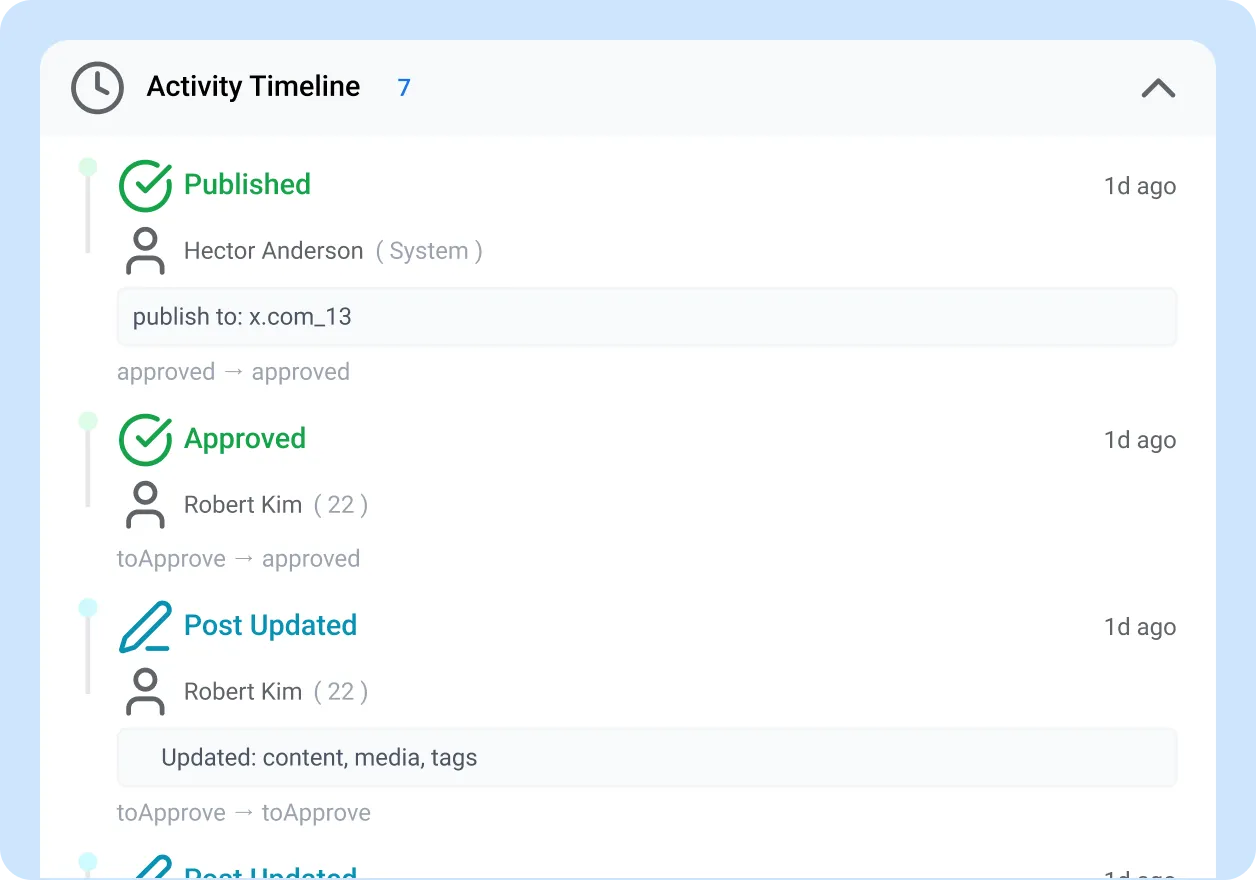
The post flows through your configured approval levels: department head checks accuracy, communications office verifies political neutrality and bilingual standards, and your records or legal reviewer gives final sign-off. Reviewers can approve, reject, or request changes with threaded feedback. Parallel reviewers evaluate simultaneously.
Auto-publish
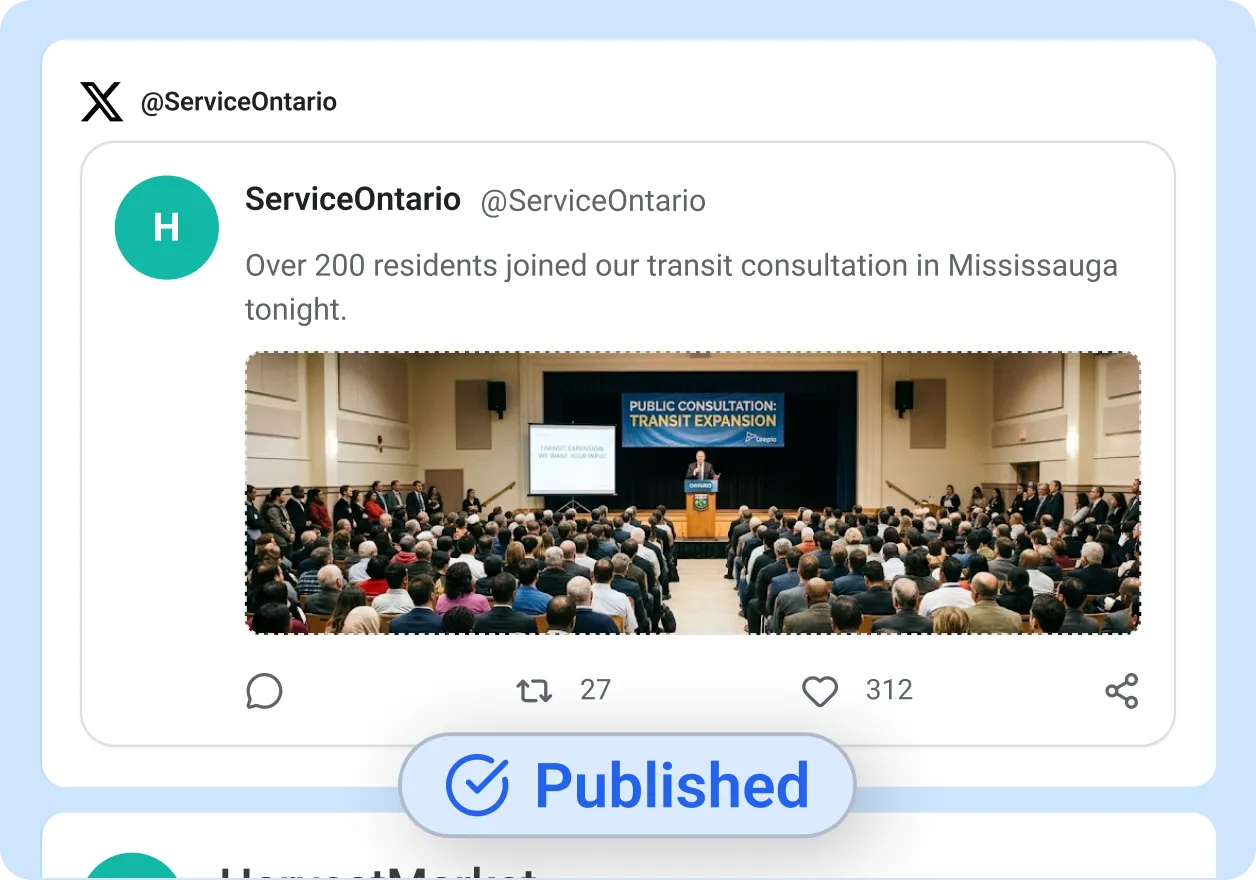
Once the final reviewer approves, ContentBridge publishes the post to your agency’s official Facebook, Instagram, X, and LinkedIn accounts automatically. The complete audit trail records every action: who created the post, who reviewed it, what changed, and when it went live. This record supports ATIA compliance and Official Languages Act documentation.
Six Ways Government Frontline Workers Create the Content Citizens Want to See
The content that builds public trust comes from the field, not from a communications desk. These are the use cases government agencies activate first.

Park rangers documenting conservation and visitor safety
Rangers, conservation officers, and wildlife biologists capture trail conditions, wildlife sightings, conservation projects, and visitor safety warnings from the field. Content guidelines flag posts near active wildlife management areas or during fire bans for additional review. The National Park Service built 10+ million followers across platforms, largely on ranger-created content. Fat Bear Week alone draws over a million votes annually.
Powered by: mobile content creation + GPS location capture + coverage maps

Public health inspectors sharing safety tips from the field
Public health inspectors, environmental health officers, and food safety specialists share inspection result summaries, food safety tips, and community health outreach from the field. Content guidelines flag posts containing identifiable businesses or individuals for privacy review before publication. Research published in PLOS One found that social media data helps inspectors identify issues that traditional surveillance methods miss.
Powered by: content guidelines + AI compliance checking + approval workflows

Transit workers showing behind-the-scenes operations
Bus mechanics, rail maintenance workers, station planners, and fleet technicians document maintenance operations, vehicle repair bays, infrastructure upgrades, and employee spotlights. This is the content that builds ridership trust and supports recruitment. The Metrolinx AI incident in July 2025 demonstrated what happens when social media content is produced without proper human oversight and approval.
Powered by: mobile content creation + approval workflows + contributor reports

Public works crews documenting infrastructure projects
Road repair crews, water and sewer maintenance teams, parks staff, and snow removal operators document infrastructure project progress from the field. Before-and-after content shows citizens where public funds go. According to GovPilot, Instagram is excellent for humanizing government work by showcasing field employees and behind-the-scenes views of public infrastructure projects. Coverage maps show which regions are active and which have gaps.
Powered by: coverage maps + territory management + media gallery

Emergency services documenting disaster response
Emergency management officers, fire department personnel, and search and rescue technicians document evacuation routes, shelter information, damage assessments, and recovery progress from the field. During the 2023 Canadian wildfires, Facebook’s news blocking forced 16,000 evacuees from Halifax to share screenshots of news stories instead of links. A structured mobile submission channel keeps emergency content flowing regardless of platform restrictions.
Powered by: mobile content creation + fast-track approval workflows

Tourism and cultural departments promoting local events
Cultural programmers, event coordinators, recreation staff, tourism officers, and library staff capture local festivals, cultural programming, seasonal activities, and community events. A single weather meme by Roanoke, Virginia reached 250,163 people and generated 15,581 engagements. Authentic, timely content from the people who run public programmes outperforms generic stock imagery from a central office.
Powered by: content creation + scheduling + department management
Six Capabilities Built for Multi-Department Government Operations
Government agencies require capabilities that general-purpose social media tools do not offer. These are the features that matter when your content comes from frontline workers across departments, regions, and jurisdictions.
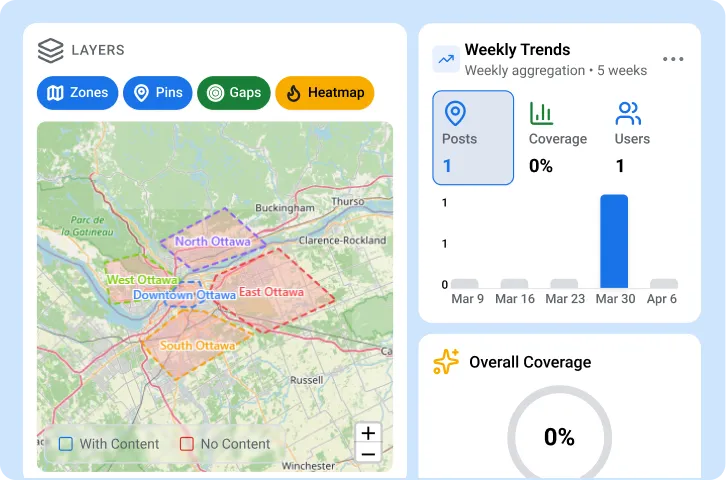
Multi-department and regional coverage maps
Interactive maps show which departments, regions, and field offices are creating content and which have gone silent. Filter by department, region, or date range. Role-based access ensures each department sees only its own content while your communications office maintains agency-wide visibility. Coverage trend reports reveal whether content activity is growing or declining across the organization.
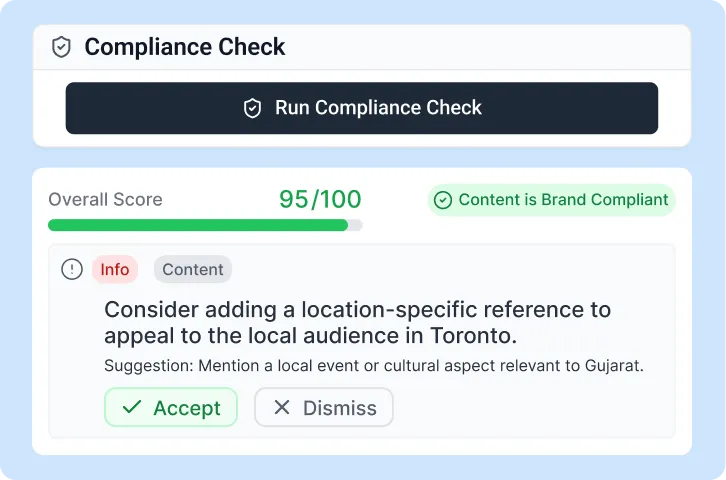
Content guidelines for political neutrality and regulatory compliance
Configure compliance rules that flag partisan language, identifiable individuals, or politically sensitive subjects for additional review. The AI compliance check reviews every post against your agency’s communications policy before it enters the approval queue. Content guidelines are configurable per department and jurisdiction, so the same platform supports federal bilingual requirements and provincial communications policies.
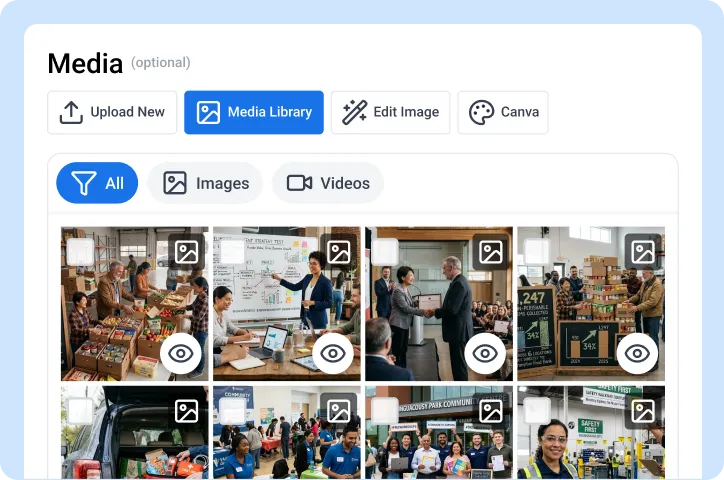
Media gallery for government visuals
Browse every photo and video captured across all departments in a searchable, Pinterest-style gallery. Filter by department, region, event type, and creator. Approved visuals are automatically tagged with metadata for easy retrieval. Bulk-export collections for annual reports, ministerial briefings, community newsletters, or ATIA responses.
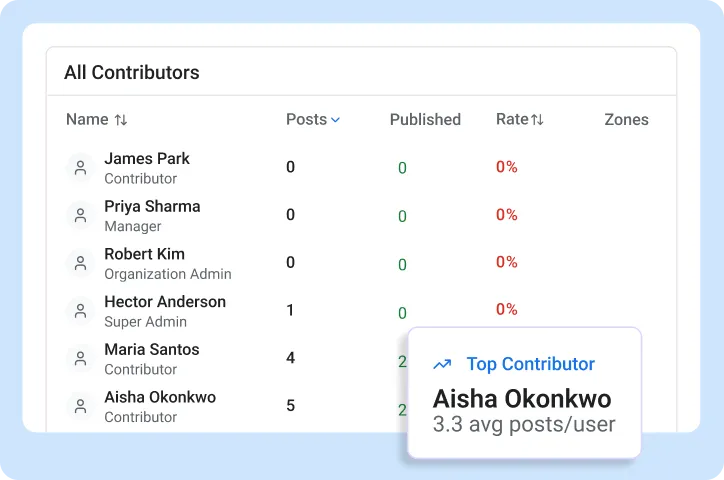
Leaderboards and contributor reports
Ranked department lists show which teams are most active. Filter by department, region, or time period. Weekly and monthly leaderboards create friendly competition that drives content volume across dispersed field offices. Contributor reports break down submissions by individual staff member, approval rate, and average turnaround time.
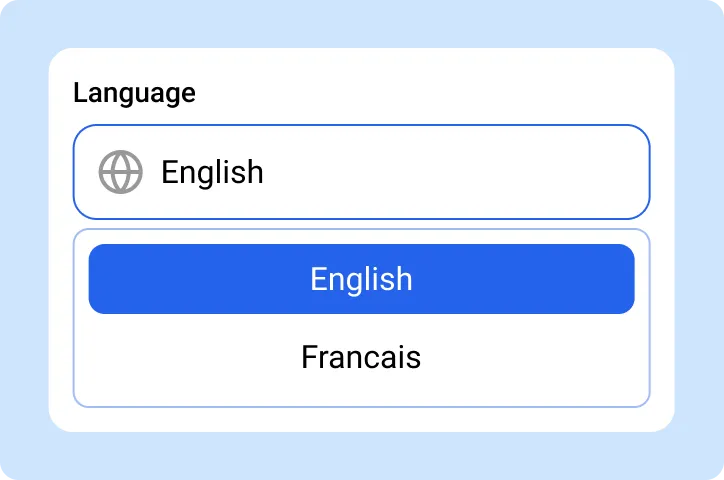
Bilingual support (EN/FR)
The full platform operates in English and French. Content creation, approval workflows, notifications, and the help centre are available in both languages. For federal agencies subject to the Official Languages Act, this is not a convenience; it is a requirement. Your approval chain can include a language reviewer to verify that English and French versions meet equal quality standards before publication.
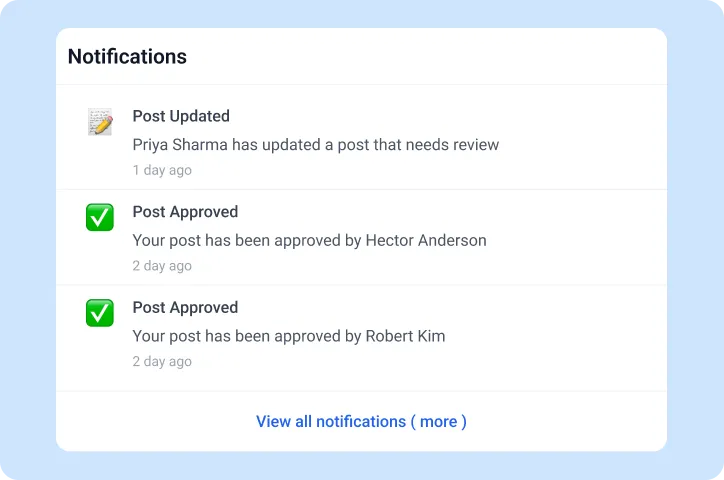
Real-time notifications
Push notifications arrive the instant a post needs review. WebSocket-powered live updates keep the approval queue current with no page refreshes. When a park ranger submits a trail closure advisory or an inspector flags a public health concern, the next reviewer in the chain sees it within seconds, not after the next email digest.

“Before ContentBridge, our park rangers and field inspectors had no way to contribute to our official social accounts. Our communications team of four managed social media for an agency with over 2,000 frontline workers across eight provinces. Six months after rollout, over 180 field staff submit content regularly. Every post goes through our communications team and bilingual reviewer before publication. Approval turnaround averages under 14 hours, and our ATIP team now exports social media records in minutes instead of assembling screenshots for days. Content volume across our accounts is up 400%.”

Michael Fournier, VP of Communications and Public Affairs
Government Compliance Followed in Every Post
Access to information laws, official languages requirements, Treasury Board directives, and privacy legislation govern every post your agency publishes. ContentBridge does not interpret regulations or replace your compliance teams. It gives your reviewers the workflow and audit trail to enforce compliance before anything goes live.

Access to Information Act (ATIA)
Social media posts are government records subject to access to information requests under the ATIA federally, and under provincial FOIP/FIPPA equivalents. Posts, comments, edits, and deletions are all within scope. Retention periods range from 3 to 7 years depending on jurisdiction and record type. ContentBridge’s audit trail provides a complete, timestamped, exportable record of every post’s lifecycle for your ATIP coordinator.

Official Languages Act
Federal institutions must communicate on social media in both official languages, published simultaneously and of equal quality. The Commissioner of Official Languages received 847 admissible complaints in 2023-2024, with growing concerns about digital non-compliance. ContentBridge’s bilingual platform supports simultaneous content creation and review in English and French. Your approval chain can include a language reviewer for bilingual compliance.

Treasury Board Directive on Communications
The Treasury Board Directive, updated March 2025, requires head of communications approval before creating any official social media account, use of a managed social media tool administered by Service Canada, and a misinformation and disinformation strategy for all federal departments by March 2026. ContentBridge’s approval workflows and audit trails align with these requirements.

Privacy Act (federal government)
The Privacy Act, not PIPEDA, governs federal government handling of personal information. Government agencies must publish privacy notices for social media accounts. When frontline workers photograph identifiable individuals at government events or in public spaces, your privacy reviewer screens the content through ContentBridge’s approval workflow before publication. The audit trail documents who approved the content and when.

Accessible Canada Act
Federal digital content must meet EN 301 549 standards, equivalent to WCAG 2.1 Level AA. This includes alt text on every image, captions on all videos, and accessible document formats. Provincial accessibility legislation adds jurisdiction-specific obligations. ContentBridge’s content guidelines can flag posts missing alt text or captions for your accessibility reviewer before publication.

Provincial FOIP/FIPPA legislation
Each province maintains its own access to information and privacy legislation. Ontario’s FIPPA, British Columbia’s FOIPPA, and Alberta’s FOIP Act each impose distinct obligations on provincial government social media. Your compliance reviewer screens content against provincial requirements through ContentBridge’s configurable content guidelines and approval chains, supporting compliance across multiple jurisdictions from a single platform.
Compliance depends on proper configuration and your organization’s specific policies. Consult your legal team for complete compliance verification.
Common Questions About ContentBridge for Government
Does ContentBridge work for government agencies with dozens of departments and separate social accounts?
Yes. ContentBridge supports government agencies with dozens of departments, each with its own approval chain, content guidelines, and connected social accounts. Your communications office sees every department and region from a single dashboard. You configure separate approval workflows for parks, transit, public health, public works, emergency services, and any other department. Coverage maps highlight content gaps across departments and regions, so your communications team can follow up before any area falls behind.
How does ContentBridge handle bilingual social media requirements under the Official Languages Act?
The full platform operates in English and French. Content creation, approval workflows, notifications, and the help centre are available in both languages. Federal agencies subject to the Official Languages Act can create and review content in both official languages simultaneously. Your approval chain can include a language reviewer to verify that English and French versions meet equal quality standards before publication. Separate language accounts can be managed from a single dashboard.
How does ContentBridge support ATIA compliance for social media records?
Social media posts by government agencies are records subject to access to information requests under the ATIA federally and under provincial FOIP and FIPPA equivalents. ContentBridge maintains a complete, timestamped audit trail for every post, recording each action from initial submission through every reviewer’s decision to final publication. This record is exportable, searchable, and includes metadata that screenshots cannot provide. Organizations should consult their ATIP coordinator or legal counsel for specific retention schedules.
How do we get park rangers and transit workers to actually create content?
ContentBridge is designed for frontline workers whose primary job is not social media. Creating a post takes under two minutes: take a photo in the field, write a caption, and submit. Staff do not need training in platform algorithms, scheduling, or brand guidelines. The approval chain handles compliance, bilingual review, and communications standards. Leaderboards and contributor reports create visibility across departments and regions. Agencies that activate ContentBridge typically see frontline adoption within the first three weeks.
How quickly can a government agency get started with ContentBridge?
Most agencies have their first department configured and submitting posts within one day. ContentBridge includes government industry templates that pre-configure common department structures and approval hierarchies. You add departments, invite staff through bulk CSV import or shareable invite links, and configure approval chains at your own pace. An agency with 10 departments typically completes full rollout within two to three weeks. Government agencies qualify for a 20% discount on all plans.
Other Industries Using ContentBridge
Government agencies are one of the sectors ContentBridge serves. See how frontline content creation works in other verticals.

Healthcare networks
Hospitals and healthcare networks empower every clinic to share patient success stories and health advisories with PHIPA-compliant approval workflows.

Law enforcement
Police departments empower every officer to share community engagement stories while multi-level approval protects investigations and officer safety.

Municipalities
Cities and towns empower public works crews, bylaw officers, and parks staff to create local content with MFIPPA-compliant approval workflows and ward-level coverage maps.