

For Healthcare
Social Media Management for Healthcare
Canada has 1,087 hospital facilities and a projected shortage of over 100,000 nurses by 2030. Your nurses, paramedics, and clinical staff are frontline workers with stories worth sharing, from community health events to recruitment content that cuts hiring time by 70%. ContentBridge is a social media management platform built for frontline workers in healthcare networks. Every post flows through your privacy officer and compliance reviewers before anything goes live. No shared passwords. No rogue posts. Full audit trail on every action.
1,087 hospitals
across Canada
Every post
reviewed before publish
70% faster
hiring with frontline content
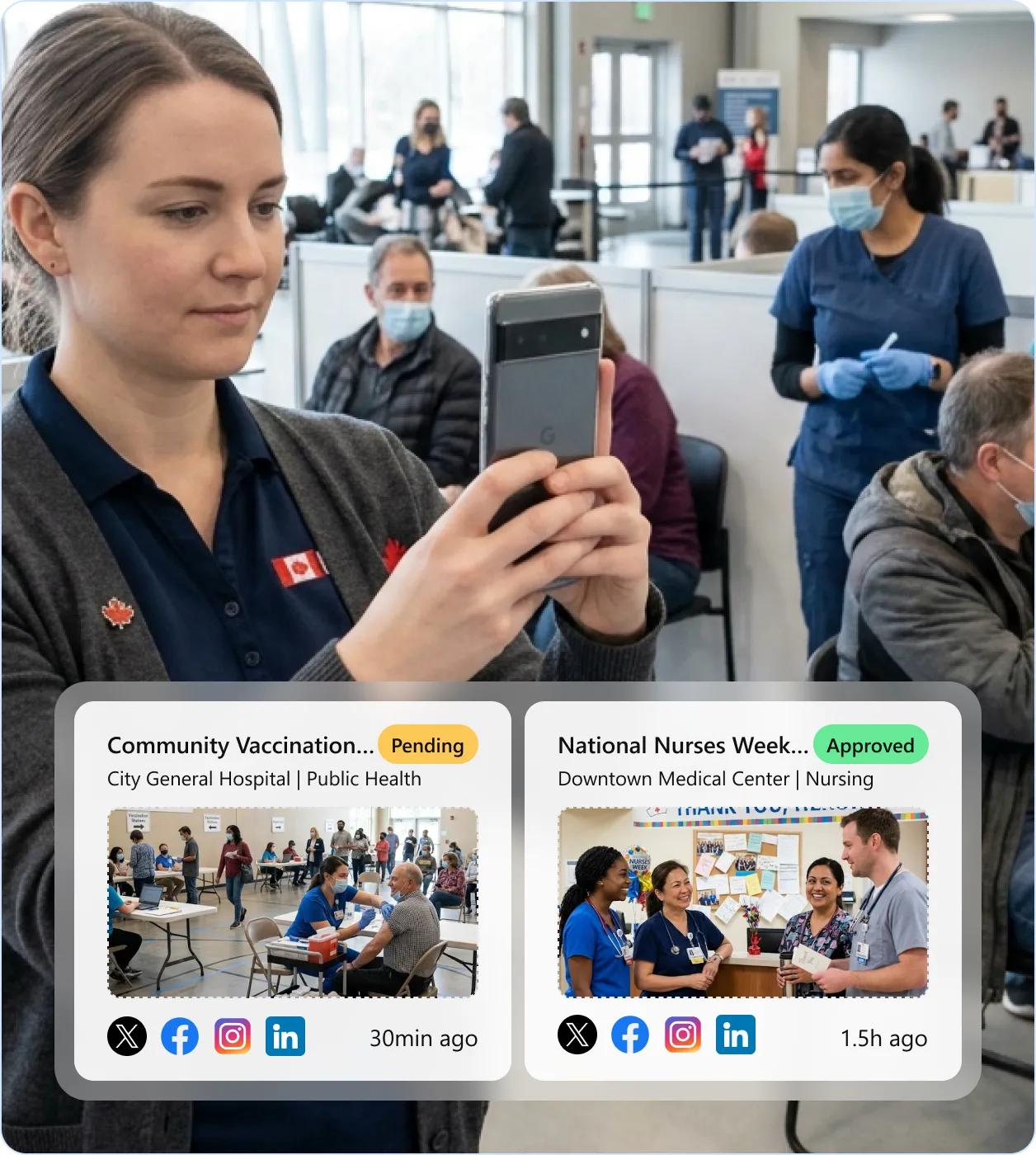
Why Healthcare Social Media Stalls at Scale
Healthcare networks with multiple hospitals and thousands of frontline workers hit the same three walls when they try to scale social media. If any of these sound familiar, the problem is structural, not creative.

Your best healthcare stories never reach official accounts
Ontario alone has 141 public hospital corporations across 217 sites (OHA). A three-person marketing team at a regional health authority overseeing 10 to 15 hospitals cannot produce authentic, location-specific content for each site. Nurses witness patient milestones, paramedics run CPR training events, and community health workers lead vaccination clinics. Those moments stay on personal phones because there is no safe submission channel to the organization’s official social accounts.

One unreviewed photo triggers a PHIPA investigation
According to Market.us, 45% of healthcare employees have accidentally shared patient data, and only 21% of healthcare organizations feel confident in their regulatory compliance. PHIPA penalties in Ontario reach up to $500,000 for organizations. A background whiteboard visible in a selfie, a chart number caught on a monitor, or a geotagged photo from a patient care area can expose personal health information. Without approval workflows, the first reviewer is the public.

Shared passwords mean no one is accountable when a violation occurs
According to Specops Software, 73% of healthcare professionals reported using a colleague’s login credentials to access systems. When applied to social media accounts, this means no audit trail for who posted what, no way to trace a privacy breach back to the individual who published it, and no ability to revoke access without changing the password for the entire department. When the IPC investigates, you need timestamped proof of who approved every post.
From the Ward to Official Hospital Accounts in Three Steps
Every post follows a controlled, auditable path from the frontline to your organization’s official social accounts. Here is the approval chain for a typical multi-hospital network.
Clinical staff create
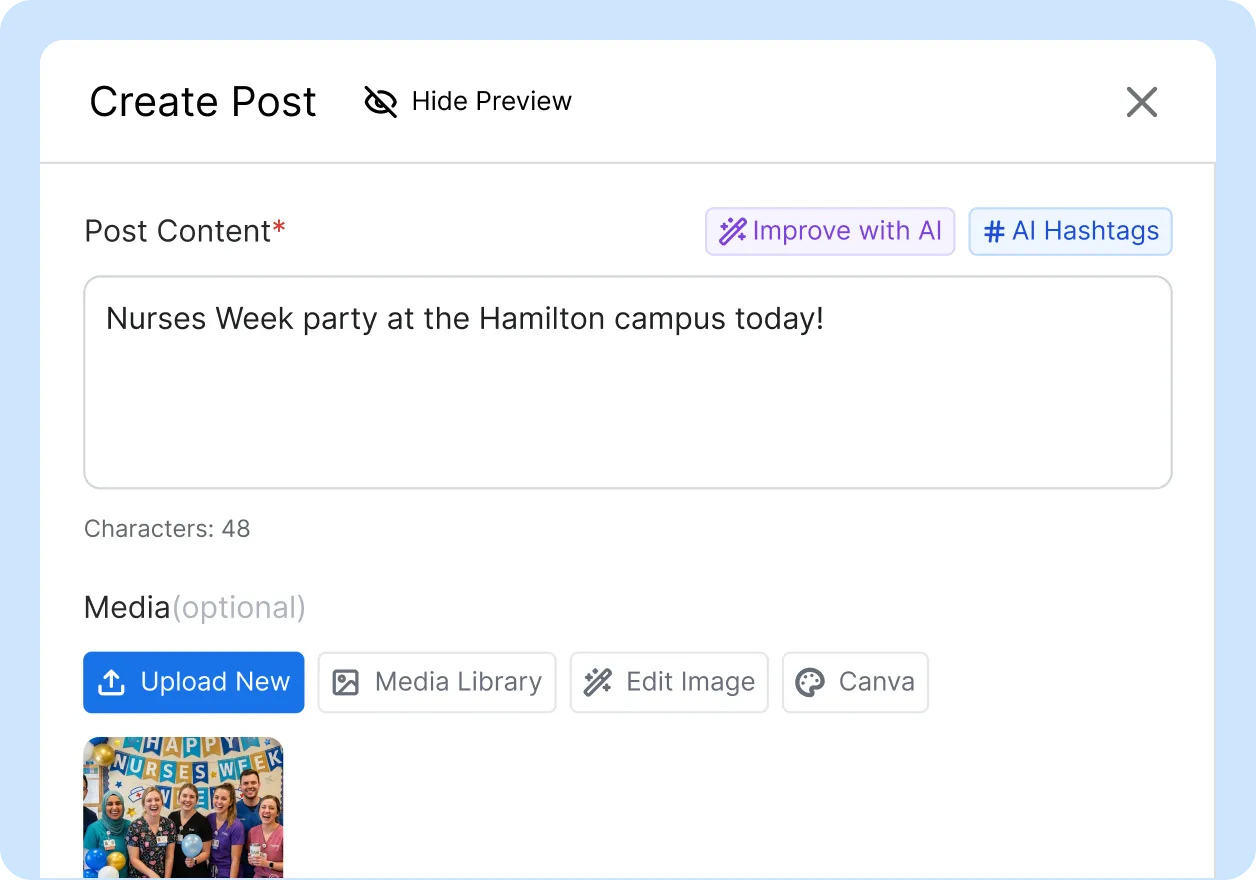
A nurse at a community vaccination clinic, a paramedic at a CPR training event, or a dietitian filming a healthy eating tip captures a photo or video and drafts a social media post from their phone. They select target platforms, add a caption, and submit for review. They never see or touch the hospital’s social media credentials.
Your chain reviews
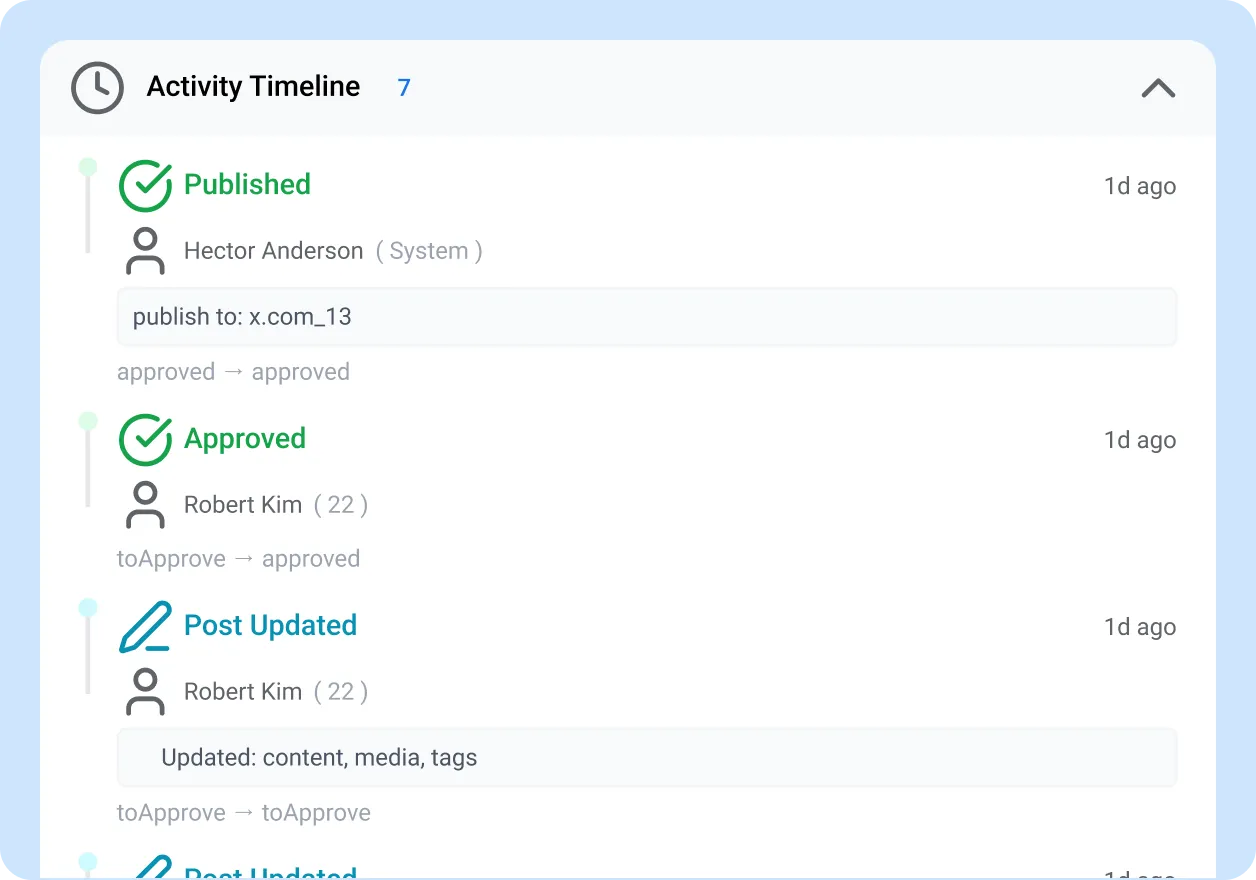
The post flows through your configured approval levels: the charge nurse or department head checks accuracy, marketing verifies brand alignment, and the privacy officer screens for personal health information, identifiable backgrounds, and PHIPA obligations. Reviewers can approve, reject, or request changes with threaded feedback. Parallel reviewers evaluate simultaneously.
Auto-publish
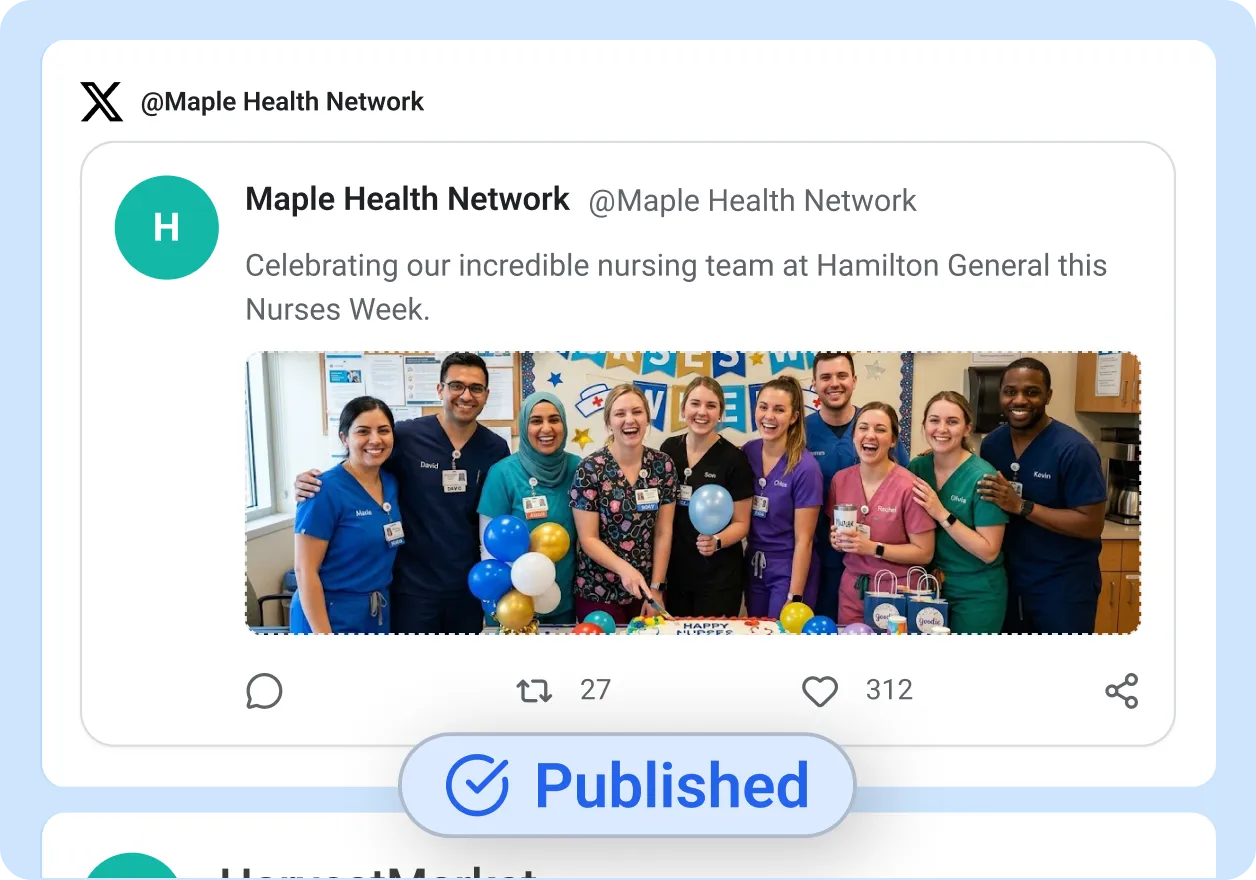
Once the final reviewer approves, ContentBridge publishes the post to your hospital’s official Facebook, Instagram, X, and LinkedIn accounts automatically. The complete audit trail records every action: who created the post, who reviewed it, what changed, and when it went live. This record serves as documentation for IPC inquiries or internal privacy audits.
Three Ways Healthcare Networks Grow Reputation and Recruit Talent Through Social Media
The content that performs best for healthcare organizations is the content your frontline workers already experience every shift.

Nurse recruitment content
Canada faces a projected shortage of over 100,000 nurses by 2030 (PMC), and 86% of job seekers use social media to find jobs (SHRM). Nurses, nursing students, and licensed practical nurses capture behind-the-scenes hospital life: shift transitions, team huddles, unit celebrations, and “a day in the life” videos. SSM Health proved this model works with 3,800+ nurse-created videos, 122M impressions, and a 70% reduction in time-to-fill positions (Nurse.org, GoodWork).
Powered by: content creation + approval workflows + leaderboards

Community health event coverage
Vaccination clinics, diabetes screenings, health fairs, and pop-up wellness events happen simultaneously across dozens of locations. Community health workers, public health nurses, and outreach coordinators capture real-time coverage from the field. A marketing team of three cannot attend 15 events in one week. Frontline staff are already there. Each submission enters the approval chain for privacy review before publication to your network’s official accounts.
Powered by: mobile content creation + coverage maps

Public health awareness campaigns
Cardiologists film heart health tips in February. Mental health counsellors share coping strategies in May. Respiratory therapists demonstrate proper inhaler technique. Educational posts earn 2.3x more engagement than promotional posts (Market.us), and content from a real clinician carries more authority than a marketing-produced graphic. ContentBridge routes clinical content through your medical affairs team and privacy officer before publication.
Powered by: content guidelines + AI compliance checking
Six Capabilities Built for Multi-Hospital Healthcare Networks
Social media management for healthcare requires capabilities that general-purpose tools do not offer. These are the features that matter when your content comes from clinical staff, not from a marketing desk.
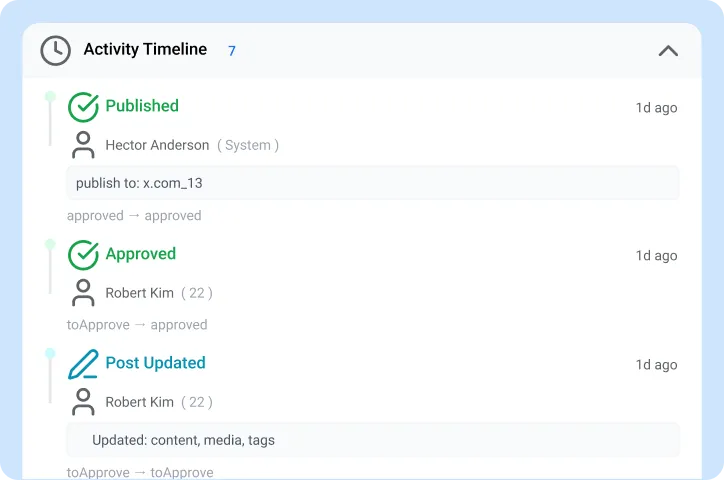
Unlimited approval workflows
Build approval chains that match your network’s privacy and governance structure: Nurse > Charge Nurse > Department Head > Marketing > Privacy Officer > Medical Director. Add as many levels as your organization requires. Route different content types through different chains. Recruitment posts follow one path; clinical education content follows another.
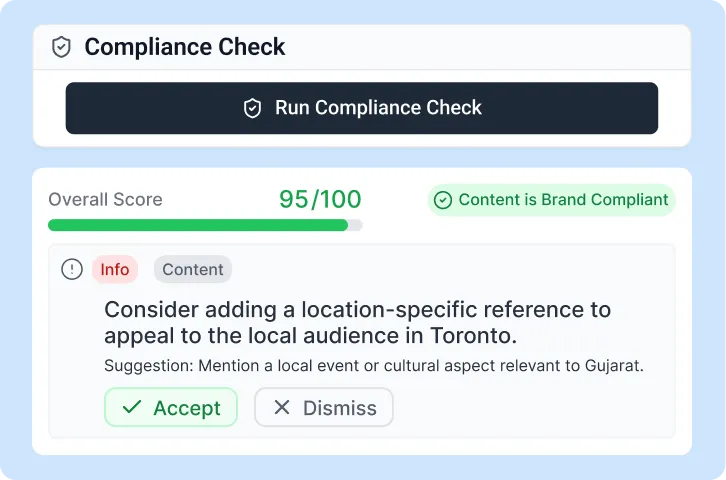
Content guidelines with AI compliance checking
Configure compliance rules that flag content referencing patient details, clinical terms that may indicate personal health information, or photos with identifiable backgrounds. The AI check screens posts before they enter the approval queue. Your privacy officer reviews flagged content and makes the compliance decision. Rules are configurable per hospital, department, or content type.
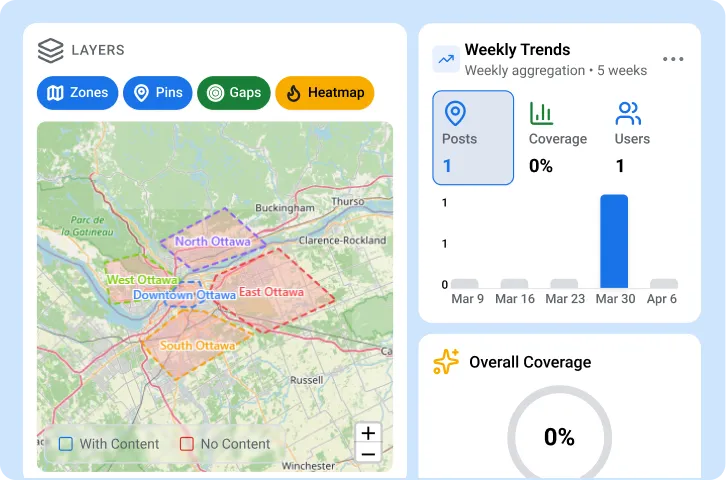
Network-wide coverage maps
Interactive maps show which hospitals and clinics are creating content and which have gone silent. Filter by hospital, department, or date range. Role-based access ensures each department sees only its own content while your corporate communications team maintains network-wide visibility. Coverage trend reports reveal whether content activity is growing or declining week over week.
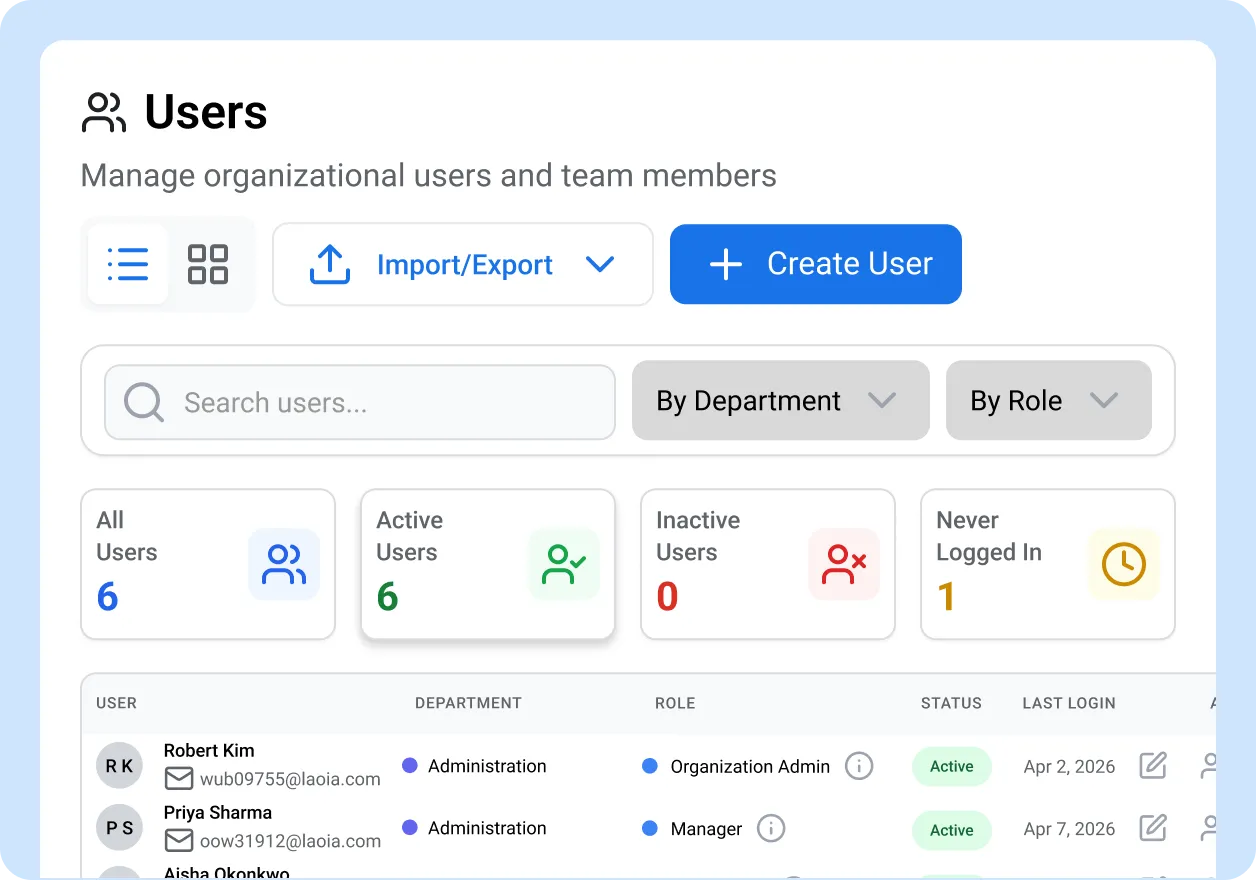
Department and location hierarchy
Organize staff by hospital, clinic, department, and unit within a single platform. Each location manages its own content calendar and approval chain. A cardiology department at one hospital can have different approval rules than the emergency department at another. Your regional health authority sees everything from one dashboard.
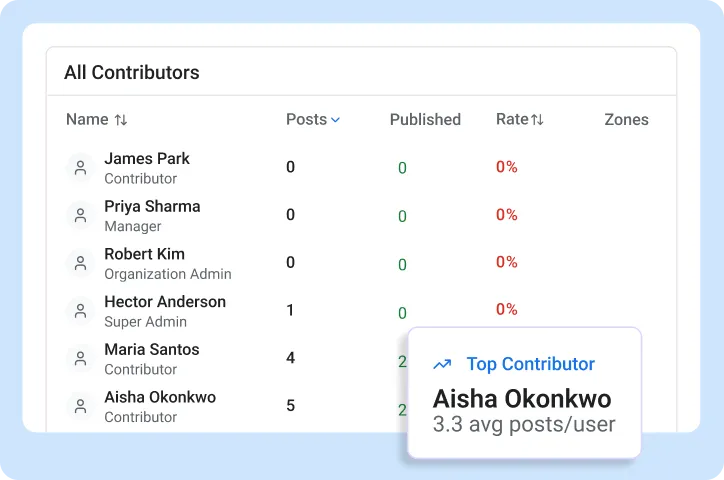
Leaderboards and contributor reports
Ranked contributor lists with gold, silver, and bronze medals show which hospitals and departments are most active. Filter by hospital, department, or time period. Weekly and monthly leaderboards create friendly competition that drives content volume without mandates. Track which nurses and clinical staff are contributing most and share best practices across the network.
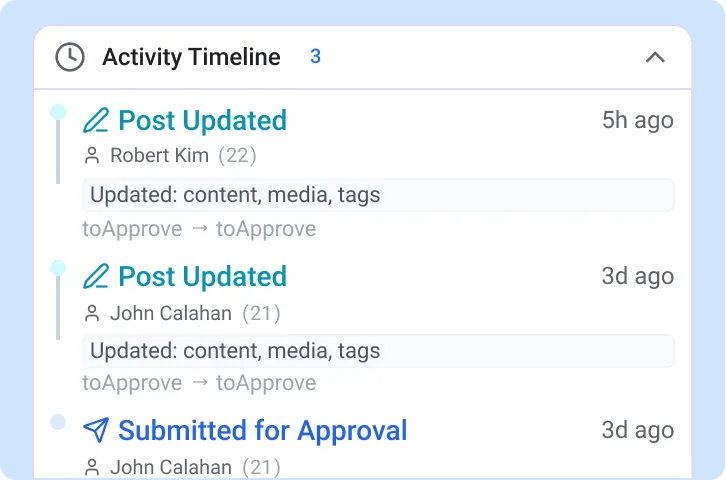
Full audit trail for privacy documentation
Every post, edit, approval, and rejection is logged with timestamps and user IDs. Export audit-ready reports in seconds for IPC inquiries, internal privacy audits, or professional college investigations. When a complaint arises about a social media post, you have complete documentation of who created, reviewed, and approved it.

“We had 12 hospitals and zero visibility into what anyone was sharing on social media. Three months after rollout, over 90 nurses and clinical staff submit content regularly. Every post goes through our marketing coordinator and privacy officer before publication. Approval turnaround averages under eight hours, and recruitment inquiries from social media are up 40%.”

Andrea Lawson, Director of Communications
Healthcare Compliance Followed in Every Post
Patient privacy legislation, professional college standards, and anti-spam rules govern every post your organization publishes. ContentBridge gives your reviewers the workflow and audit trail to follow compliance requirements before anything goes live.

PHIPA (Ontario)
The Personal Health Information Protection Act governs hospitals, care homes, psychiatric facilities, pharmacies, and healthcare practitioners in Ontario. PHIPA requires explicit consent before collecting, using, or disclosing personal health information. Penalties reach up to $500,000 for organizations and $200,000 for deliberate individual violations. ContentBridge routes every post through your privacy officer, who screens for PHI before publication.

PIPEDA (federal)
The Personal Information Protection and Electronic Documents Act applies to private-sector organizations collecting, using, or disclosing personal information in commercial activities. Hospitals may fall under PIPEDA for certain activities, especially when sharing data across provincial borders. ContentBridge’s content guidelines flag posts containing identifiable personal information for your compliance reviewer’s assessment before publication.

College of Nurses of Ontario (CNO)
Nurses must use proper communication channels and cannot share patient information even without names if the patient could be identifiable. The CNO’s Professional Boundaries practice standard, effective March 2026, reinforces these obligations. ContentBridge’s approval workflow ensures every nurse-created post passes through your designated reviewer before reaching official accounts.

CPSO guidelines
The College of Physicians and Surgeons of Ontario publishes guidelines on protecting personal health information and maintaining professional boundaries in digital communications. Physicians who create social media content about clinical practices, treatments, or patient outcomes need review before publication. ContentBridge routes physician-created content through your medical affairs team for guideline review.

Provincial privacy laws (HIA, FIPPA)
Alberta’s Health Information Act and British Columbia’s Freedom of Information and Protection of Privacy Act each impose province-specific obligations on healthcare organizations. ContentBridge’s content guidelines are configurable per location, so each hospital’s posts are screened against its home province’s privacy standards by your designated reviewer.

CASL compliance
Social media posts that link to registration forms, gated health resources, or email sign-up pages may trigger Canada’s Anti-Spam Legislation requirements. CASL mandates sender identification, contact information, and unsubscribe mechanisms for commercial electronic messages. ContentBridge’s content guidelines flag promotional health content for CASL review through the approval workflow.
Common Questions About ContentBridge for Healthcare
Does ContentBridge work for multi-hospital networks with different departments and specialties?
Yes. ContentBridge supports networks operating across multiple hospitals, clinics, and departments. Each location has its own approval chain, content guidelines, and connected social accounts. Your corporate communications team sees every location from a single dashboard. You configure separate compliance rules per department so that a post from your cardiology unit follows different review steps than a post from your community outreach team.
How does ContentBridge handle social media across 20+ hospitals?
Each hospital manages its own content calendar, approval chain, and connected social accounts within the same platform. Your regional or corporate communications team maintains oversight across all locations through a centralized dashboard. Coverage maps show which hospitals are actively creating content and which have gone silent. Department-level hierarchy lets you organize teams by hospital, clinic, unit, or specialty.
How does ContentBridge help hospitals address PHIPA when staff create social media content?
ContentBridge routes every post through your configured approval levels before publication. Your privacy officer or compliance reviewer screens content for identifiable patient information, background details in photos, and references to specific cases. Content guidelines flag posts that contain terms associated with patient data or clinical details. The platform does not replace your professional privacy judgment, but it provides a structured checkpoint so that no content reaches your official accounts without review.
How do we get nurses and clinical staff to actually create content?
ContentBridge is designed for frontline workers whose primary job is patient care, not social media. Creating a post takes under two minutes: take a photo at a community event or on the unit, write a caption, and submit. Clinical staff do not need training in platform algorithms, scheduling, or brand guidelines. The approval chain handles privacy and brand review. Leaderboards and contributor reports create visibility across departments and hospitals. SSM Health activated over 3,800 nurse-created videos using a similar frontline content model.
How quickly can a hospital network get started with ContentBridge?
Most hospital networks have their first location configured and submitting posts within one day. ContentBridge includes healthcare industry templates that pre-configure common department structures and approval hierarchies. You add hospitals, invite staff through bulk CSV import or shareable invite links, and configure approval chains at your own pace. A network with ten hospitals typically completes full rollout within two to three weeks.
Other Industries Using ContentBridge
Healthcare is one of the industries ContentBridge serves. See how frontline content creation works in other verticals.

Government agencies
Provincial and federal agencies empower every department to communicate with constituents through controlled approval workflows and bilingual support.

NGO and humanitarian
International NGOs and humanitarian organizations empower field staff and volunteers to share impact stories with verification workflows and vulnerable population protections.

Law enforcement
Police departments empower officers to share community engagement stories with multi-level approval chains, audit trails, and public records compliance.