


Frontline teams operate in moments that matter. They see updates, stories, and issues as they happen. But when social media content is spread across emails, chats, shared drives, and disconnected tools, those moments rarely turn into timely posts.
Gartner research shows that 47% of digital workers struggle to find the information they need to perform their jobs. For frontline social media, that gap shows up as missing context, outdated drafts, unclear approvals, and constant back and forth. Teams are left guessing which version is approved and who signed off.
This is why frontline teams need a single source of truth for social media. In this blog, we break down the risks of fragmented content management, explain what a true single source of truth looks like for frontline teams, and show how the right platform helps centralize content, speed up approvals, and maintain compliance without slowing execution.
What Is a Single Source of Truth for Social Media?
A single source of truth is one centralized platform where all social media content lives, gets reviewed, and moves to publication. This system becomes the only place teams need to look for approved content, brand assets, and publishing workflows. Everyone from corporate marketing to local frontline teams accesses the same information from the same location.
Traditional content management spreads files across email, cloud drives, messaging apps, and personal devices. This approach worked when teams were small and content volume was low. Today, distributed organizations produce dozens or hundreds of social posts monthly across multiple locations. The old approach cannot keep up.
A single source of truth changes everything by eliminating the question of where content lives. When a frontline worker needs the latest promotion graphic, they know exactly where to find it. When a manager needs to approve a post, they access one system. This clarity saves time and prevents the mistakes that scattered content causes.
Why Content Fragmentation Hurts Frontline Teams
Frontline workers operate in fast-paced environments with limited time to search through files. When content scatters across multiple systems, every task takes longer than it should. The problems compound as organizations grow and more people contribute to social media content.
Understanding these pain points helps organizations recognize the urgency of centralizing their content systems. Here are the five core challenges that fragmented content creates for frontline teams.
1. Content Chaos Across Systems and Devices
Social media content naturally collects at its point of creation. Marketing creates assets in one tool. Local teams capture photos on personal phones. Regional managers store templates in their own folders. Each department builds its own content library without coordinating with others.
This fragmentation creates daily frustration for frontline workers. They spend valuable time searching through multiple platforms to find what they need. Studies show that 40% of companies report that each department operates with its own agenda and its own version of the truth. The result is wasted effort and missed opportunities.
Frontline teams often give up searching and create new content from scratch. This leads to inconsistent messaging and duplicate work across locations. The cycle continues as more content gets created in more places without any central organization.
2. Version Control Becomes a Nightmare
Multiple people editing content creates confusion about which version is current and approved. Files with names like “Final_v2_REAL_final” become common across organizations. No one knows which document represents the actual approved version.
This version of chaos causes real damage to brands. Frontline teams post outdated promotions because they found an old file first. Managers approve content that someone has already rejected in another system. Customers see conflicting messages from the same brand.
Collaborative reviews happening outside the central system scatter feedback across email and messaging apps. Comments and approvals get lost in inboxes. The lack of a clear version history makes it impossible to track what changed and who approved it.
3. System Silos Block Team Collaboration
Different departments use different tools for content creation, storage, and publishing. Each system creates walls that prevent information from flowing freely. Research indicates that 69% of CFOs identify siloed information as the biggest financial mistake companies make.
Frontline teams feel these silos most acutely. They need content from marketing, but cannot access the marketing platform. They capture great local moments but have no way to share them with the corporate team. The technology that should connect teams keeps them apart instead.
Integration gaps between systems mean that content must be manually moved and reformatted. This creates delays and opportunities for errors. A post approved in one system must be copied to another for publishing, introducing version risks at every handoff.
4. Decision Making Slows to a Crawl
Leaders cannot make informed decisions when data and content are spread across disconnected sources. Data analysts become bottlenecks as they try to compile insights from multiple platforms. Teams debate which source contains the accurate information.
Frontline managers face this challenge daily when planning local social content. They cannot see what worked at other locations because that data lives in separate systems. Best practices remain hidden within individual teams rather than spreading across the organization.
Cross-functional alignment becomes nearly impossible when everyone works from different information. Marketing sees social engagement data. Customer service sees complaint data. Sales sees conversion data. No one sees the complete picture that would drive better decisions.
5. Duplicate Work Drains Resources
Without visibility into existing content, teams recreate assets that already exist elsewhere. The same promotional graphic gets designed three times by three different people. The same caption gets written for the same campaign at multiple locations.
This duplication wastes creative resources and budget. Organizations pay for work that already exists somewhere in their scattered systems. Frontline workers spend time on tasks that someone else already completed.
Content that could be repurposed sits unused because no one knows it exists. A great customer story from one location never reaches other locations. National campaigns cannot leverage successful local content because there is no system to surface it.
Unify Your Frontline Social Media Content Today
Stop searching for files across scattered systems. Centralize your content and give every frontline team member instant access to approved brand assets.
How Scattered Content Impacts Brand Consistency
When content lives across multiple platforms, devices, and folders, maintaining brand consistency becomes impossible. Marketing loses visibility into what frontline teams are creating. Regional offices develop their own styles. Agencies work from outdated assets. The result is a fragmented brand experience that confuses customers and dilutes your market position.
The impact of scattered content includes:
- Inconsistent messaging across locations: Different teams use different languages to describe the same products or services, creating confusion for customers who interact with multiple touchpoints.
- Outdated assets remain in circulation: Old logos, expired promotions, and retired taglines continue appearing in posts because teams cannot find or access current materials.
- Duplicate efforts waste resources: Multiple teams create similar content without knowing what others have produced, leading to redundant work and inefficient use of creative resources.
- Brand guidelines get ignored: When guidelines live in forgotten documents, teams default to their own interpretation of brand standards, resulting in inconsistent visuals and tone.
- Quality control becomes reactive: Marketing only discovers off-brand content after it goes live, forcing damage control instead of prevention.
- Approval history disappears: Without centralized records, no one knows who approved what or why certain decisions were made, making it impossible to learn from mistakes.
- Content performance stays unmeasured: Scattered systems prevent accurate tracking of what works and what does not, leaving teams unable to optimize their efforts.
Brand consistency requires centralized content management. Organizations that allow content to scatter across systems will continue to struggle with mixed messages and a diluted brand identity. A single source of truth for all social media content ensures every post, regardless of who creates it or where they are located, meets brand standards before it reaches your audience.
Protect Your Brand Identity Across Every Location
Give local teams the assets and brand guidelines they need. Help them stay on brand while building genuine connections with their communities.
What Frontline Teams Need from a Content System
Frontline workers have different needs than desk-based marketing teams. They work on mobile devices in fast environments. They need instant access to approved content without having to search through complex folder structures. The right system accounts for these unique requirements.
Understanding these needs helps organizations choose solutions that frontline teams will actually use. A system that works great for corporate marketing may fail completely for distributed frontline teams.
Mobile Access to All Content
Frontline workers rarely sit at desks with computer access. They capture moments and create content using mobile phones. Any content system must work seamlessly on mobile devices to serve these users effectively.
Mobile access means more than a responsive website. Frontline teams need native app experiences that load fast and work offline when needed. They need to upload photos, find templates, and submit content for approval, all from their phones.
Push notifications keep frontline workers informed about approvals, feedback, and urgent updates. Without mobile notifications, content sits in queues while approvers remain unaware. Fast mobile workflows match the pace at which frontline teams actually operate.
Simple Search and Navigation
Complex folder structures fail frontline workers who need content fast. They cannot spend time clicking through nested folders to find one image. Search must work intuitively with the words they naturally use.
Tags and categories should match how frontline teams think about content. A promotion for summer products should surface when someone searches “summer sale” or “July campaign.” Smart search understands context and returns relevant results quickly.
Recent and frequently used content should appear prominently. If a team uses the same template weekly, that template should be easy to find without searching. Good systems learn usage patterns and surface the most helpful content first.
Clear Approval Workflows
Frontline workers need to know exactly what happens after they submit content. Who reviews it? How long will approval take? Where can they check the status? Unclear workflows create anxiety and lead to duplicate submissions.
The ideal system clearly shows each step in the approval process. Frontline teams see their content move from submission through review to publication. They receive notifications when feedback arrives or when approval is complete.
Fast approval loops encourage frontline participation in content creation. When workers see their content published quickly, they stay motivated to capture more great moments. Slow, opaque processes discourage the authentic content that audiences value most.
How to Build Your Single Source of Truth for Social Media
Creating a centralized content system requires intentional planning and the right tools. Follow these steps to eliminate content chaos and establish a single source of truth for your social media operations.
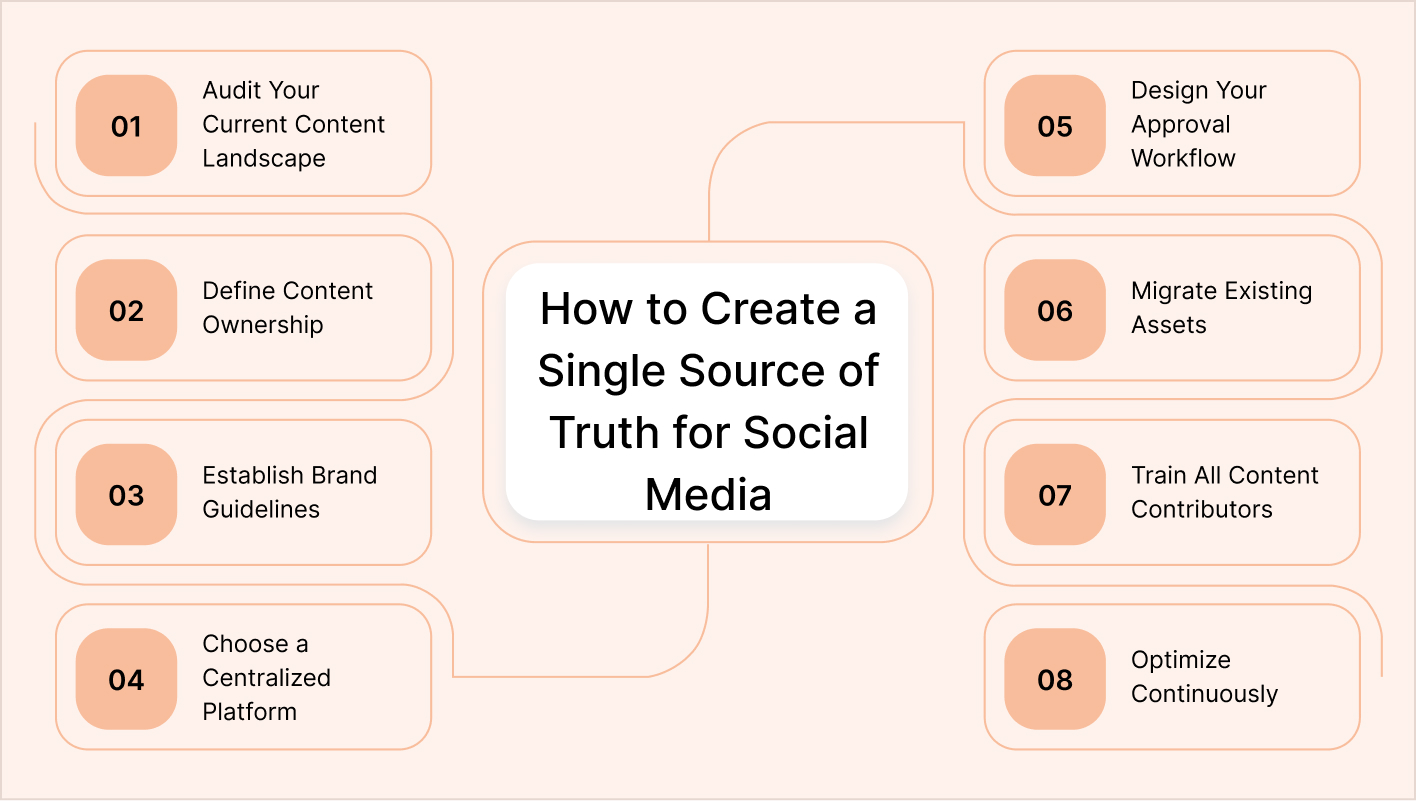
Step 1: Audit Your Current Content Landscape
Start by mapping where content currently lives across your organization. Identify every platform, folder, drive, and tool where teams store social media assets. Document who has access to each location and how content flows between them. This audit reveals the full scope of your scattered content problem and highlights the gaps that need to be addressed.
Step 2: Define Content Ownership and Roles
Clarify who is responsible for creating, reviewing, approving, and publishing content. Establish clear roles for frontline contributors, regional managers, marketing teams, and compliance reviewers. Document these responsibilities so everyone understands their part in the content workflow. Role clarity prevents duplication and ensures accountability at every stage.
Step 3: Establish Brand Guidelines and Templates
Create comprehensive brand guidelines that cover voice, tone, visuals, and messaging standards. Develop pre-approved templates for common content types, such as employee spotlights, customer stories, and promotional posts. Make these resources easily accessible within your centralized system. Templates accelerate content creation while maintaining consistency.
Step 4: Choose a Centralized Platform
Select a social media management tool that supports your workflow requirements. Look for features like role-based access, multi-level approvals, audit trails, and mobile content capture. The platform should accommodate frontline workers who create content in the field and reviewers who approve from anywhere. ContentBridge is purpose-built for this, enabling frontline teams to submit content on mobile while approval workflows ensure brand compliance before publication.
Step 5: Design Your Approval Workflow
Map out who needs to review content and in what order. Determine which content types require legal review and which can move through faster approval paths. Build parallel approvals where possible so multiple stakeholders can review simultaneously. Configure your workflow in your chosen platform to automate routing and notifications.
Step 6: Migrate Existing Assets
Move approved brand assets, templates, and guidelines into your centralized platform. Archive outdated materials so teams cannot accidentally use them. Organize content by category, campaign, or location for easy retrieval. A clean migration ensures teams start with the right resources from day one.
Step 7: Train All Content Contributors
Educate frontline teams, regional managers, and reviewers on how to use the new system. Demonstrate how to submit content, provide feedback, and approve posts. Explain why centralization matters for brand consistency and compliance. Training ensures adoption and prevents teams from reverting to old habits.
Step 8: Monitor and Optimize Continuously
Track post-launch content volume, approval times, and rejection rates. Identify bottlenecks where content gets stuck and address root causes. Gather feedback from contributors and reviewers on what is working and what needs improvement. A single source of truth requires ongoing maintenance to stay effective.
Building a single source of truth transforms how your organization manages social media content. Scattered files become organized assets. Inconsistent messaging becomes a unified brand voice. Approval chaos becomes streamlined workflows. The investment in centralization pays dividends in brand consistency, confidence in compliance, and faster content speed.
Centralize Frontline Social Media Without Slowing Teams Down
ContentBridge keeps content organized, visible, and approval-ready while frontline teams move fast.
How ContentBridge Delivers a Single Source of Truth for Frontline Teams
Managing social media content across distributed teams requires more than shared folders and email chains. ContentBridge is a centralized platform where every piece of frontline content lives, from initial capture to final publication. Frontline workers submit content directly from mobile devices, and everything flows into one system where marketing, legal, and leadership can review without confusion.
Approval workflows keep content moving without sacrificing control. ContentBridge supports unlimited approval levels with parallel review, so legal and marketing can evaluate posts simultaneously rather than waiting in sequence. Every action is automatically logged, creating complete audit trails that meet compliance requirements in healthcare, financial services, and government organizations.
The result is brand consistency at scale. Whether content comes from a nurse in Calgary or a franchise owner in Montreal, every post meets the same brand standards before reaching your audience. No scattered files. No lost approvals. No off-brand surprises. Just authentic frontline content published with confidence.
Frequently Asked Questions
What is a single source of truth for social media content?
A single source of truth is a centralized platform where all social media content, assets, and workflows live in one location. It eliminates scattered files across email threads, shared drives, and multiple systems. Every team member accesses the same, accurate, up-to-date information from a single source, preventing version confusion, reducing duplicate work, and ensuring brand consistency across all locations.
Why do frontline teams struggle with scattered content systems?
Frontline workers operate in fast-paced environments with limited time for administrative tasks and often work on mobile devices without full system access. Scattered content forces them to search multiple platforms, and many lack access to enterprise systems from personal devices. This gap pushes them toward workarounds like saving old files locally or recreating assets from memory.
How does content fragmentation affect brand consistency?
When content is scattered across systems, different teams use different versions of brand assets and messaging, leading to outdated logos, incorrect templates, and inconsistent information spreading throughout the organization. Research shows that only 30% of companies consistently enforce brand guidelines despite 85% having documented standards. Without a central system, teams cannot follow guidelines that are not easily accessible.
What features should a content platform have for frontline teams?
Effective platforms for frontline teams prioritize mobile access, simple search, clear approval workflows, and push notifications that keep mobile workers informed. Frontline workers need to access and submit content from phones without complex navigation. Integration with publishing tools eliminates manual content copying and keeps everything moving from creation to publication.
How long does it take to implement a single source of truth?
Implementation timelines vary based on organization size and system complexity, ranging from weeks for smaller organizations to several months for enterprise deployments. The technology setup is often faster than the change management required for adoption. Organizations should plan for a transition period during which training and habit-shifting occur alongside the rollout of the new system.
How do you measure the success of content centralization?
Key metrics include time spent searching for content, content error rates, brand consistency scores, and platform adoption rates. Survey frontline teams about their experience and compare content performance before and after implementation. Customer perception surveys can reveal whether internal improvements translate to better external brand experience.