


When your brand has teams spread across locations, time zones, and roles, speaking in one clear voice on social media becomes harder than it looks. Frontline employees, franchise partners, and regional teams all want to show up online, share local stories, and engage customers in real time.
But without the right guardrails, those well-intentioned posts often end up sounding inconsistent, off-brand, or disconnected from the company’s larger message.
This is where many distributed organizations struggle. Different people interpret brand voice differently. Messaging guidelines live in documents that rarely get opened. Approval processes slow things down or get skipped entirely. The result is a single social media account that feels like it’s run by multiple brands instead of one cohesive identity.
In this blog, we break down why distributed teams find it so difficult to sound like one brand, the common breakdowns that happen between central marketing and frontline teams, and what it takes to maintain a consistent brand voice without limiting local authenticity.
What Is Brand Voice Fragmentation?
Brand voice fragmentation occurs when different teams communicate in different styles across channels and locations. Your marketing team uses one tone. Your social media team uses another. Regional offices develop their own “local” voices that do not align with corporate standards. Each department believes they represent the brand correctly.
This problem multiplies in large organizations with distributed workforces. Teams become geographically dispersed across cities, states, and countries. External agencies add another layer of inconsistency to the mix. Each department creates content without awareness of what others are doing. The brand identity you carefully crafted becomes diluted over time.
The gap between brand identity and brand image grows wider with each inconsistent message. Brand identity is how you define yourself as an organization. Brand image is how consumers perceive you in the marketplace. When these two become misaligned, customers lose confidence in your organization and seek alternatives.
How Brand Voice Drift Happens in Distributed Teams
Brand voice drift does not happen overnight. It builds gradually through small decisions and missed coordination opportunities. Understanding the root causes helps you prevent fragmentation before it damages customer trust and revenue.
1. Multiple Writers Create Conflicting Styles
Every team member brings their own writing style to content creation. Without documented guidelines, each person interprets brand voice differently. One writer sounds formal and corporate in their messaging. Another sounds casual and friendly in similar communications. Both believe they represent the brand correctly.
No practical examples exist to guide content creators in their daily work. Platform variations add more confusion to an already complex situation. LinkedIn content sounds different from TikTok content by necessity. But there are no clear guardrails for how far teams can stretch the brand voice. New hires lack proper onboarding on brand standards and expectations.
2. Departments Work in Silos
As per Econsultancy, 40% of companies report that each department has its own agenda without support from other teams. Different systems and tools prevent meaningful collaboration across departments. No central repository exists for brand assets or approved content templates.
Content teams create materials without checking PR messaging for alignment. Social teams post campaigns without coordinating with regional offices. Each department optimizes for its own goals and performance metrics. The customer sees fragmented communication from what should be one unified brand.
3. Local Teams Go Rogue or Go Silent
Multi-location organizations face a specific and challenging problem. Local teams either post off-brand content or stay completely silent. Posting feels too complicated when approval processes are unclear or slow. Local success stories get lost because they do not fit corporate templates.
Franchise locations develop their own voice without corporate guidance. Regional offices adapt messaging for local audiences without clear guidelines. Global teams face cultural and language variations that complicate consistency. No system exists to effectively balance central control with local autonomy.
4. Leadership Fails to Prioritize Brand Governance
Many organizations lack executive commitment to brand voice consistency. Leadership views brand guidelines as a marketing concern rather than a business priority. Without top-down enforcement, teams prioritize speed over consistency.
Budget allocation reflects these misplaced priorities across departments. Training programs focus on job skills rather than brand representation. Performance reviews rarely include brand consistency as a measured metric. The message is clear: brand voice matters less than other objectives.
5. Technology Systems Create Barriers to Coordination
Different teams use different tools for content creation and publishing. Marketing uses one platform while regional offices use another entirely. There is no integration between systems to ensure consistent messaging across locations.
Content moves through informal channels like email and messaging apps. Metadata is lost when files are repeatedly transferred between systems. Version control becomes impossible when content lives in multiple places. Technology that should enable consistency actually creates more fragmentation.
Ensure Brand Voice at Scale with ContentBridge
ContentBridge combines approval workflows and AI brand voice checks to help distributed teams publish consistent social media content.
Why Brand Inconsistency Hurts Customer Trust
Customers notice when your brand sounds different across channels and locations. That inconsistency creates confusion and erodes the trust you worked hard to build. The impact extends beyond perception to measurable business outcomes.
1. Customers Cannot Recognize Your Brand
When brand voice varies across locations, customers question if communications come from the same company. They receive conflicting messages from different touchpoints throughout their journey. The brand experience feels disconnected and unreliable at every interaction.
Recognition drives purchase decisions in today’s competitive markets. Customers choose familiar brands because familiarity signals safety and reliability. When your voice changes constantly, you sacrifice the recognition advantage you built. Competitors with consistent voices become easier to identify and trust.
2. Trust Erodes with Every Mixed Message
Only 1 in 3 consumers says they trust most of the brands they use. Inconsistent communication contributes significantly to this trust deficit across industries. Every contradictory message raises questions about your organization’s credibility and reliability.
Trust takes years to build but moments to destroy. A formal corporate message followed by a casual social post creates cognitive dissonance. Customers wonder which version represents the real organization behind the brand. This uncertainty pushes them toward competitors who communicate more predictably.
3. Customer Experience Becomes Unpredictable
Customers expect consistent experiences across every brand touchpoint. When voice varies, so does the perceived quality of customer experience. A professional website paired with amateur social content signals organizational dysfunction.
Consistent experience drives loyalty in modern consumer relationships. Customers return to brands that deliver predictable, reliable interactions every time. Inconsistent voice suggests inconsistent service quality throughout the organization. Customers protect themselves by choosing brands with proven track records of consistency.
4. Competitors Capture Your Confused Customers
Brands that communicate clearly gain a significant competitive advantage in crowded markets. When your messaging feels scattered, competitors with unified voices attract your customers. Fragmented messaging directly impacts revenue and long-term customer loyalty.
Customers choose familiarity and reliability when making purchase decisions. A brand that sounds the same everywhere feels inherently more trustworthy. Your inconsistency becomes your competitor’s opportunity to win market share. Every confused customer represents revenue that walks away toward a clearer alternative.
5. Brand Equity Diminishes Over Time
Brand equity represents the value your brand name adds to products and services. Inconsistent voice slowly but persistently erodes this equity. Customers pay premium prices for brands they completely recognize and trust.
Fragmented messaging undermines the premium positioning you worked to establish. Price sensitivity increases as brand differentiation decreases in customers’ minds. Marketing investments deliver diminishing returns when brand identity lacks coherence. The compounding effect of inconsistency destroys the value you spent years building.
Common Operational Gaps That Create Brand Fragmentation
Brand voice drift occurs due to specific operational failures within organizations. Identifying these gaps helps you build systems that effectively prevent fragmentation. Most organizations share similar weaknesses in their content operations infrastructure.
1. No Central Repository for Brand Assets
Teams cannot follow brand guidelines if they cannot easily find them. Content creators waste valuable time searching for approved assets and templates. They create new materials because finding existing ones takes too long.
According to a Gartner survey, 47% of digital workers struggle to find the information they need to do their jobs. Without a central content library, teams constantly create duplicate work. Outdated content circulates while approved versions sit unused in forgotten folders. Version control becomes impossible when assets are distributed across multiple locations.
2. Training Gaps Leave Teams Unprepared
Only 30% of companies consistently enforce their brand guidelines, despite 85% having documented brand guidelines. This enforcement gap starts with training failures at the organizational level. New team members never learn brand standards during onboarding. Existing staff forget the guidelines over time without regular reinforcement.
Frontline workers face additional training challenges in distributed organizations. They do not sit at desks with easy access to learning resources. Carving out time for brand training proves difficult in fast-paced environments. High turnover creates a constant onboarding burden for already-stretched teams.
3. External Partners Add Inconsistency
Agencies and freelancers manage specific channels for many organizations today. They receive brand guidelines but interpret them differently based on experience. Each external partner adds another layer of potential voice drift.
No system tracks whether partners follow brand standards consistently over time. Feedback loops do not exist to correct misalignment before publishing. Partners create content based on their own understanding of your brand. The more partners involved, the more fragmented your voice becomes.
4. Approval Processes Lack Clear Ownership
Content moves through organizations without clear accountability at each stage. No one knows who approves what type of content for which channel. Approvers have different standards and interpretations of brand guidelines.
52% of companies miss deadlines due to approval delays and collaboration bottlenecks. Content gets stuck in inboxes while time-sensitive opportunities pass by. Some content is published without any review, while other content waits endlessly. Inconsistent approval creates inconsistent output across the organization.
5. Measurement Systems Ignore Brand Consistency
Organizations measure engagement, reach, and conversions, but not voice consistency. What gets measured gets managed in most business environments. Without consistency metrics, teams end up optimizing for other goals instead.
Performance reviews consistently reward speed and volume over brand alignment. Regional managers face pressure to produce content without consistency requirements. No dashboard shows voice drift across locations in real time. Leaders cannot fix problems they cannot see or measure effectively.
Make Brand Consistency Part of the Social Media Workflow
With ContentBridge, every social post goes through structured approvals and AI brand voice validation before publishing.
How to Create Brand Voice Consistency Across Locations
Solving brand fragmentation requires systematic changes to how distributed teams create and approve content. These strategies help you build consistency at scale without sacrificing speed or local relevance.
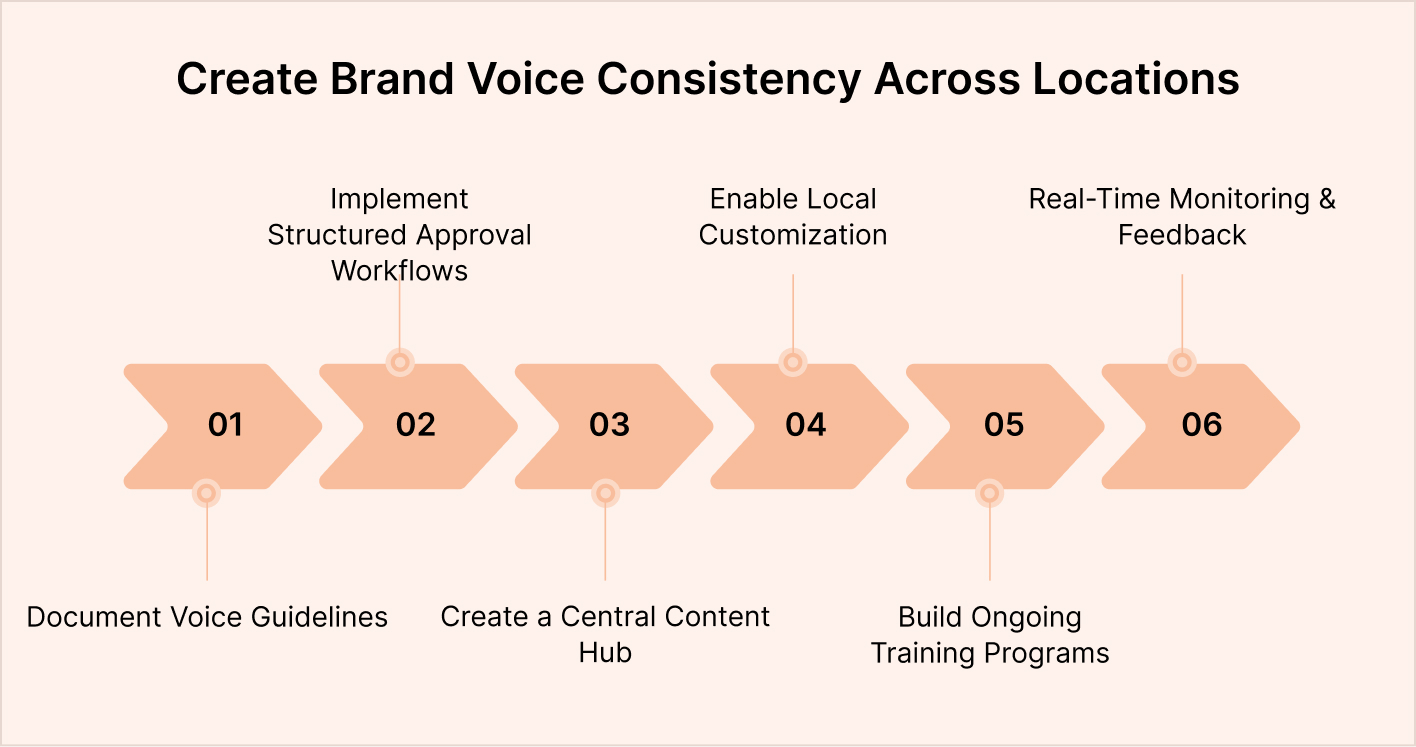
1. Document Voice Guidelines with Practical Examples
Abstract guidelines fail to create consistency in real-world content creation. Teams need specific examples that clearly show correct and incorrect usage. Create templates that demonstrate brand voice for different content types. Show how tone adapts across platforms while staying true to the brand.
Include real examples from your organization that teams can reference. Highlight content that represents the ideal brand voice in action. Show common mistakes to avoid with clear explanations of why. Make guidelines accessible from where teams actually create content daily.
2. Implement Structured Approval Workflows
Every piece of content should undergo a consistent review before publication. Approval workflows catch voice drift before it reaches customers online. Templates enforce brand standards automatically without slowing production.
Build tiered approval based on content risk level for efficiency. Simple posts need light review from designated team members. Campaign content needs deeper oversight from senior stakeholders. Route content to the right reviewers without creating unnecessary bottlenecks.
3. Create a Central Content Hub
Eliminate silos by consolidating all content into a single, accessible system. Teams see what others create across the entire organization. Approved templates remain accessible to everyone who needs them. Version control prevents outdated content from circulating to audiences.
A central hub enables consistency at scale across distributed teams. Teams can quickly find approved assets without extensive searching. Duplicate work decreases as visibility across departments increases. Brand voice remains unified across every channel and location automatically.
4. Enable Local Customization Within Clear Guardrails
Local teams need flexibility for community events and regional promotions. But that flexibility must always operate within defined boundaries. Create an adaptation matrix that clarifies what local teams can change.
Define which elements must remain untouched under all circumstances. Specify where local customization is actively welcome and encouraged. Local voices should amplify the brand, not dilute its impact. Give teams autonomy without sacrificing consistency across the organization.
5. Build Ongoing Training and Reinforcement Programs
Initial training fades without regular reinforcement and practice opportunities. Create microlearning modules that fit into busy frontline schedules. Use real examples of good and poor brand voice from actual content.
Celebrate teams that publicly exemplify brand voice consistency. Share best practices across locations so everyone learns together. Include brand consistency in performance evaluations for accountability. Make training accessible on mobile devices for deskless workers everywhere.
6. Establish Real-Time Monitoring and Feedback Systems
You cannot fix problems you cannot see in your content operations. Implement monitoring tools that quickly flag potential inconsistencies in voice. Create dashboards showing brand consistency metrics across all locations.
Provide immediate feedback to content creators before publishing occurs. Use AI tools to automatically check content against brand guidelines. Share performance data with regional managers for local accountability. Make consistency visible so teams prioritize it appropriately.
Transform Distributed Teams Into One Unified Voice
ContentBridge delivers the approval workflows, brand templates, and oversight tools you need to scale consistency.
How ContentBridge Solves Brand Voice Fragmentation
Brand voice fragmentation stems from a fundamental gap in today’s distributed content operations. Multiple teams create content without coordination or visibility into each other’s work. No system exists to enforce consistency at scale across locations. Manual review cannot keep pace with the volume of content across dozens or hundreds of locations.
The core issue is operational, not creative. Distributed teams need centralized oversight without losing local agility and relevance. They need approval workflows that enforce standards without slowing publication speed. They need templates that guide content creation while allowing appropriate customization.
ContentBridge addresses this challenge with purpose-built brand-consistency tools designed for distributed organizations. Approval workflows ensure every piece of content meets brand standards before publication. Templates automatically guide content creators toward a consistent voice and messaging. Editorial oversight catches drift before it reaches customers and damages trust.
For organizations with distributed workforces, ContentBridge provides the infrastructure needed to ensure brand consistency. Local teams gain tools to create on-brand content quickly and confidently. Corporate teams gain visibility across every location in real time. Customers experience the unified brand voice they expect at every touchpoint.
Frequently Asked Questions
Why do distributed teams struggle with brand consistency?
Distributed teams struggle because content creation happens across multiple locations without central coordination. Each team develops its own interpretation of brand standards over time. Different systems and tools hinder effective collaboration across departments. 40% of companies report that departments work from their own agendas without cross-team support.
Training gaps make the problem significantly worse across organizations. Only 30% of companies consistently enforce brand guidelines despite most having documented ones. New team members lack proper onboarding on brand expectations. External partners add another layer of inconsistency to communications.
How does brand inconsistency affect customer trust?
Brand inconsistency erodes customer trust over time through repeated mixed messages. Only 1 in 3 consumers trusts most of the brands they use today. When customers receive conflicting messages across touchpoints, they question the brand’s reliability.
Customers reward consistent communication with loyalty and repeat purchases. They choose brands whose messaging feels familiar and predictable. Inconsistent messaging pushes customers toward competitors who communicate more clearly. Trust loss translates directly to revenue loss over time.
What causes brand voice drift in multi-location organizations?
Brand voice drift happens through several operational gaps in organizations. Multiple writers create content without documented guidelines or examples. Local teams develop regional voices without guardrails or oversight. Departments work in silos without cross-team coordination or visibility.
The problem multiplies as organizations grow and add locations. More locations mean more content creators with different interpretations. More content creators mean more variation in voice and tone. Without systematic oversight, small inconsistencies compound into significant brand fragmentation.
How can organizations enforce brand guidelines at scale?
Enforcing brand guidelines at scale requires systematic solutions and technology support. Create a central content hub where teams access approved templates and assets. Consistently implement approval workflows that review content before publication. Document guidelines with practical examples, not abstract principles alone.
Provide ongoing training for distributed teams with regular reinforcement. Build tiered approval matching review depth to content risk level. Enable local customization within defined boundaries for flexibility. Use technology to enforce consistency that manual review alone cannot achieve.
What tools help maintain brand voice across locations?
Content management platforms with approval workflows help maintain brand voice effectively. These tools provide central repositories for brand assets and templates. They enforce review processes before publication across all channels. They give corporate teams visibility into content across all locations.
Look for platforms designed specifically for distributed workforces and multi-location organizations. They should offer templates, approval routing, and editorial oversight capabilities. The goal is consistency at scale without sacrificing local agility or publication speed.
How long does it take to fix brand voice fragmentation?
Fixing brand voice fragmentation requires sustained effort over months, not days. Initial infrastructure setup takes weeks, depending on organization size. Training programs need time to reach all team members effectively.
Results appear gradually as new processes take hold across locations. Quick wins come from implementing approval workflows and central repositories. Long-term consistency requires ongoing monitoring and reinforcement of standards. Most organizations see significant improvement within two to three quarters.