
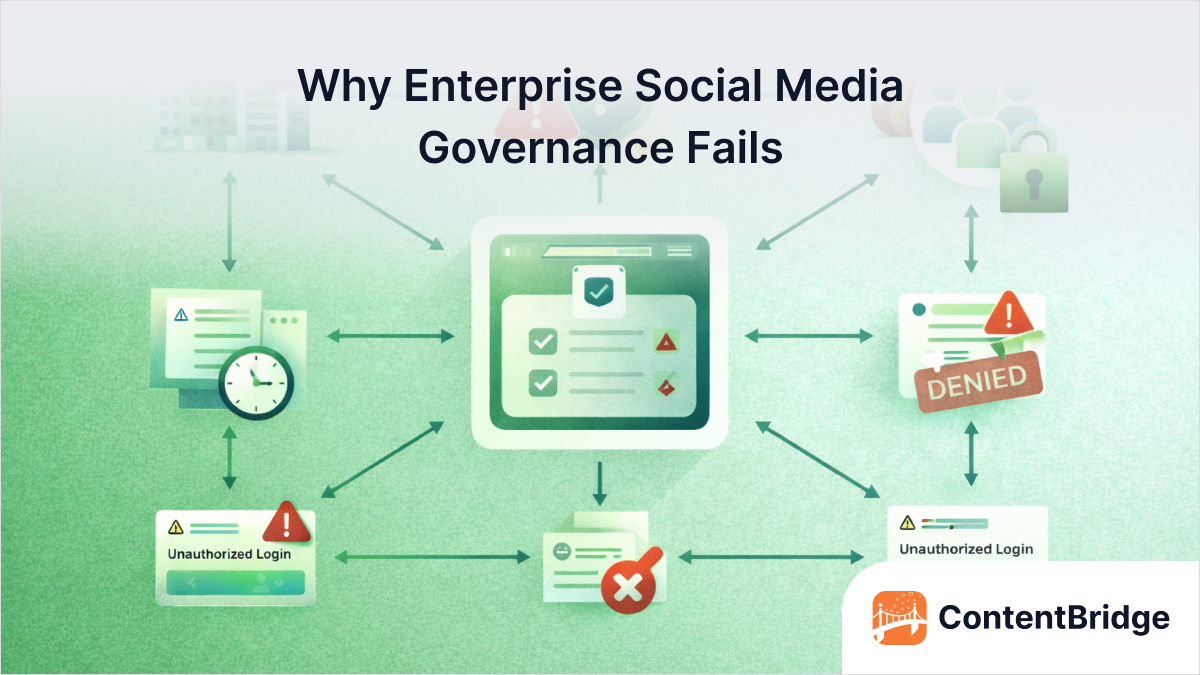

Your marketing team launches a campaign. Three regional managers posted variations without approval. An intern accidentally publishes a draft to the corporate account. Nobody knows who authorized the post that triggered customer complaints last week.
This chaos is not unusual. It is the daily reality for large organizations without proper social media governance. When dozens of people touch your brand accounts, control disappears fast.
According to Forbes, 80% of security breaches involve privileged access abuse. Social media accounts represent privileged access to your brand voice. Yet most organizations manage these credentials with spreadsheets, shared passwords, and hope.
The problem grows worse as organizations scale. More locations mean more people posting. More platforms mean more accounts to manage. More regulations mean higher stakes for every mistake. Without structured governance, social media becomes a liability rather than an asset.
This blog explains why social media governance breaks down in large organizations. You will learn the root causes behind permission chaos and discover practical solutions to regain control.
The Permission Crisis: Too Many Admins, Zero Clarity
Permission problems sit at the heart of social media governance failures. Organizations add users to accounts without clear role definitions. Over time, nobody knows who can do what.
1. Unauthorized Publishing Becomes Normal
When everyone has posting access, approval processes become suggestions rather than requirements. Employees skip reviews because they can publish directly. Content goes live without brand alignment checks. Compliance violations slip through unnoticed.
The problem compounds in organizations with multiple locations. Regional teams post local content without corporate oversight. Franchisees customize campaigns beyond brand guidelines. Each unauthorized post chips away at brand consistency.
Employees often mean well when they bypass approval processes. They see time-sensitive opportunities and act quickly. But good intentions create the same brand risks as careless mistakes.
2. Credential Sprawl Creates Security Gaps
Organizations accumulate platform logins across departments, agencies, and individual employees over time. Nobody maintains a central record of who has access. When employees leave, their credentials often remain active.
Consider the typical large organization’s credential landscape:
- Marketing team members have direct platform logins for daily posting.
- Regional managers access local accounts with separate credentials.
- Agency partners store passwords in their own systems without oversight.
- Former employees retain saved passwords on personal devices indefinitely.
Each untracked credential represents a potential security breach. This is exactly why giving frontline teams social media passwords is a disaster waiting to happen.
3. Role Confusion Paralyzes Teams
Teams waste hours figuring out who should approve content when roles lack a clear definition. Employees create drafts but do not know who reviews them. Approvers hesitate because they assume someone else handles sign-off. Posts sit in limbo while opportunities pass.
This confusion affects regulated industries most severely. Healthcare organizations need a compliance review before publishing. Financial services firms require legal approval for certain content types. Without clear workflows, these requirements become bottlenecks rather than safeguards.
The Audit Trail Problem: Who Posted What and When?
Compliance teams dread social media audits because most organizations cannot answer basic questions. Who approved this post? When did it go live? What review process did it follow? Without audit trails, these questions have no answers.
1. Invisible Publishing History
Native social media platforms log activity at the account level, not at the individual user level. When five people share login credentials, the platform cannot distinguish between them. A problematic post appears, and the investigation immediately hits a dead end.
This invisibility extends beyond crisis response. Routine operations suffer when managers cannot track team activity. Performance reviews become guesswork. Training needs go unidentified. The lack of individual accountability affects daily management as well as emergency situations.
2. Regulatory Exposure Grows Quietly
Regulated industries face strict documentation requirements for public communications. Healthcare organizations must demonstrate HIPAA compliance. Financial services firms are subject to FINRA and SEC oversight. Government agencies navigate FOIA transparency rules.
Auditors ask pointed questions during compliance reviews:
- Who created this social media content?
- What approval process did it follow before publication?
- When was the final version authorized and by whom?
- Can you provide documentation of the review workflow?
Organizations without audit trails cannot answer these questions honestly. The resulting compliance gaps create legal and financial exposure. This is the core of the “who approved this post” problem that causes social media audits to fail.
3. Martech Investments Fail to Deliver
Organizations spend heavily on marketing technology yet struggle to prove its value. Only 17% of marketing leaders feel “very confident” in their ability to prove marketing’s contribution to business outcomes. Missing audit trails contribute directly to this measurement problem.
When you cannot track who did what, you cannot measure effectiveness. Budget discussions become political arguments rather than data-driven conversations. Marketing loses credibility with executive leadership when it cannot demonstrate results.
Centralize Social Media Oversight Without Slowing Teams Down
ContentBridge empowers frontline-focused organizations with structured workflows and clear visibility across locations.
Why Social Media Governance Fails at Scale
Small teams manage social media informally without major problems. Governance breaks down specifically when organizations grow beyond certain thresholds.
1. Growth Outpaces Process Development
Most organizations add social media accounts faster than they build governance structures. A new location opens, and someone creates local social profiles. A product launch requires dedicated campaign accounts. Each addition happens without integrating into existing oversight systems.
The marketing team lacks time to formalize processes while managing daily demands. Governance becomes a future project that never reaches the priority list. Meanwhile, the ungoverned account inventory continues expanding.
2. Multiple Stakeholders Create Competing Priorities
Social media ownership fragments across departments in large organizations. Marketing handles brand accounts. Customer service manages support channels. HR runs employer branding profiles. Each department develops its own practices independently.
Cross-functional coordination requires effort that busy teams cannot spare. Departments protect their autonomy rather than accepting centralized governance. The result is inconsistent standards and duplicate efforts across the organization. This siloed approach is a major reason why frontline, marketing, and legal teams fail to collaborate on social media.
3. Technology Choices Limit Governance Options
Many organizations rely on tools designed for small businesses. These platforms lack enterprise features like role-based permissions and approval workflows. Teams cannot implement proper governance because their technology does not support it.
Research shows that martech accounts for 25.4% of marketing expense budgets, yet issues lead to underutilization. Organizations invest in tools that cannot solve their actual problems. Governance gaps persist despite significant technology spending.
Real Consequences of Broken Governance
Governance failures create tangible business impacts beyond operational inconvenience. Organizations pay real costs when social media management breaks down.
1. Brand Damage From Inconsistent Messaging
Customers notice when your brand voice changes between posts and locations. Inconsistency signals disorganization and erodes trust over time. Competitors with unified messaging appear more professional and reliable.
The damage accumulates gradually rather than arriving through single incidents. Each off-brand post slightly weakens customer perception. Over months and years, this erosion significantly impacts brand equity.
2. Compliance Violations Trigger Financial Penalties
Regulatory agencies impose substantial fines for social media violations. The FTC penalizes undisclosed sponsored content. HIPAA violations in healthcare settings carry severe consequences. Financial regulators enforce strict communication standards.
Organizations without governance cannot consistently ensure compliance. Violations become statistical certainties rather than unlikely possibilities. The question shifts from “if” to “when” penalties arrive.
3. Security Breaches Compromise Brand Accounts
Uncontrolled access increases vulnerability to both external attacks and internal misuse. Studies show that, on average, 66% of companies have been breached five or more times. Social media accounts with scattered credentials present attractive targets.
A compromised brand account can publish harmful content to your entire audience. Recovery requires damage control, customer communication, and potential legal response. Prevention through proper governance costs far less than breach remediation.
Protect Your Brand Across Every Location
Maintain compliance, brand consistency, and publishing control with a platform built for distributed organizations.
How to Fix Social Media Governance
Effective governance requires systematic changes, not just policy documents. Organizations need technology, processes, and culture shifts to work together.
1. Implement Role-Based Access Control
Replace shared credentials with individual accounts tied to specific permissions. Define clear roles for creators, reviewers, approvers, and publishers. Ensure each person can perform only their designated functions.
For frontline teams, using a frontline social media management platform like ContentBridge helps strengthen access control. Such platforms help involve frontline teams in social media while maintaining strong control over who can create, review, and publish posts.
Role-based systems provide several advantages over shared access:
- Individual accountability for every action taken on accounts.
- Instant access revocation when employees depart or change roles.
- Clear workflows that eliminate confusion about responsibilities.
- Granular permissions that match your organizational structure.
2. Establish Mandatory Approval Workflows
Build review processes directly into your publishing technology. Content should flow through defined stages before reaching your audience. Approvers receive notifications and must explicitly authorize publication.
Workflow automation removes human judgment from process enforcement. Busy employees cannot skip steps because the system requires them to be completed. Urgent content moves through expedited paths while maintaining oversight. Without such automation, frontline content often dies in approval bottlenecks before it ever reaches your audience.
3. Centralize Social Media Operations
Bring all social accounts under unified management regardless of department ownership. Central visibility enables consistent standards and efficient resource allocation. Departments retain operational responsibility within enterprise-wide governance.
Centralization does not mean eliminating local or departmental contributions. It means establishing common platforms, processes, and standards. Teams gain efficiency through shared resources while maintaining appropriate autonomy.
How ContentBridge Solves Social Media Governance Challenges
Governance problems require purpose-built solutions. ContentBridge addresses the specific challenges large organizations face with social media management.
ContentBridge is an enterprise-grade social media management platform designed for organizations with frontline teams across multiple locations. The platform provides granular role-based access control that eliminates permission confusion and reduces the risk of unauthorized publishing.
Zero-credential publishing keeps your account passwords secure. Team members contribute content without ever accessing social platforms directly. ContentBridge publishes approved content on their behalf. This approach eliminates credential sprawl, which creates security vulnerabilities.
Complete audit trails automatically document every action. You always know who created, edited, and approved each piece of content. Compliance teams can demonstrate governance during audits. Managers track individual performance with accurate data.
Multi-level approval workflows match your organizational structure. Different content types route through appropriate review chains. Regulated industries can enforce compliance checks before publication. Urgent content moves through expedited processes without bypassing oversight.
Role definitions eliminate confusion about responsibilities. Every team member understands exactly what they can do within the platform. Creators draft content. Reviewers provide feedback. Approvers authorize publication. Publishers execute the final posting. Clear boundaries prevent bottlenecks and unauthorized actions.
Contact us today to see how ContentBridge helps large organizations regain control of social media governance.
Frequently Asked Questions
Why does social media governance break down in large organizations?
Governance fails because growth outpaces process development. Organizations add accounts, users, and locations without building corresponding oversight structures. Shared credentials, unclear roles, and missing audit trails compound these problems over time.
The challenge intensifies in organizations with frontline workers across multiple locations. Each location creates local content without central visibility. Permission structures that worked for small teams cannot scale to enterprise operations.
What are the biggest risks of poor social media governance?
Poor governance creates three primary risk categories. Brand damage results from inconsistent messaging and unauthorized posts. Compliance violations trigger regulatory penalties and legal exposure. Security breaches compromise accounts and enable the publication of harmful content.
These risks increase proportionally with organization size. More users mean more potential failure points. More accounts mean larger attack surfaces. More regulations apply as organizations grow into new markets.
How can organizations track who posted specific social media content?
Native social media platforms cannot track individual users when multiple people share credentials. Organizations need third-party management platforms that log individual actions with unique user accounts.
ContentBridge maintains comprehensive audit trails showing who created, edited, and approved every piece of content. This documentation satisfies compliance requirements and enables accurate performance tracking.
How do approval workflows prevent governance failures?
Approval workflows create mandatory checkpoints between content creation and publication. Nothing reaches your audience without explicit authorization from designated approvers. This structure catches errors, brand guideline violations, and compliance issues before they cause damage.
Automated workflow enforcement prevents people from skipping steps under pressure. The system requires completion of each stage regardless of urgency or circumstance. Technology ensures governance without relying on individual discipline.