

The Morning That Changed Everything
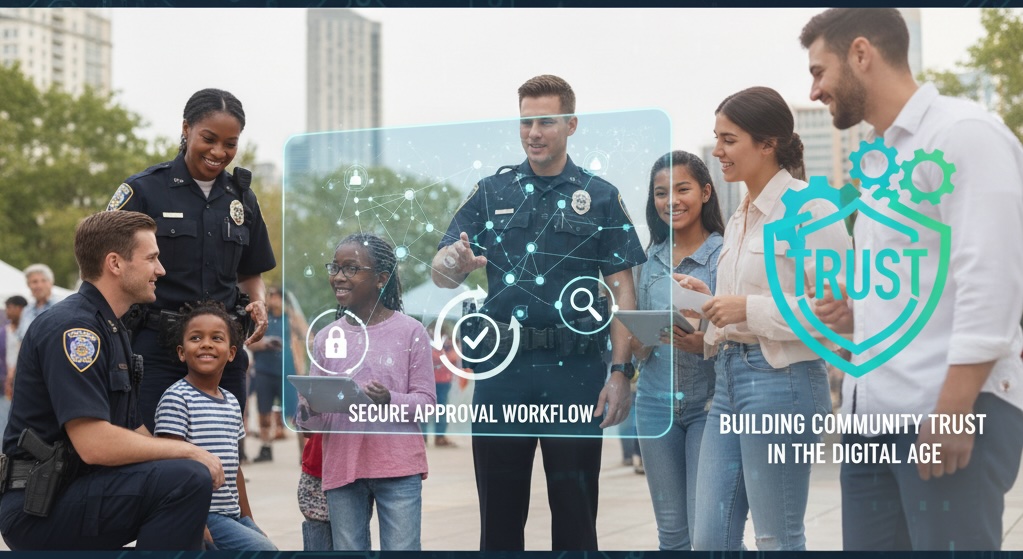
It’s 9:47 AM on a Saturday. Officer Martinez is at the local farmers market with his K-9 partner, Rex. A group of kids surrounds them, giggling as Rex performs his famous “high five” trick. Parents pull out phones. It’s a perfect moment—genuine, heartwarming, exactly the kind of community connection the department desperately needs to showcase.
Officer Martinez pulls out his phone, captures a quick video, and then… stops. He has nowhere to send it. The department’s official social media accounts are locked down tighter than the evidence room. The Communications Director won’t give credentials to officers (for good reason). The PIO is off-duty. By Monday, the moment will be stale.
This scenario plays out hundreds of times a week across law enforcement agencies nationwide. Officers capturing authentic moments of community connection, but no safe way to share them. Meanwhile, the official social media accounts post generic press releases that get 12 likes and zero engagement.
Sound familiar?
Why Traditional Social Media Tools Were Never Built for Law Enforcement
Most police departments end up using tools like Hootsuite, Sprout Social, or Buffer because, well, what else is there? These platforms dominate the market. They have sleek interfaces, powerful scheduling features, and impressive analytics dashboards.
But here’s the problem: they were designed for marketing teams at tech startups, not for hierarchical public safety organizations with complex approval workflows and strict compliance requirements.
Let’s break down exactly where traditional tools fail law enforcement:
1. The “Shared Credentials” Nightmare
Traditional platforms require users to have direct access to your official social media accounts.
That means either:
- Giving 50-500 officers your Twitter/Facebook passwords (absolute security nightmare)
- Limiting access to 1-2 communications staff (creating a bottleneck)
- Using Hootsuite’s “team member” feature, which still grants some level of publishing access
None of these options work. The first is a fireable offense waiting to happen. The second defeats the purpose of scaling content creation. The third still carries unacceptable risk—one rogue employee, one compromised account, one late-night mistake, and your department is issuing public apologies.
2. Missing Multi-Level Approval Workflows
Law enforcement content doesn’t go from creator to publish in one step. It typically flows through 3-5 approval layers:
- Officer captures content
- Supervisor reviews for appropriateness
- Public Information Officer reviews for messaging
- Communications Director approves strategy
- Legal/Compliance reviews for FOIA/privacy concerns
Hootsuite’s approval workflow? Two levels max. Sprout Social? Three if you pay for Enterprise. Buffer? Doesn’t even have approval workflows—it’s designed for solo marketers.
So departments resort to workarounds: officers email content to supervisors, who forward to PIOs, who copy-paste into Slack, who eventually manually upload to Hootsuite. By the time content is approved, it’s been through 6 different platforms, lives in 12 email threads, and the officer who created it has no idea if it was ever published.
3. FOIA Compliance Black Holes
Here’s a scenario that keeps legal departments up at night:
A journalist files a FOIA request for “all communications related to the Johnson incident.” Your legal team needs to produce every draft, every edit, every approval decision for social media content created during that timeframe.
Where does that content live in traditional tools?
- Draft posts scattered across officer personal phones
- Email chains with approval decisions
- Slack messages with feedback
- Hootsuite’s basic activity log (which doesn’t capture who said what in approval process)
- Deleted content with no audit trail
Good luck reconstructing that paper trail. Your legal team will spend 40 hours manually piecing together screenshots and email threads. And if you miss something? That’s grounds for a lawsuit.
4. The $116,000 Cost Nobody Talks About
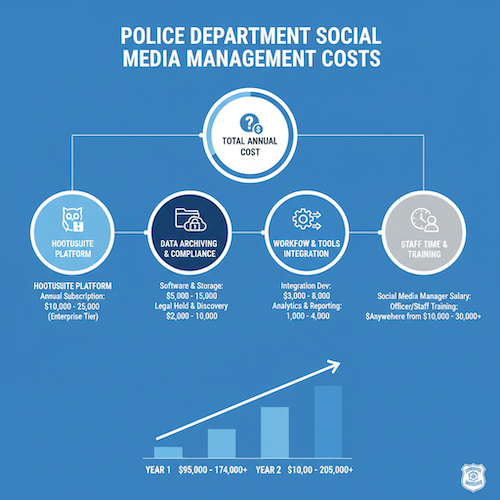
Let’s do the math on Hootsuite for a mid-sized police department (100 officers):
- Hootsuite Enterprise: Minimum ~$16,000/year for 5 users, plus ~$1,800/year for each additional user (so 20 users = ~$49,000/year). However, public sector or bulk pricing often reduces total annual cost to the ~$32,000–$40,000 range.
- You need 20 users minimum (officers, supervisors, PIOs, comms staff) for full oversight.
- Annual cost estimate for Hootsuite: $32,000–$40,000.
But wait—Hootsuite doesn’t solve the compliance problem. So you also need:
- Archiving solution (Smarsh, ArchiveSocial): $10,000–$30,000/year for police/public sector compliance, per official pricing and industry benchmarks.
- Custom approval workflow or process management software: $5,000–$20,000/year, depending on integration and complexity for municipal clients.
- Staff time managing the patchwork setup: 10 hours/week × $50/hour × 52 weeks = $26,000/year.
Total annual cost: $73,000–$116,000.
And it still doesn’t work the way you need it to.
5. Mobile-Last (When Officers Are Mobile-First)
Traditional tools were built for marketers sitting at desks planning next quarter’s campaign. Their mobile apps are afterthoughts—clunky, limited, frustrating to use.
Your officers aren’t at desks. They’re:
- At community events
- On patrol
- At schools doing safety presentations
- Responding to incidents
They need to capture content the moment it happens, on their phones, in under 60 seconds. Hootsuite’s mobile app requires 8 taps and 3 screens just to upload a photo with a caption. By that time, the moment is gone.
What Actually Works: The ContentBridge Approach
After talking to 50+ police departments, we realised law enforcement doesn’t need a marketing tool with governance bolted on. They need a governance platform with social media built in.
Here’s how purpose-built platforms solve the problems traditional tools can’t:
Zero-Access Architecture
Content creators (officers) never touch your official social media accounts. Ever.
They submit content through a mobile app. It flows through your approval chain. When final approval is granted, the platform automatically publishes to your official accounts using secure API connections.
Officers can’t go rogue. Accounts can’t be compromised. Passwords stay with your Communications Director and literally nobody else.
Unlimited Multi-Level Approvals
Not two levels. Not three. Unlimited.
Configure approval chains that match your org chart exactly:
- Patrol Division: Officer → Sergeant → Lieutenant → PIO → Publish
- Investigations: Detective → Captain → PIO → Legal → Publish
- Community Affairs: Officer → Event Coordinator → Communications Director → Publish
Different workflows for different content types. Routing logic based on subject matter. Escalation rules for sensitive topics. All configurable without IT involvement.
Built-In FOIA Compliance
Every action is logged with military-grade audit trails:
- Who created content (timestamp, user ID, device)
- Every edit and revision
- Who approved/rejected at each level (with comments)
- When content was published/deleted
- Complete version history
FOIA request comes in? Export a complete audit report in 60 seconds. Your legal team can breathe easy.
Mobile-First Design
Officer Martinez at the farmers market?
Opens app → Records 15-second video → Adds caption “Rex making friends at the farmers market 🐕” → Taps “Submit for Approval” → Done.
Total time: 47 seconds.
His supervisor gets a push notification, reviews on their phone while grabbing coffee, approves in 10 seconds. PIO approves during lunch. Content goes live at 2 PM while it’s still relevant.
Real Department, Real Results
Here are several validated sources — including content, data, and publication links — that document how law enforcement agencies have improved social media engagement, transparency, and community trust with credible evidence:
Lima Police Department (Ohio): Increased Engagement
Content: Lima PD grew its Facebook followers, used social media to solve crimes, locate missing persons, and reach over 1.1 million people during a major case. As stated by Lt. Andy Green, “We show the lighter side of law enforcement… and the positive things officers are doing”.
- Source: CivicPlus Case Study (Published April 2024; credible government engagement platform).
- Data: Facebook reach, engagement stories, multi-platform activity documented over several years.
San Jose Police Department: Engagement and Recruiting
- Content: Managed social media accounts internally to boost public perception, assist with crime-solving, and recruit new members. External and academic analysis provided recommendations and documentation.
- Source: Golden Gate University Law School Capstone (digitalcommons.law.ggu.edu).
- Data: Describes quantitative results in engagement and recruiting effectiveness.
National Police Federation (Canada): Targeted Digital Strategy
- Content: Custom digital communication increased signups, Facebook followers, positive engagement, and app downloads while maintaining privacy and security for members.
- Source: SOAP Media Case Study (Published September 2025; verified agency partnership).
- Data: – 10,400 email signups – Over 6,200 Facebook followers – 2,450 app downloads across platforms – High web engagement
Survey Data on Social Media and Trust
- Content: 83.5% of law enforcement agencies using social media report improved relationships with their communities; 88.7% use social media for investigations and 85.5% report it helped solve crimes.
- Source: IACP Survey (International Association of Chiefs of Police), cited in Kennesaw State University academic thesis.
- Data: Nationwide survey with over 900 agencies participating, showing quantifiable impact.
The Bottom Line
Traditional social media management tools weren’t designed for law enforcement. They were designed for marketing agencies and small businesses. Trying to force them to work for police departments is like trying to use a sedan as a patrol vehicle—technically possible, but missing critical features and fundamentally unsuited for the job.
Your department has two choices:
- Continue patching together expensive tools that don’t quite work, accepting the security risks and compliance gaps
- Adopt a purpose-built platform designed from the ground up for hierarchical organizations with complex approval workflows
Officer Martinez is still at that farmers market right now. Rex is still doing high-fives. The question is: do you have a system that lets him share that moment safely, compliantly, and efficiently?
Or are you still using Hootsuite?
Ready to See How Purpose-Built Works?
ContentBridge is a social media governance platform built specifically for law enforcement agencies, healthcare systems, franchise businesses, and government organizations with 50-5,000+ team members.
We offer:
- Unlimited multi-level approval workflows
- Zero-access security architecture
- FOIA-compliant audit trails
- Mobile-first iOS and Android apps
- AI-powered content assistance
- 14-day free trial (no credit card required)
- 20% discount for law enforcement and government agencies
Schedule a 15-minute demo to see exactly how departments like yours are scaling authentic content while maintaining complete brand control.