


Enterprise social media is no longer just a brand awareness channel. It is a high-stakes business function tied directly to revenue, customer experience, and reputation. With billions of users engaging daily and brands investing heavily to capture attention, the scale of opportunity and risk has never been greater.
Statista projects that global social media advertising spending will reach approximately US$317.33 billion in 2026. For enterprises, this means social media is not just a communication platform. It is a major investment channel that demands governance, accountability, and measurable performance.
Managing enterprise social media today requires more than scheduling posts. It involves coordinating distributed teams, ensuring brand consistency across regions, handling high engagement volumes, managing compliance risks, and aligning social media efforts with broader business objectives.
In this guide, we break down what enterprise social media management truly involves, how it differs from traditional social media management, and the frameworks, processes, and systems enterprises need to operate effectively at scale.
What Is Enterprise Social Media Management?
Enterprise social media management is the practice of planning, creating, publishing, and analyzing social media content across large organizations with multiple brands, locations, departments, or business units.
Unlike standard social media management used by small businesses or individual marketers, enterprise management handles coordination at scale with added layers of governance and compliance. An enterprise social media management system typically covers:
- Multiple accounts and platforms. Enterprises manage dozens to hundreds of social profiles across Facebook, Instagram, LinkedIn, X, TikTok, and other platforms simultaneously.
- Distributed teams. Content creation and publishing involve corporate marketing teams, regional managers, frontline workers, and external agencies working in parallel.
- Governance and compliance. Content must pass through approval workflows, legal reviews, and compliance checks before publication, especially in regulated industries like healthcare, finance, and government.
- Cross-regional coordination. Campaigns must account for time zones, languages, cultural nuances, and regional regulations across multiple markets.
Enterprise social media management is not simply using a social media tool with more seats. It requires purpose-built workflows, role-based permissions, and analytics that connect social activity to business outcomes rather than vanity metrics.
Why Effective Social Media Management Is Essential for Enterprises
The scale and complexity of social media operations have grown dramatically. Several forces make enterprise-grade management essential for large organizations today.
The market is expanding rapidly. As per MarketsandMarkets, the social media management market is projected to reach $51.8 billion by 2027, growing at a compound annual growth rate exceeding 24.2%. This growth reflects the increasing recognition that managing social media at enterprise scale requires specialized solutions rather than stitched-together workarounds.
- Customer expectations demand consistency: Customers interact with brands across multiple locations and platforms. When messaging, promotions, or brand voice vary by location, trust erodes quickly. Enterprises that deliver consistent experiences across every touchpoint build stronger and longer-lasting customer relationships.
- AI has raised the competitive baseline: Competitors using AI-powered tools produce more content, respond faster, and optimize performance continuously. Organizations without enterprise-grade management systems fall behind as the baseline for social media excellence rises every quarter.
- Regulatory requirements keep increasing: Data privacy regulations like GDPR, industry-specific requirements like HIPAA, and evolving platform policies create compliance obligations that informal social media processes cannot handle. Enterprises need auditable workflows and controlled access to avoid costly violations.
- Employee advocacy is now a strategic channel: Organizations are activating frontline employees as brand advocates on social media. This creates enormous organic reach but requires systems that maintain brand standards while enabling authentic participation from non-marketers across the organization.
Core Challenges of Managing Social Media at Enterprise Scale
Understanding these challenges is the first step toward building systems that overcome them. Every enterprise faces these obstacles when scaling social media operations beyond a small central team.
1. Coordinating Content Across Multiple Brands and Locations
Large organizations operate dozens or hundreds of social media accounts spanning different brands, product lines, and geographic locations. Each account needs content that aligns with both the corporate brand and local market relevance.
Corporate teams create campaign assets, but local teams need flexibility to adapt messaging for their specific audience. Without centralized coordination, this adaptation becomes an improvisation that fragments brand identity. Content intended for a product launch in one region may conflict with messaging in another, creating confusion for customers who follow multiple location accounts.
The coordination challenge multiplies with each new account, location, and platform added to the portfolio. What works for ten locations breaks completely at fifty.
2. Navigating Content Approval Bottlenecks
Centralized content approval is essential for brand protection. But traditional approval processes create bottlenecks that prevent timely publishing and frustrate contributing teams.
When local teams submit content and wait days for corporate approval, campaign windows close. Frustrated employees either bypass the approval process entirely or stop contributing altogether. Both outcomes damage the organization through either uncontrolled content or a reduced social presence.
The challenge intensifies in regulated industries where legal and compliance teams add review layers. Without efficient multi-level approval workflows, enterprises cannot balance publishing speed with necessary oversight.
3. Ensuring Regulatory Compliance Across Regions
Enterprises operating across multiple jurisdictions face different regulatory requirements in each region. Healthcare organizations must comply with HIPAA. Financial institutions follow specific advertising disclosure rules. Government agencies have public records and transparency requirements.
Social media compliance requires more than periodic training sessions. Organizations need systems that enforce compliance through controlled access, mandatory approval steps, and complete audit trails. A single non-compliant post can trigger regulatory penalties and reputational damage that far outweigh the cost of proper compliance infrastructure.
4. Tracking ROI Beyond Vanity Metrics
Likes and follower counts tell leadership very little about social media’s actual business impact. Enterprises need analytics that connect social activity to revenue, customer acquisition, brand sentiment, and competitive positioning.
Most standard social media tools provide platform-level metrics that require manual aggregation across accounts. Enterprise organizations need analytics broken down by location, region, campaign, and business unit. Without this granularity, it is impossible to identify what works, allocate resources effectively, or justify continued investment to executive leadership.
5. Keeping Brand Voice Consistent With Distributed Teams
When frontline employees, regional managers, and agency partners all create content, maintaining a consistent brand voice becomes a significant challenge. Each contributor brings different writing styles, levels of brand knowledge, and interpretations of guidelines.
Style guides help, but cannot cover every scenario a distributed team encounters. Without systems that provide content guardrails, customizable templates, and AI-assisted creation, voice consistency depends entirely on individual knowledge, which varies dramatically across large organizations and erodes further with employee turnover.
Scale Enterprise Social Media Without Losing Control
ContentBridge centralizes conversations, automates workflows, and gives enterprise teams full visibility across regions and brands using AI-powered frontline management.
Key Components Every Enterprise Social Media Management System Needs
An effective enterprise social media management system combines technology with well-defined processes. These components work together to create scalable, controlled, and measurable social operations.
1. Centralized Content Management and Publishing
All content assets, templates, and campaign materials should live in a single, organized library accessible to every authorized team member. Centralization eliminates the version-control chaos that occurs when assets scatter across shared drives, email attachments, and messaging threads.
The content library must support mobile access because many enterprise social media contributors work from stores, clinics, field offices, and other non-desk environments. Content search needs to be fast and intuitive since frontline workers will not spend time digging through complex folder structures during a busy shift.
Publishing capabilities should cover all major platforms from a single interface. Scheduling, bulk posting, and timezone-aware automation reduce the manual effort required to maintain consistent posting frequency across every location.
2. Multi-Level Approval and Governance Workflows
Enterprise approval workflows must support multiple review levels and parallel approvers. A content piece might need sign-off from a local manager, a regional marketing lead, and a compliance officer before it goes live.
Effective workflows include built-in feedback mechanisms where approvers can request specific changes with contextual comments. Creators should see exactly what needs revision without starting over. The entire approval history should remain accessible for audit and accountability purposes.
These workflows must balance thoroughness with speed. If the approval process takes too long, it defeats its purpose by delaying time-sensitive content. Configurable SLAs and automated escalation rules prevent content from stalling indefinitely in review queues.
3. Advanced Analytics and Performance Reporting
Enterprise analytics go beyond individual post metrics. Organizations need dashboards that aggregate performance across all accounts and segment it by location, region, brand, campaign, department, and team.
Benchmarking capabilities allow organizations to compare locations against each other and against historical performance baselines. Identifying consistently high performers reveals best practices worth replicating across the organization, while highlighting underperformers guides targeted support.
Executive reporting should translate social metrics into business language. Leadership needs to understand how social media drives customer engagement, supports brand objectives, and contributes to revenue, not raw engagement numbers stripped of business context.
4. Role-Based Access Control and Enterprise Security
Not every contributor needs the same level of access. Role-based permissions define exactly what each user can do: create content, approve submissions, publish directly, view analytics, or manage platform settings.
Security features should include complete audit trails tracking every action, SSO integration with enterprise identity providers, and data isolation between business units when required. For regulated industries, compliance-specific capabilities like HIPAA-compatible workflows and records retention become essential requirements.
Access control prevents unauthorized publishing while enabling broad participation. The goal is to let more people contribute to social media without increasing organizational risk.
5. Cross-Platform Scheduling and Automation
Manual posting across dozens of accounts is not sustainable at enterprise scale. Platforms must support automated scheduling across Facebook, Instagram, LinkedIn, X, TikTok, and emerging networks.
Scheduling should account for timezone differences automatically. A national campaign should be published at optimal local times in each region without requiring manual timezone calculations from busy local teams. Bulk scheduling capabilities handle high-volume content calendars efficiently across the full account portfolio.
Automation extends beyond scheduling. Auto-publishing approved content, triggered posting based on campaigns or events, and automated recycling of evergreen material all reduce the operational burden on enterprise social media teams.
How AI and Automation Are Transforming Enterprise Social Media
AI is no longer a future consideration for enterprise social media management. It is a current operational necessity that transforms how large organizations create, distribute, and optimize social content at scale.
1. AI-Powered Content Creation at Scale
Enterprise teams need to produce content for multiple accounts, platforms, and locations simultaneously. AI content assistants integrated directly into management platforms accelerate this process dramatically.
AI tools generate draft posts, suggest relevant hashtags, adapt messaging for different platform formats, and optimize content for engagement. For frontline workers who are not professional writers or marketers, AI assistance bridges the gap between their valuable on-the-ground knowledge and polished social content that meets brand standards.
The critical factor is AI that operates within brand guardrails. Enterprise AI tools should generate content that follows established brand voice and compliance requirements rather than producing unconstrained output that needs extensive manual review to be usable.
2. Predictive Analytics and Intelligent Social Listening
AI-powered analytics predict content performance before publishing, identify emerging trends relevant to your industry, and surface insights from vast amounts of social data that human analysts would miss entirely.
Social listening at enterprise scale monitors brand mentions, competitor activity, industry conversations, and sentiment shifts across millions of social interactions daily. AI filters this data into actionable intelligence rather than overwhelming teams with unstructured information.
Predictive capabilities help enterprises allocate resources proactively. Instead of reacting to trends after they peak, AI-driven systems identify emerging opportunities and potential crises early enough to act with strategic advantage.
3. Automated Compliance and Risk Monitoring
AI monitors published content for compliance violations, brand guideline deviations, and potential reputational risks in real time. Automated flagging catches issues that manual review might miss, especially when content volume exceeds what human reviewers can reasonably handle.
For regulated industries, AI-powered compliance monitoring provides an essential safety layer beyond initial approval workflows. Systems continuously scan published content against regulatory requirements and internal policies, alerting teams to potential violations immediately rather than after damage is done.
Bring Structure and Governance to Your Social Media Operations
From role-based access to AI-powered approvals, ContentBridge helps enterprises manage social media securely and consistently at scale.
How to Build an Enterprise Social Media Management Strategy
A platform alone does not solve enterprise social media challenges. Success requires a social media management strategy that aligns technology, processes, and people around clear business objectives.
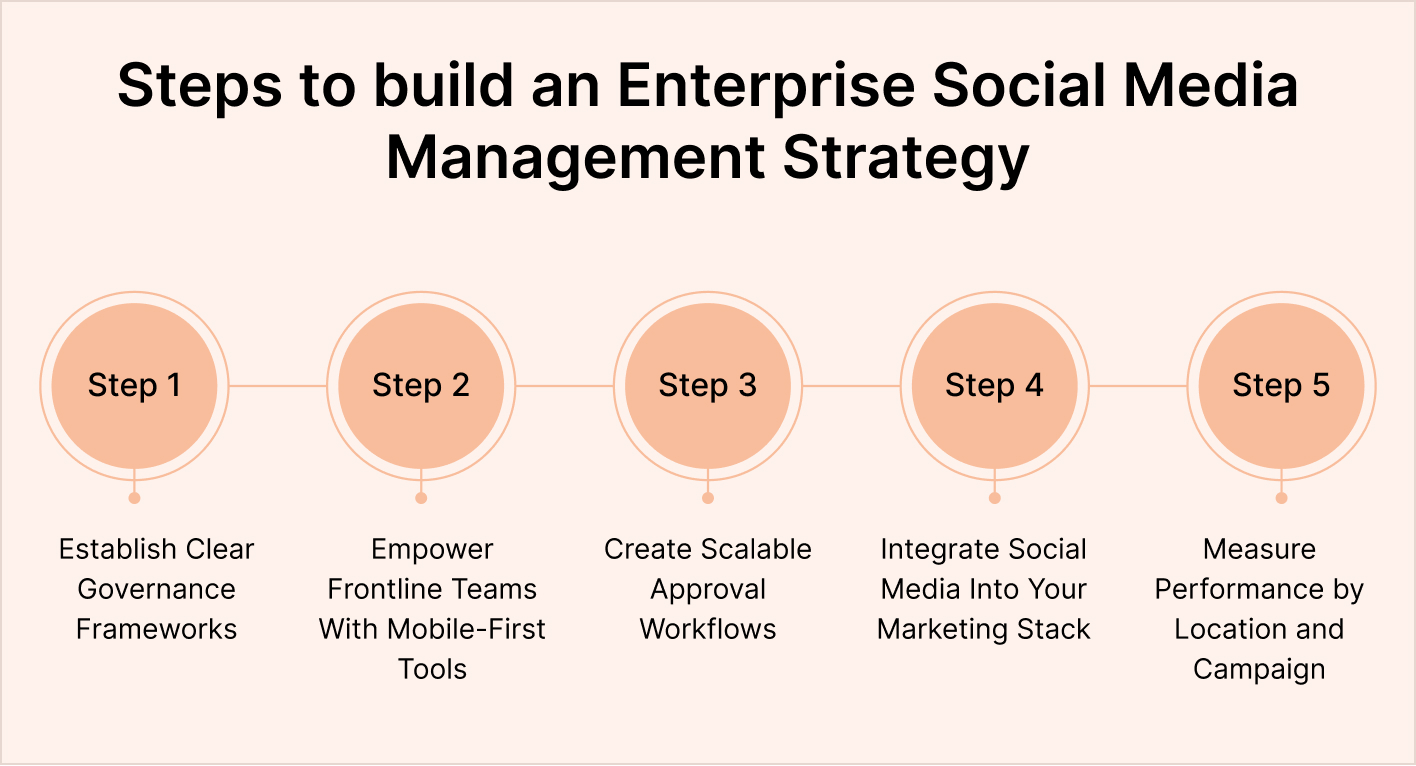
1. Establish Clear Governance Frameworks
Define who can create, approve, and publish content across your organization. Document these roles and responsibilities in a governance framework that covers every scenario: routine content, coordinated campaigns, crisis communications, and employee-generated posts.
Governance should specify content standards, brand voice guidelines, compliance requirements, and escalation procedures for exceptions and emergencies. Make this documentation accessible and update it regularly. A governance framework buried in a forgotten shared drive protects no one.
2. Empower Frontline Teams With Mobile-First Tools
Enterprise social media increasingly depends on authentic content from frontline employees. Store managers capturing product displays, healthcare workers sharing community health events, and franchise operators promoting local offerings all contribute content that resonates more strongly than polished corporate messaging.
These contributors work on mobile devices in the field, not at desks with multiple monitors. Your social media management platform must deliver a mobile experience that makes content creation simple enough for non-marketers to use confidently during their workday.
ContentBridge addresses this directly with native iOS and Android apps built specifically for frontline content creation. Workers capture photos and videos, draft posts with integrated AI assistance, and submit content through structured approval workflows, all without ever needing direct access to official social accounts.
3. Create Scalable Approval Workflows
Design approval workflows that scale with your organization’s complexity. A one-size-fits-all approval process either bottlenecks large teams or provides insufficient oversight for sensitive content categories.
Configure different approval chains based on content type, author role, and risk level. Routine content from trained contributors might need single-manager approval. Campaign content or anything involving regulated topics should pass through additional review levels. Parallel approvers allow legal and marketing to review simultaneously rather than sequentially, cutting approval time significantly.
4. Integrate Social Media Into Your Marketing Stack
Enterprise social media does not operate in isolation. Connect your social media management platform with your CRM, marketing automation tools, customer service systems, and business intelligence platforms to create a unified operational picture.
Integration creates a complete view of how social media contributes to the customer journey. When social engagement data feeds into your CRM, sales teams gain a fuller context. When customer service interactions inform social content strategy, messaging becomes more responsive and relevant to actual customer needs.
5. Measure Performance by Location and Campaign
Define KPIs that matter for your business before launching campaigns. Track metrics by location, region, team, and campaign to understand what drives results and where targeted improvement is needed.
Establish benchmarks and review performance on a consistent schedule. Use data to identify top-performing locations whose practices can be replicated organization-wide. Address underperforming areas with specific support and training rather than blanket policies that frustrate your best-performing teams.
What to Look for in an Enterprise Social Media Management Platform
Choosing the right platform determines whether your enterprise social media strategy succeeds or stalls in execution. Evaluate platforms against these critical criteria:
- Scalability: The platform must handle your current account volume and grow as your organization expands without performance degradation.
- Mobile-first design: If frontline teams will contribute content, a strong mobile experience is non-negotiable. Evaluate the actual mobile app thoroughly, not just whether one exists.
- Approval workflow flexibility: Rigid single-path approval processes break at enterprise scale. Look for configurable chains with parallel approvers, feedback loops, and automatic escalation rules.
- Compliance capabilities: For regulated industries, evaluate HIPAA compatibility, audit trail completeness, data residency options, and the depth of role-based access control.
- AI integration: AI-powered content assistance, predictive analytics, and automated compliance monitoring are baseline expectations for 2026, not premium add-ons.
- Pricing at scale: Many platforms charge per user. At enterprise scale with hundreds of contributors, per-user pricing becomes prohibitive. Evaluate total cost for your full organization, not just the core marketing team.
- Platform coverage: Confirm the tool fully supports all social networks your organization uses, including Facebook, Instagram, LinkedIn, X, and TikTok, with complete feature support on each platform.
Streamline Enterprise Social Workflows with AI
Eliminate silos, automate routing, and empower frontline teams with intelligent automation built for enterprise complexity.
Manage Enterprise Social Media at Scale With ContentBridge
Enterprise social media management demands a platform built for the realities of large, distributed organizations. Generic social media tools designed for small marketing teams cannot handle the complexity of multi-location coordination, regulatory compliance, and frontline content creation at scale.
ContentBridge is a frontline-first social media management platform purpose-built for enterprise operations. It serves organizations with 100 to 5,000 employees that need centralized brand control combined with distributed content creation capabilities across every location.
Mobile-native iOS and Android apps enable frontline workers to capture photos, create videos, and draft posts from any location. AI-powered content assistance using GPT-5 integration reduces content creation time by up to 70%, helping non-marketers produce professional social content quickly and confidently.
Multi-level approval workflows support unlimited chain configurations with parallel approvers. Legal, marketing, and management teams review content simultaneously rather than sequentially. Real-time team chat built directly into the workflow keeps communication focused, contextual, and fully documented. Complete audit trails track every action for compliance and accountability.
ContentBridge publishes directly to Facebook, Instagram, X, LinkedIn, and TikTok with advanced scheduling and bulk posting capabilities across all accounts. Role-based access control with five permission levels ensures contributors participate appropriately without ever gaining direct access to official social accounts.
For regulated industries, ContentBridge delivers HIPAA and FOIA compliance, enterprise-grade data isolation, and the audit trail documentation that regulators require during reviews and investigations.
At $999 per month for 100 users, ContentBridge provides enterprise capabilities at a fraction of competitor pricing. Traditional enterprise social media platforms cost between $8,300 and $39,900 monthly, making them impractical for organizations that need to enable hundreds of frontline contributors alongside their marketing teams.
Request a demo today to see how ContentBridge transforms your enterprise social media operations from fragmented to unified.
Frequently Asked Questions
How does enterprise social media management differ from standard social media tools?
Standard social media tools are designed for small teams managing a handful of accounts. Enterprise platforms handle hundreds of accounts across multiple platforms, support multi-level approval workflows, provide granular role-based permissions for large distributed teams, offer compliance features for regulated industries, and deliver analytics segmented by location, region, and business unit.
What features should an enterprise social media management platform include?
Essential features include centralized content management, multi-level approval workflows with parallel approvers, cross-platform scheduling with timezone automation, role-based access control, compliance and audit trail capabilities, AI-powered content assistance, mobile-first interfaces for frontline teams, and advanced analytics with location-level performance breakdowns.
How does AI improve enterprise social media management?
AI accelerates content creation by generating drafts, suggesting hashtags, and optimizing posts for platform-specific engagement. It powers predictive analytics that identify trends before they peak and automates compliance monitoring across all published content. AI also helps frontline non-marketers produce professional-quality content through guided creation tools and intelligent suggestions.
What is the best enterprise social media management platform for distributed teams?
The best platform for distributed teams prioritizes mobile-first design, intuitive interfaces for non-marketing employees, multi-level approval workflows, and scalable pricing that does not penalize broad adoption. ContentBridge serves organizations with 100 to 5,000 employees, offering native mobile apps, AI content assistance, and enterprise-grade features at $799 per month for 100 users.