

Frontline teams spot moments worth sharing long before marketing ever does. A customer reaction on the shop floor, a real-time service update, or an on-ground win that builds instant trust on social media. The power of this content depends on speed. When it goes out late, it loses relevance and impact.
Yet speed is exactly where most organizations struggle. A ProofJump report found that 52% of companies regularly miss deadlines due to approval delays and collaboration issues. For frontline social media content, this problem is even more damaging. Every extra review step, unclear ownership, or slow legal sign-off increases the chance that a post becomes outdated or is dropped entirely.
This is how frontline content dies. Not because it lacks authenticity or value, but because traditional approval workflows are not built for fast-moving social moments.
In this blog, we explore why approval bottlenecks kill frontline content and how smarter, faster approval systems can help teams publish on time without compromising brand or compliance.
What Causes Content Approval Bottlenecks?
Content approval bottlenecks occur when too many reviewers, unclear processes, or competing priorities slow down publishing. These delays turn timely content into outdated posts that audiences ignore.
Most organizations require multiple approvals before any content goes live. Marketing teams check brand alignment. Legal reviews compliance requirements. Regional managers verify local accuracy. Each step adds time to the publishing process.
The problem is not that reviews happen. Reviews protect your brand. The real issue lies in the social media approval failures frontline teams face when processes are unclear and ownership is fragmented. It’s not whether reviews happen, but how they happen. Sequential approvals, scattered feedback, and undefined timelines create unnecessary delays. Understanding these causes is the first step toward fixing them.
How Approval Delays Kill Frontline Content: The Full Breakdown
Approval delays quietly strip frontline content of speed, relevance, and authenticity. Systems built for brand protection end up blocking real-time communication, turning timely, human content into slow, generic messaging that fails to connect with audiences.
1. Sequential Approvals Create Compounding Delays
Traditional approval workflows move content through reviewers one at a time. Marketing finishes, then sends to legal. Legal finishes, then sends to leadership. Each handoff adds waiting time that compounds quickly.
Organizations with six approval stages show median performance that is 3 times lower than in single-approval workflows. Every additional reviewer doubles the total approval time. Content that should be published in hours takes days or weeks instead.
2. Trending Moments Expire While Posts Wait
Social media rewards speed. Trending topics have short lifespans measured in hours. Content tied to current events must be published quickly to capture audience attention.
Approval queues do not care about trending algorithms. Your perfectly timed post gathers dust while stakeholders finish other priorities. Competitors flood the conversation while your content waits for sign-off.
3. Scattered Feedback Creates Revision Chaos
Review feedback arrives from everywhere. Some comments land in email threads. Others appear in Slack messages. A few show up in shared document comments. Verbal notes from meetings add another layer.
Content creators waste hours hunting for feedback across multiple platforms. Contradictory notes from different reviewers trigger endless revision cycles. Nobody knows which version contains the latest approved changes.
4. Undefined Processes Leave Teams Guessing
Many organizations lack clear documentation of their approval requirements. Content creators do not know who approves what type of content. Reviewers do not know their deadlines or review criteria.
This ambiguity creates unnecessary friction at every step. Teams send content to the wrong reviewers. Approvers are sitting on requests because the urgency levels are unclear. Simple posts get the same scrutiny as regulated content.
5. Stakeholder Overload Buries Review Requests
Every department wants input on social content. Legal, compliance, brand, regional, and executive teams all request review access. Routine posts require five or more sign-offs.
Approvers have responsibilities beyond reviewing marketing content. Review requests pile up behind higher priorities. Content creators have no visibility into reviewer workloads or competing demands.
6. Teams Stop Creating Ambitious Content
Approval friction changes how teams approach content creation. Knowing that bold ideas face the toughest scrutiny, creators default to safe and predictable posts.
The most interesting content ideas require the longest approval cycles. Teams learn to avoid anything that might trigger extra review stages. Innovation dies because the approval process punishes creativity. This creative suppression is a major reason frontline content fails to scale beyond safe, predictable posts.
When approvals punish speed and creativity, teams stop taking risks, and relevance disappears. Fixing frontline content performance requires redesigning approval systems to enable trust, clarity, and fast decision-making, not more control layers.
Accelerate Your Social Media Content Without Sacrificing Compliance
ContentBridge enables parallel approvals and mobile review access, so your team can publish content that meets brand and legal standards in a timely manner.
Warning Signs Your Frontline Content Approval Process Is Broken
Bottlenecks do not always announce themselves clearly. These symptoms indicate your approval workflow needs attention. Recognizing the problem early prevents bigger issues later.
1. Content Takes More Than Five Days to Publish
Frontline social content should move from creation to publication in one to three days. Longer timelines suggest process problems. Track your average time from first draft to live post.
2. Teams Regularly Miss Campaign Windows
Holiday content arrives after the holiday. Product launch posts are published days after announcements. Timely content consistently misses its intended publish date. These patterns reveal systemic approval delays.
3. Version Control has Become Chaotic
Nobody knows which file contains the approved content. Folders hold multiple versions with confusing names. Teams publish wrong versions because the correct one is buried somewhere.
4. Reviewers Give Conflicting Feedback
Different stakeholders request opposite changes. One reviewer wants shorter copy, while another wants more detail. Creators bounce between conflicting demands without resolution.
5. Content Creators Avoid Complex Projects
Teams stick to simple posts because ambitious content is not worth the hassle. Great campaign ideas never get pitched. Creativity stays suppressed to avoid approval headaches.
Speed-Up Frontline Approvals Without Losing Control
ContentBridge uses custom approval workflows, AI based checks, and human approval flags to help frontline content go live on time.
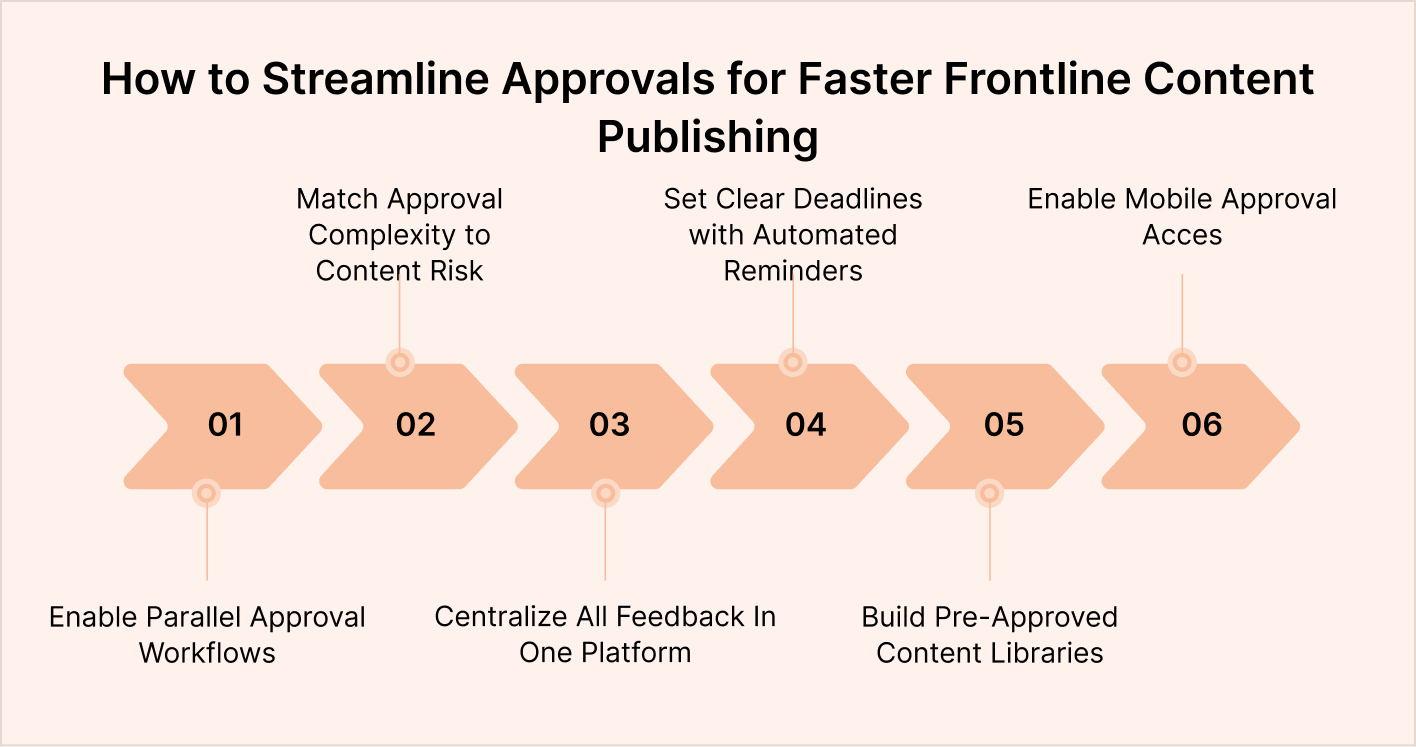
How to Fix Approval Bottlenecks and Speed Up Frontline Content Publishing
Solving approval delays requires intentional redesign of the process. These strategies help teams publish faster while maintaining quality standards. Implementation starts with small changes that build momentum for bigger improvements.
1. Enable Parallel Approval Workflows
Stop routing content through reviewers one at a time. Allow marketing, legal, and leadership to review simultaneously. Parallel workflows dramatically reduce approval time without reducing oversight.
Using a frontline social media management platform like ContentBridge is the smarter choice here. Such platforms offer approval workflows tailored to frontline social media content needs. This ensures speed, efficiency, and on-time posting.
Implementation steps
- Identify review stages that can run in parallel without dependencies.
- Configure your workflow tool to notify all required reviewers immediately.
- Set clear deadlines for each parallel review stage.
- Establish a process for resolving conflicts between parallel reviewer feedback.
2. Match Approval Complexity to Content Risk
Not every post requires executive approval. Create tiers that route low-risk content through faster pathways. Reserve a comprehensive review for content with compliance or legal implications.
Content tiering examples
- Tier one posts include routine updates using approved templates needing single approval.
- Tier two posts include original content with brand elements needing marketing sign-off.
- Tier three posts include claims, testimonials, or regulated content needing legal review.
- Tier four posts include crisis communications or major campaigns needing executive approval.
3. Centralize All Feedback In One Platform
Eliminate feedback scattered across email, chat, and documents. Force all review comments through a single system. Consolidation prevents lost notes and conflicting revision requests. ContentBridge does exactly this by centralizing all review comments, revision requests, and approvals within a single platform. No more digging through email threads or chat histories.
Platform requirements
- Threaded comments are attached directly to content elements.
- Clear version history showing every change and who made it.
- Notification system alerting creators to new feedback.
- Resolution tracking that marks issues as addressed.
4. Set Clear Deadlines with Automated Reminders
Reviewers need explicit timelines, not vague requests. Define expected turnaround for each approval stage. Automated reminders keep content moving without manual follow-up.
Deadline best practices
- Define standard review windows by content tier and reviewer type.
- Send automated reminders at 24 hours and 4 hours before the deadline.
- Establish escalation paths when deadlines pass without response.
- Track reviewer performance to identify chronic delay sources.
5. Build Pre-Approved Content Libraries
Create templates and asset libraries that skip approval stages. Pre-approved elements let teams quickly assemble compliant content. Investing in templates pays dividends by enabling faster future publishing.
Library components
- Brand-approved image templates for common post types.
- Caption frameworks with compliant language for regulated industries.
- Hashtag sets vetted by marketing and compliance teams.
- Seasonal content approved in advance of relevant time periods.
6. Enable Mobile Approval Access
Reviewers are not always at their desks. Mobile approval access lets stakeholders review and approve from anywhere. Removing location barriers significantly speeds up response times.
Mobile enablement checklist
- Ensure your workflow tool has a functional mobile application.
- Train reviewers on mobile approval features and expectations.
- Set notifications to alert reviewers across all their devices.
- Track mobile approval rates to measure adoption success.
Eliminate Approval Bottlenecks in Frontline Content with ContentBridge
Approval bottlenecks are not just inconvenient. They represent a fundamental breakdown in how content moves through organizations. Every delayed post is a missed opportunity to connect with your audience. Every slow approval cycle drains team energy and enthusiasm.
The problem is not too much oversight. Brand protection and compliance matter. The problem is outdated workflows that were never designed for modern content velocity. Sequential approvals, scattered feedback, and undefined processes create friction that kills timely content.
ContentBridge solves these challenges with workflows built for speed and accountability. Parallel approval routing lets multiple reviewers work simultaneously. Centralized feedback eliminates version confusion. Automated reminders keep content moving without manual chasing.
ContentBridge automatically matches approval complexity to content risk. Simple posts flow through fast tracks. Sensitive content gets appropriate review without slowing everything else. Mobile access ensures approvers can respond from anywhere.
Request a demo today to see how ContentBridge helps your team publish timely frontline content without sacrificing compliance or brand safety.
Frequently Asked Questions
How long should content approval take?
Routine social media content should move from creation to publication within one to three days. Regulated content or major campaigns may require longer timelines. If your average exceeds 5 days, your process likely has a bottleneck. Track time at each approval stage to identify where delays occur. Often, a single step causes most of the total delay. Addressing that specific bottleneck can dramatically improve overall speed.
How many approvers should review social content?
Most social content needs two to three approvers at most. Organizations with six or more approval stages show significantly lower content performance. More approvers rarely improve quality but always increase delays. Implement content tiering to match approval depth with risk level. Reserve extensive review chains for content with compliance implications. Fast track low risk content through minimal approval stages.
What causes approval delays most often?
Sequential workflows create the biggest delays because each stage waits for the previous one. Scattered feedback forces revision cycles that extend timelines. Unclear processes leave content sitting while teams figure out next steps. Stakeholder overload also contributes significantly. Reviewers with competing priorities deprioritize content approval requests. Automated reminders and clear deadlines help, but cannot fully solve capacity issues.
How do parallel approvals work?
Parallel approval workflows send content to multiple reviewers simultaneously instead of sequentially. Marketing, legal, and leadership can all review the same content at once. Total approval time reflects the slowest reviewer, not the average of all reviewers. Parallel workflows require tools that support simultaneous review and consolidated feedback. Teams also need processes for resolving conflicts in feedback from parallel reviewers.
Should all content go through the same approval process?
Different content types carry different risk levels and should follow different approval paths. A routine product photo needs less scrutiny than a testimonial with health claims. Tiered approval routes content appropriately based on its characteristics. Create clear criteria defining which tier applies to each content type. Train content creators to correctly classify their work. Build fast tracks for low-risk content that represents most of your volume.