


Your hospital system spent months developing comprehensive brand guidelines. The visual standards are detailed. The messaging framework is clear. The voice and tone guidelines are specific. Yet when you look at your hospital locations’ social media pages, they appear fragmented. One location emphasizes patient testimonials while another posts lifestyle wellness content. Some locations maintain professional clinical messaging while others adopt a casual, conversational tone. Visual styles diverge. Color palettes shift. Patients following multiple location accounts notice the inconsistency.
This scenario repeats across hospital networks nationwide. Brand fragmentation occurs not from negligence but from structural gaps in coordination, governance, and accountability. Without systems enforcing consistency, individual hospital locations operating independently will inevitably create divergent brand expressions. The challenge is not understanding brand importance but operationalizing consistency across complex, distributed organizations.
This guide explains why hospital brand consistency matters, reveals where fragmentation originates, and provides proven strategies to maintain unified brand presence across all your locations. If your teams also struggle with proving social media is brand-safe, this guide will help. Learn how to create governance frameworks that balance corporate standards with local autonomy.
Why Hospital Brand Consistency Drives Business Results
Hospital networks that maintain strong brand consistency significantly outperform fragmented competitors. The business case for consistency extends beyond aesthetic preferences—it directly impacts patient behavior and financial outcomes.
Consistent branding directly impacts patient acquisition and retention. According to PR Newswire, organizations with strong, consistent branding achieve 33% higher patient acquisition rates compared to competitors with fragmented brand presence. Patients choosing between healthcare providers rely heavily on brand recognition and first impressions. Consistent hospital branding creates institutional credibility that fragmented messaging cannot achieve.
The financial impact extends beyond acquisition rates. Hospital networks with unified branding experience measurable improvements in patient retention, staff recruitment, donor engagement, and insurance partnership negotiation. Conversely, brand fragmentation creates patient confusion, wasted marketing spend, competitive disadvantage, and staff disengagement that compounds over time.
Where Hospital Brand Consistency Breaks Down
Brand fragmentation occurs predictably when hospital systems lack dedicated governance structures. Understanding breakdown points helps organizations intervene before problems compound.
1. Decentralized Management Without Oversight
Most hospital networks operate multiple social media accounts independently. Each location manages Facebook pages, Instagram accounts, and Twitter profiles without centralized coordination. While local management enables community connection, decentralized control without oversight creates inevitable inconsistency.
Each location feels empowered to interpret brand guidelines differently. Marketing directors apply visual standards inconsistently. Social media managers develop their own local tone. Without monitoring consistency across locations, fragmentation accelerates unchecked.
2. Unclear or Inaccessible Brand Guidelines
Many hospital systems create comprehensive brand style guides that remain locked in shared drives or documented in formats that frontline teams cannot easily reference. Guidelines become irrelevant when social media managers need a quick turnaround and cannot easily find standards. Complex visual requirements that require design expertise are skipped when urgent content needs arise.
Additionally, staff directed to “maintain consistency” without understanding why standards exist often prioritize speed and local autonomy over institutional alignment. Compliance with unclear standards feels bureaucratic rather than purposeful.
3. Insufficient Training on Brand Standards
New social media managers hired at hospital locations often receive minimal onboarding about institutional brand identity. They learn platform best practices and local policies, but may never understand the hospital system’s visual identity, voice positioning, or strategic messaging framework.
Even established staff experience training erosion as teams turn over. Brand understanding fades as institutional knowledge walks away with departing employees. Without reinforcement training, consistency deteriorates over time as new staff members lack foundational knowledge. This knowledge loss contributes to uncontrolled employee content creating brand risk.
4. Competing Priorities Between Corporate Standards and Local Autonomy
Hospital location administrators often prioritize local relevance and community connection over corporate brand standards. From their perspective, community authenticity matters more than institutional uniformity. They fear that strict branding requirements limit their ability to connect with local patients and communities.
This tension between corporate consistency and local autonomy creates perpetual conflict without clear frameworks that enable both objectives. This is exactly why distributed teams struggle with brand voice.
5. Technology Limitations in Multi-Location Management
Most hospital networks use commercial social media management platforms designed for single organizations, not multi-location healthcare networks. These platforms lack features for centralized brand governance across distributed accounts. Asset libraries become disorganized. Approval workflows don’t account for location hierarchies. Analytics don’t break down by location effectively.
Enforce Brand Standards Across Your Social Media Presence
ContentBridge provides centralized brand governance designed specifically for multi-location healthcare systems managing dozens of independent social media accounts.
The Hidden Costs of Brand Inconsistency
Healthcare systems that tolerate brand fragmentation pay costs that extend far beyond social media. These costs often remain invisible until reputation problems force recognition.
1. Diminished Patient Trust and Selection
Patients researching hospitals compare messaging across multiple channels and locations. Encountering fragmented branding across different location accounts creates doubt about organizational professionalism and reliability. Inconsistent messaging suggests internal dysfunction, influencing patient selection decisions negatively.
Patient trust erodes with each inconsistent experience. If the hospital cannot maintain consistent branding, can it be trusted with consistent, high-quality patient care? This question influences patient decision-making more than most healthcare systems realize. To avoid such instances, hospitals should create a compliance-first social media content calendar with patient timelines in mind. It will help them optimize ROI while sticking to all the required rules and regulations.
2. Inefficient Marketing Spend and Lower ROI
Hospital marketing budgets grow increasingly constrained. Systems must maximize return on limited spend. Inconsistent branding reduces marketing effectiveness by diluting message impact and confusing target audiences.
When different locations pursue different messaging, paid advertising campaigns cannot reinforce unified brand positioning. Media spend amplifies fragmented messages rather than building cumulative brand recognition. This fragmentation is why enterprise social campaigns fail locally. The result is higher patient acquisition costs and lower conversion efficiency across the network.
3. Competitive Disadvantage in Crowded Markets
Hospital networks compete with increasingly sophisticated competitors in crowded healthcare markets. Competitors operating unified, consistent brands appear more professional and trustworthy. Healthcare systems with fragmented branding signal internal dysfunction and concede competitive advantage to better-organized competitors.
As patient selection becomes more competitive, brand consistency becomes an increasingly valuable strategic asset. Hospital networks accepting fragmentation systematically lose market share to competitors with superior brand coordination.
Stop Brand Voice Fragmentation on Social Media with Unified Governance
ContentBridge centralizes brand management, ensuring every location maintains institutional standards while maintaining community relevance.
How to Build Hospital Brand Governance Frameworks
Maintaining a consistent brand across hospital networks requires systematic frameworks coordinating corporate standards with local autonomy. The right approach combines clear policies with enabling technology.
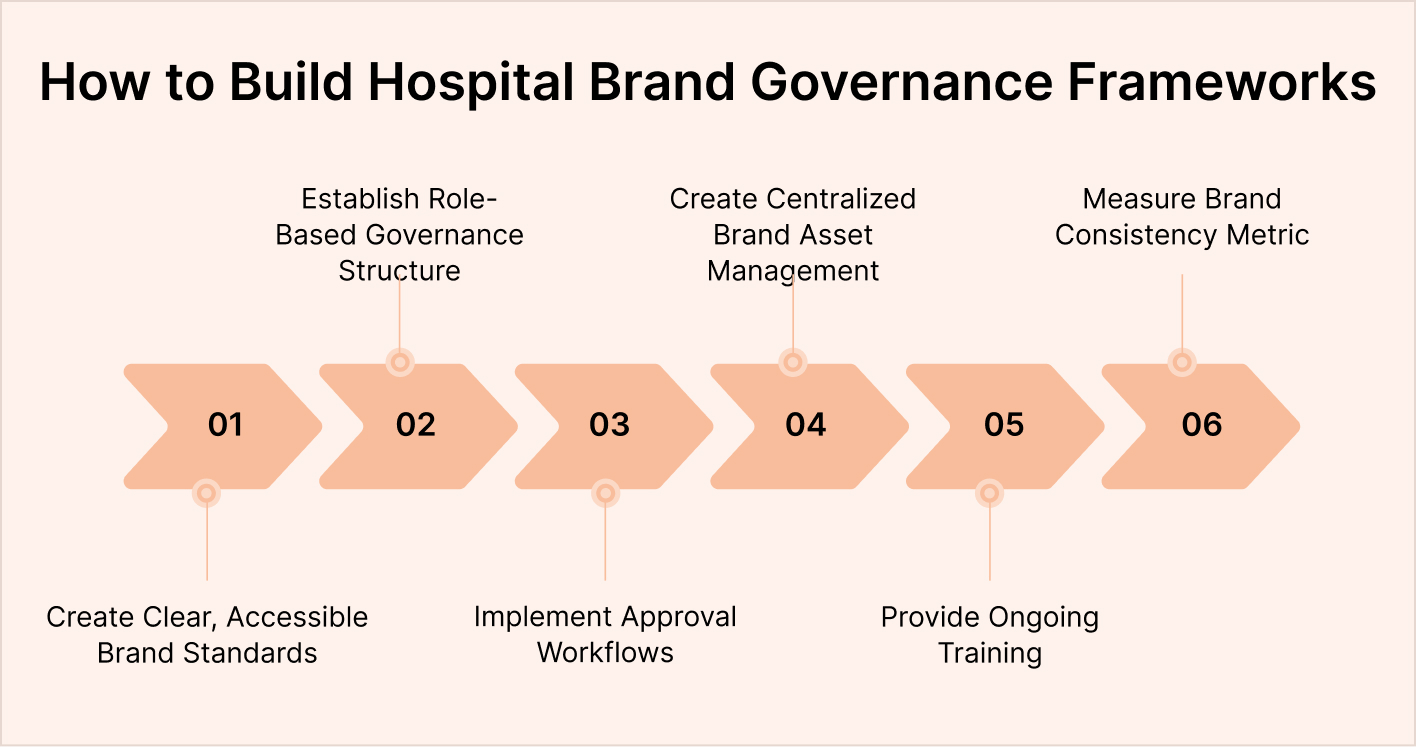
1. Create Clear, Accessible Brand Standards
Develop comprehensive brand guidelines clearly defining visual standards (logos, colors, typography, photography style, templates), messaging standards (positioning, voice and tone, approved terminology), and implementation guidelines (local customization parameters, posting frequency, response protocols).
Most importantly, make guidelines accessible and understandable to frontline teams. Store guidelines in centralized, searchable systems. Use visual examples rather than abstract concepts. Explain the reasoning behind standards, so teams understand why consistency matters rather than viewing standards as arbitrary requirements. This centralized approach is why frontline teams need one source of truth.
2. Establish Role-Based Governance Structure
Define clear responsibility and authority for brand decisions: Corporate Brand Officer responsible for system-wide consistency, Location Marketing Directors implementing standards at facilities, Social Media Managers creating and submitting content, Compliance/Approval Authority reviewing for consistency, and Brand Ambassadors trained to guide peers.
Clear governance structures distribute responsibility and ensure accountability for consistency rather than assuming everyone will self-manage.
3. Implement Approval Workflows Enforcing Brand Standards
No single workflow suits all hospital networks. However, effective workflows share common features: pre-publication review including brand consistency checks, documented approvals creating audit trails, and balanced centralization applying corporate review to content most critical for brand consistency while granting location teams discretion for locally-dependent content.
Effective workflows feel like support systems enabling better content rather than bureaucratic obstacles. You can use a healthcare social media management platform like ContentBridge that helps streamline social media approvals without creating process bottlenecks. ContentBridge ensures consistent and brand-compliant social media content for hospitals with zero friction.
4. Create Centralized Brand Asset Management
Most hospital networks maintain brand assets scattered across locations and systems. Centralized asset management dramatically improves consistency: a single searchable repository storing all approved assets, clear naming conventions enabling easy search, version control preventing outdated asset use, and automatic updates notifying stakeholders when brand assets change.
5. Provide Ongoing Training and Reinforcement
Brand consistency requires continuous training: initial onboarding for new social media managers covering organizational history, brand positioning, and approval processes; quarterly refresher training for all teams, reinforcing standards and communicating updates; brand ambassador networks identifying location leaders to coach peers; and performance metrics tied to training, creating accountability for consistency.
6. Measure Brand Consistency Metrics
What gets measured gets managed. Establish metrics quantifying brand consistency: visual consistency metrics (color usage percentage, approved photography style usage, template usage), messaging metrics (percentage aligned with brand messages, tone compliance), operational metrics (posting frequency consistency, approval workflow compliance), and engagement metrics (performance consistency across locations).
Share metrics transparently with location leadership. Use metrics to identify best practices worth sharing and problems requiring targeted intervention.
Track Brand Consistency Performance Across Locations
ContentBridge delivers brand consistency analytics showing which locations maintain standards and where improvement opportunities exist.
Maintain Consistent Hospital Brand With ContentBridge
Brand fragmentation reveals a fundamental gap in hospital social media operations. The problem is not apathetic local teams or poor brand design. The issue is that traditional coordination tools cannot handle the complexity of multi-location operations.
ContentBridge is a social media management platform built specifically for frontline workers. The platform centralizes brand governance across all locations while enabling local teams to maintain authentic community connections.
Centralized Asset Management ensures all approved brand assets (logos, templates, color swatches, approved imagery) live in a single searchable, mobile-friendly library. Version control prevents outdated asset use. Automatic updates notify teams when brand assets change. Social media managers find the correct materials in seconds rather than searching through folders or creating improvised variations.
Brand Approval Workflows incorporate brand consistency checks alongside compliance review. Content submitted for approval gets evaluated for visual consistency, messaging alignment, and voice/tone appropriateness before publication. Documented approvals create audit trails proving that brand review occurred. Escalation procedures are defined for content requiring special brand consideration.
Brand Consistency Analytics provides comprehensive metrics showing visual consistency performance, messaging alignment across locations, operational compliance, and engagement consistency. Dashboards show which locations maintain standards consistently and where improvement opportunities exist. Benchmarking identifies best practices worth sharing across the hospital network.
Distributed Team Coordination enables location teams across the hospital network to access centralized brand governance information, complete training resources, ask real-time brand questions, and coordinate with corporate brand leadership. Role-based permissions ensure appropriate accountability while enabling location autonomy for locally-appropriate decisions.
Request a demo today to see how ContentBridge helps hospital networks maintain a consistent brand presence across all locations while enabling community connection.
Frequently Asked Questions
How do we maintain brand consistency when hospital locations need autonomy?
The most successful hospital networks achieve both corporate consistency and local autonomy through tiered requirements. Define core elements (logo, colors, brand voice) that remain non-negotiable across locations. Allow flexibility in content themes, photography style, and posting frequency. Enable locations to add local events and community news while maintaining institutional brand standards. This balance prevents locations from feeling controlled while enforcing meaningful consistency.
What are the most common brand inconsistencies hospital networks experience?
Common inconsistencies include: logo variations (outdated versions, incorrect sizing, unapproved modifications), color palette inconsistency (some locations using approved colors, others using variations), tone inconsistency (some posts professional and clinical, others casual and lifestyle-focused), messaging inconsistency (locations emphasizing different value propositions), and operational inconsistency (some locations responding to patient comments while others rarely engage).
How often should hospital networks audit brand consistency?
Quarterly audits are standard minimum practice. Hospital networks with high social media volume or significant brand fragmentation challenges may conduct audits monthly or even weekly. Audits should evaluate visual consistency, messaging consistency, and operational consistency. Use audit findings to identify best practices worth sharing and problems requiring intervention.
How can hospital locations customize brand standards while maintaining consistency?
Effective customization frameworks establish core non-negotiable brand elements while enabling variation in flexible areas. Locations can feature local patients (with proper de-identification), participate in community events, highlight local providers and staff, use local imagery alongside corporate brand elements, and adjust content themes to reflect community health interests. The framework ensures customization reinforces rather than contradicts institutional brand identity.
What role should corporate marketing play in multi-location brand management?
Corporate marketing should establish brand standards, provide resources (templates, assets, training), monitor consistency through audits, and coach locations needing improvement. However, effective corporate marketing avoids micromanaging individual posts. Instead, it creates frameworks enabling locations to make consistent decisions independently while ensuring accountability for results.