

Your hospital marketing team publishes a patient success story. A kidney transplant recipient shares how their treatment improved their quality of life. The post gains traction quickly on Facebook and Instagram. Three weeks later, your legal team receives a compliance concern from your FDA liaison officer.
The problem: One phrase in the testimonial crossed the line into unsubstantiated disease claims. The patient said the treatment would “cure” their kidney disease. No clinical evidence supports that word choice. Now your hospital faces regulatory scrutiny for FDA and FTC violations you didn’t know you made.
This scenario repeats across hospitals and healthcare providers daily. Medical claims violations happen because marketing teams don’t understand FDA and FTC regulations clearly. The difference between compliant and non-compliant claims often depends on a single word or phrase choice. A strong foundation in healthcare social media management is the first step toward preventing these violations.
This guide explains exactly how to prevent FDA and FTC medical claims violations on social media. You will learn the specific differences between FDA and FTC jurisdiction. Most importantly, you will discover the pre-publishing checklist that catches compliance violations before they reach your audience.
Understanding FDA and FTC Jurisdiction Over Medical Claims
Healthcare marketers face enforcement from two different federal agencies. The FDA and FTC have overlapping but distinct authority over medical claims. Confusion about which agency regulates what leads many hospitals to violate rules they didn’t know existed.
1. FDA Regulates Drug and Device Promotion
The Food and Drug Administration controls claims about prescription drugs, medical devices, and healthcare products. When a pharmaceutical company advertises a medication, the FDA’s Office of Prescription Drug Promotion reviews those claims. The FDA focuses particularly on whether companies present adequate risk information alongside benefits.
The FDA has specific requirements for what information must appear in drug advertisements. Every claim about what a drug does must be supported by substantial clinical evidence. Risk information must be presented with equal prominence to benefits. Social media posts claiming a medication provides disease relief face FDA scrutiny automatically.
Medical device claims fall under similar FDA authority when they make disease claims. A spinal fusion device can describe its structure and function, but cannot claim to “cure back pain.” That language crosses from device promotion into unsubstantiated disease claim territory.
According to a 2025 FDA enforcement analysis, the agency issued over 100 cease-and-desist letters to pharmaceutical companies for social media violations. The vast majority involved inadequate risk disclosure or unsubstantiated benefits. Hospital social media accounts promoting medications face the same scrutiny that drugmakers do.
2. FTC Regulates All Advertising Health Claims
The Federal Trade Commission has broader authority than the FDA. The FTC reviews advertising claims about all consumer products, including health and wellness items. Unlike the FDA’s focus on labeling and promotion, the FTC examines advertising across all channels, including social media.
The FTC’s standard for claim substantiation is rigorous. Every health claim must be backed by “competent and reliable scientific evidence.” For healthcare providers, this means clinical trials or peer-reviewed research, not anecdotal patient experiences. Patient testimonials alone cannot substantiate broader health claims to the FTC.
The FTC also regulates influencer partnerships and endorsements in healthcare marketing. When a healthcare provider partners with an influencer to promote wellness products, the FTC requires clear disclosure of material connections. Influencers must reveal payment, free products, or benefits they received for promoting healthcare items. Organizations managing multiple locations and contributors need to understand enterprise social media management to enforce these standards consistently across every channel and location.
3. FDA and FTC Enforcement in 2025
Federal enforcement of healthcare advertising claims intensified dramatically in 2025. The Make America Healthy Again Commission directed both the FDA and FTC to increase scrutiny of direct-to-consumer advertising. This crackdown focused particularly on social media, where inadequate risk disclosure is common.
The FDA now monitors influencer partnerships, user-generated content, and company reposts on social platforms. Hospital accounts sharing content created by patients or employees may face enforcement if the reposts contain unsubstantiated claims. Simple sharing no longer shields hospitals from responsibility for the claims being promoted. This is why understanding compliance risks of frontline social media is critical for every healthcare organization.
The FTC increased penalties for deceptive health claims, with consent decrees now exceeding millions of dollars annually. Companies making false health claims pay not just fines but also agree to pre-approval requirements for all future advertising. These penalties create lasting operational burdens beyond initial compliance violations.
Ensure Medical Claims Compliance Across All Channels
ContentBridge centralizes medical claims review for healthcare marketers. Screen every post before publishing to social media channels.
Types of Medical Claims to Screen Before Publishing
Not all health-related statements constitute regulated medical claims. Understanding the difference between compliant and non-compliant claims is essential for social media success and determines whether your post faces regulatory scrutiny.
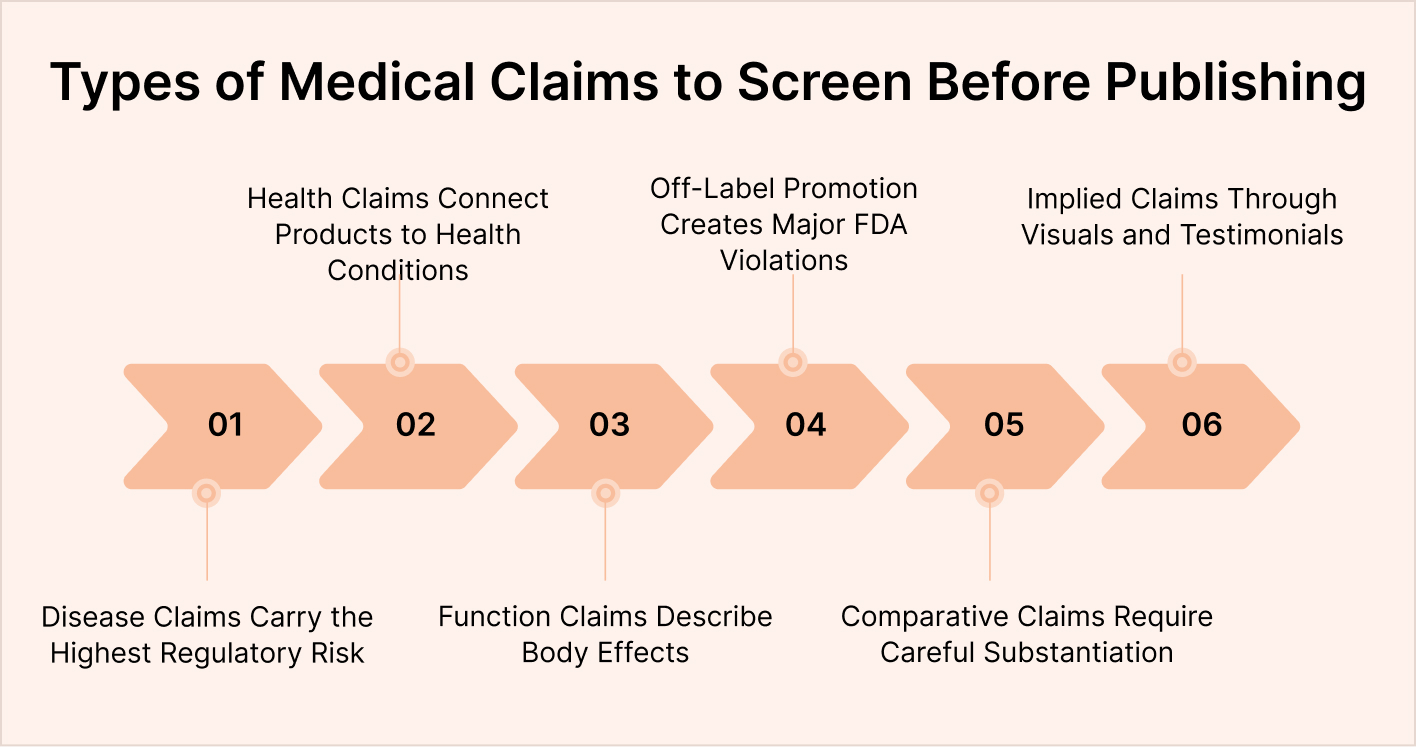
1. Disease Claims Carry the Highest Regulatory Risk
Disease claims state that a product, treatment, or service prevents, diagnoses, treats, or cures a specific disease and face strict FDA and FTC scrutiny. Patient testimonials describing a cure create additional risk because when a hospital shares these unchanged, it becomes responsible for substantiating that claim, even though the patient made the statement.
2. Health Claims Connect Products to Health Conditions
Health claims link a product or service to improved health or wellness without referencing specific diseases, such as “supports healthy heart function” or “promotes joint mobility.” The FTC evaluates not just the words but the overall message, including imagery, and all health claims require substantiation through credible scientific evidence rather than testimonials alone.
3. Structure/Function Claims Describe Body Effects
Structure/function claims describe how a product or treatment affects the body’s normal structure or function and carry lower regulatory risk. The critical distinction is that you can say treatment “improves joint flexibility” but not “treats arthritis,” and training your team on this line prevents thousands of potential compliance violations.
4. Off-Label Promotion Creates Major FDA Violations
Promoting a drug or medical device for a use the FDA never approved is strictly prohibited, regardless of whether clinical evidence supports the off-label use. Off-label violations carry especially severe consequences, and the FDA views this promotion as deliberately misleading patients, often leading to aggressive scrutiny of all future content.
5. Comparative Claims Require Careful Substantiation
Statements comparing your treatments, outcomes, or services to competitors must be backed by verifiable evidence. Claims like “best outcomes in the region” or “faster recovery than other hospitals” require documented data, and unsubstantiated comparative claims attract both FTC enforcement and potential legal action from competitors.
6. Implied Claims Through Visuals and Testimonials
Not all claims are made through words. Showing a patient running a marathon after knee surgery implies a specific outcome that the FTC treats as a claim requiring substantiation. Hospitals must screen visual content, patient imagery, and before-and-after presentations with the same rigor applied to written claims.
Screening every piece of social media content for these claim types before publishing is essential. Hospitals that train their teams to recognize the differences between disease, health, structure/function, off-label, comparative, and implied claims will avoid costly regulatory violations and maintain credibility with both patients and regulators. Learning how healthcare teams review frontline content before publishing can help build these screening habits into daily workflows.
Pre-Publishing Medical Claims Compliance Checklist for Hospitals
Healthcare teams need a systematic process for screening medical claims before posting. Random spot-checking misses violations and creates inconsistent enforcement. A thorough pre-publishing checklist catches violations before they reach your audience.
1. Identify Every Express and Implied Claim
List every health claim in your post, including implied claims created by images, videos, or contextual information. A post with text saying “improves mobility” paired with a video of a patient running creates a stronger claim than the text alone, and the FDA evaluates the complete message across all elements as one unified communication.
2. Classify Each Claim Correctly
Categorize each claim as a disease claim, health claim, structure/function claim, or educational statement, as this classification determines your substantiation requirements. Resolve gray areas conservatively in favor of stricter classification, and document classification reasoning to demonstrate compliance diligence if enforcement action ever occurs.
3. Verify Substantiation for Every Claim
Each claim must be supported by credible scientific evidence before publishing, as patient testimonials alone never constitute sufficient substantiation. Maintain a substantiation file linking clinical trials, peer-reviewed research, or medical society guidelines to every healthcare claim in your social media content.
4. Check Fair Balance in Risk and Benefit Presentation
The FDA requires that risk information be presented with equal prominence to benefits, and social media character limits do not excuse non-compliance. If risks cannot be adequately presented within a single post or video, find a different way to communicate that claim or avoid it entirely.
5. Verify Influencer Compliance and Endorsement Requirements
Healthcare influencer partnerships require written agreements specifying compliance requirements, content review before posting, and clear disclosure of material connections. Hospitals remain fully liable for claims made by influencers on their behalf, and the FTC treats paid promotions as company-endorsed content regardless of influencer independence.
6. Screen for Off-Label and Unapproved Use Promotion
Review every medication or device reference against FDA-approved uses, as promoting a drug for unapproved conditions constitutes off-label promotion even in patient education content. Testimonials mentioning off-label uses require special scrutiny, and reposting them unmodified creates significant compliance risk.
A consistent pre-publishing checklist ensures every piece of content is screened against the same standards before it goes live. Hospitals that embed this process into their workflow will reduce regulatory risk, protect their reputation, and publish social media content with full confidence in its compliance.
Build Compliance Workflows Into Your Publishing Process
ContentBridge helps healthcare teams create review workflows that catch compliance risks before publishing.
How to Build an Approval Workflow That Prevents Medical Claims Violations
A systematic approval workflow prevents compliance violations from reaching social media. Sporadic reviews by random team members miss violations and create inconsistent standards. Documented processes demonstrate to regulators that you prioritize compliance.
1. Assign Clear Roles for Medical Claims Review
Assign specific team members, like your Chief Medical Officer, Compliance Officer, or Legal Counsel, to approve content making healthcare claims. Create a role matrix showing who reviews what content types, and document the entire approval process in writing so enforcement agencies can see your organization established compliance procedures intentionally.
2. Ensure No Content Publishes Without Documented Approval
Establish a system where posts requiring medical claims review cannot be published without sign-off. ContentBridge is a social media platform for healthcare and provides healthcare teams with built-in medical claims review workflows where frontline team members submit drafts through mobile interfaces, designated medical reviewers evaluate claims against FDA and FTC standards, and only approved content reaches your social media accounts.
3. Standardize Reviews With a Medical Claims Checklist
Develop a standardized checklist prompting reviewers to identify claims, verify substantiation, check fair balance, and confirm educational accuracy. Include approved language templates for common claims to accelerate review, and document all modification notes to identify recurring compliance mistakes for targeted training. When multiple teams handle compliance across locations, having a single source of truth for social media ensures consistent standards and prevents duplicate or conflicting reviews.
4. Train Your Entire Marketing Team on FDA and FTC Requirements
Invest in regular training that goes beyond procedural checklists to build a genuine understanding of FDA jurisdiction, FTC standards, and claim categorization. Use before-and-after examples of non-compliant posts and measure effectiveness through scenario-based exercises where team members identify claims requiring review.
5. Maintain a Centralized Substantiation Library
Build a database of all healthcare claims your hospital makes alongside supporting clinical evidence, organized by condition, treatment, or content category. Include one-page evidence summaries for quick reviewer access and update the library quarterly as new research emerges or existing evidence is contradicted.
A well-structured approval workflow turns compliance from guesswork into a repeatable system. Without one, hospitals risk the kind of delays and confusion described in our guide on how to speed up hospital social media approvals. Hospitals that define clear roles, standardize reviews, and maintain centralized documentation will catch violations before they publish and demonstrate regulatory commitment that protects the entire organization.
5 Common Compliance Mistakes Healthcare Teams Make (And How to Avoid Them)
Healthcare marketers repeatedly make similar mistakes because regulations are complex and inconsistent with marketing instincts. Learning from common errors helps you avoid these pitfalls.
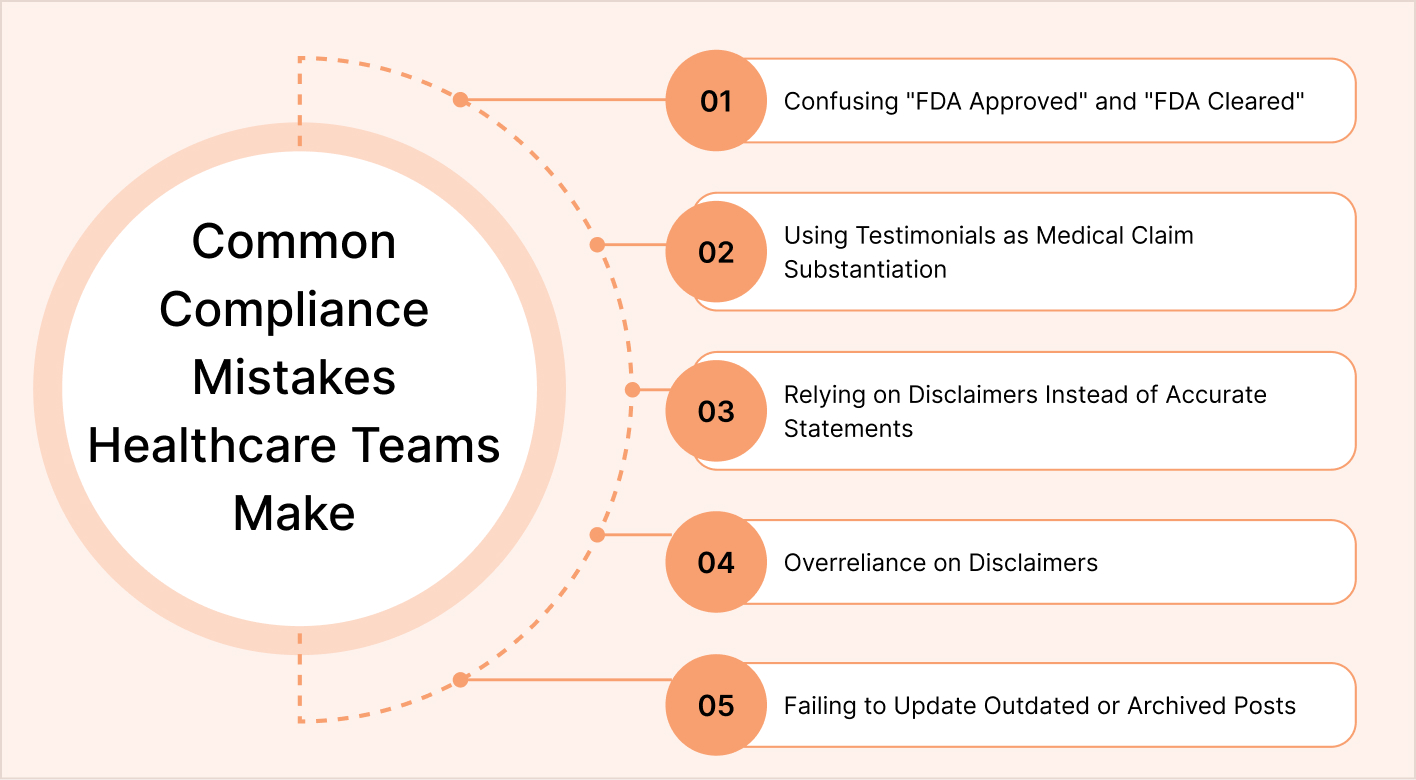
1. Confusing “FDA Approved” and “FDA Cleared”
The FDA “clears” devices through the 510(k) process and “approves” drugs through more rigorous applications. Stating a device is “FDA approved” overstates the clearance level and can trigger enforcement action.
How to Overcome This
- Create a style guide specifying correct terminology for your organization.
- Embed correct language in content templates so individual writers do not need to remember the distinction.
- Use spell-check or automated tools to flag common misuses like “FDA-approved device” before publishing.
2. Using Testimonials as Medical Claim Substantiation
Patient testimonials prove patients feel better, but do not demonstrate clinical efficacy. The FTC specifically rejects testimonials as adequate substantiation for health claims, even when the stories are genuine.
How to Overcome This
- Use testimonials for engagement and humanization separately from medical claims.
- Screen all testimonials for embedded language like “cured” or “eliminated disease” before sharing.
- Add strong disclaimers clarifying that testimonials represent individual experiences, not guarantees of effectiveness.
3. Relying on Disclaimers Instead of Accurate Statements
Disclaimers do not cure false claims. The FTC explicitly rejects the idea that adding “individual results vary” or “not evaluated by FDA” fixes unsubstantiated content. If the core claim lacks evidence, no disclaimer makes it compliant.
How to Overcome This
- Revise the claims themselves rather than relying on disclaimers to provide coverage.
- Use disclaimers only to qualify truthful claims that need additional context.
- Audit your social media for posts with excessive disclaimers, as these likely signal unsubstantiated claims underneath.
4. Overlooking Implied Claims in Images and Videos
Healthcare marketers focus on written claims and miss visual ones. An image of a patient celebrating a pain-free accomplishment creates an implied claim about treatment effectiveness, and the FDA evaluates images equally with text.
How to Overcome This
- Assign a separate team member to evaluate content, focusing only on imagery and video elements.
- Review what message a viewer would understand watching the video without sound.
- Assess whether background music, camera angles, or editing style suggest stronger benefits than the words convey.
5. Failing to Update Outdated or Archived Posts
Previously published content with outdated claims can trigger enforcement action years later. Posts may remain live promoting approaches that newer research no longer supports, and old testimonials may reference treatments that are no longer best practice.
How to Overcome This
- Establish a schedule to review all medical claims in published content at least annually.
- Remove or update posts that current evidence no longer supports and document all changes.
- Prioritize reviewing patient testimonials that reference specific treatments or outcomes for continued accuracy.
Compliance mistakes are preventable when teams know what to look for. Hospitals that build awareness of these common pitfalls into their training, templates, and review processes will catch errors before they become costly regulatory violations. For a deeper look at how approval failures compound these risks, see our guide on frontline social media approval failures.
Monitor All Medical Claims for Ongoing Compliance
ContentBridge tracks all published posts and flags claims requiring review as regulations or evidence evolve.
How to Build a Medical Claims Compliance Program That Scales
Healthcare organizations need a cohesive compliance program, not sporadic reviews. A well-documented program demonstrates regulatory commitment and prevents violations through a systematic approach that scales across teams and locations.
- Form a cross-functional compliance committee: Combine medical, legal, marketing, and compliance perspectives in a committee that meets monthly to review claims and discuss emerging regulations. Document all decisions to demonstrate deliberate compliance efforts during any regulatory inspection.
- Assign regulatory monitoring to a dedicated team member: Stay current on FDA and FTC guidance by tracking enforcement actions, updated guidance documents, and new advertising standards. Brief the compliance committee monthly on any changes that affect your content strategy.
- Engage external healthcare advertising counsel: Outside legal perspective often catches risks that internal teams miss. Periodic review from counsel familiar with FDA and FTC enforcement prevents more expensive violations down the line.
- Develop policies specific to your organization: Generic compliance guidance fails because it does not address your hospital’s specific services, patient populations, and common claim types. Create tailored policies that your teams can understand and apply quickly.
- Include social media supplements in your policies: General marketing compliance policies miss platform-specific challenges like character limits, visual claims, and format restrictions. Make these supplements accessible to all marketing team members.
- Review and update all policies annually: As your social media management strategy evolves, compliance policies must evolve with it. Regular review ensures your standards stay relevant to your current content mix and platform usage.
A structured compliance program turns reactive enforcement responses into proactive violation prevention. Hospitals that invest in cross-functional oversight, regulatory monitoring, and organization-specific policies will build a sustainable foundation that protects their brand and patients long term.
Prevent Compliance Violations Before They Happen with ContentBridge
Medical claims compliance isn’t optional for healthcare social media. FDA and FTC enforcement is intensifying rapidly. Healthcare organizations that ignore compliance now face escalating consequences.
The good news: compliance violations are preventable through systematic processes. Your team doesn’t need to memorize FDA and FTC regulations. You need a documented approval workflow that catches violations before publishing. A pre-publishing checklist eliminates most compliance risks.
ContentBridge is a social media management platform built for frontline workers that helps healthcare teams build compliance into their social media workflow. Frontline team members draft content through mobile interfaces. Medical reviewers evaluate claims against FDA and FTC standards. Only compliant content reaches your social media accounts.
Systematic compliance creates confidence for your marketing team. Rather than worrying whether posts might trigger enforcement, teams follow clear procedures. Confidence increases content velocity while reducing risk. This combination delivers marketing results with compliance protection.
The cost of ignoring compliance far exceeds the investment in compliance systems. Enforcement letters, consent decrees, and operational restrictions damage healthcare organizations far more than compliance tools cost. Build compliance now before violations damage your brand and business.
Frequently Asked Questions
What is the difference between the FDA and the FTC medical claims authority?
The FDA regulates claims about drugs, devices, and related products through labeling and promotion standards. The FTC regulates advertising claims about all consumer products through its “unfair or deceptive” advertising standard. Both agencies oversee healthcare claims on social media, with the FDA focusing on substantiation and fair balance for drugs/devices and the FTC evaluating the deceptiveness of all health advertising broadly.
Can hospitals make disease claims on social media?
Disease claims require substantial clinical evidence substantiation. Hospitals can make disease claims if backed by clinical evidence, but social media character limits make adequate risk presentation difficult. Many hospitals find it simpler to avoid disease claim language and instead describe health benefits or treatment experiences. This eliminates the highest regulatory risk category.
How should hospitals handle patient testimonials on social media?
Patient testimonials can describe individual experiences without including medical claims. Share what a patient experienced without generalizing to broader claims about effectiveness. Screen testimonial language for words like “cured,” “prevents,” or “treats.” Either edit these claims or add disclaimers that testimonials represent individual experiences, not guaranteed results.
What happens if the FDA or FTC finds medical claims violations on social media?
Minor violations might trigger warning letters requesting corrections. The FDA issues Untitled Letters for more serious violations. Continued violations lead to cease-and-desist letters and enforcement action. The FTC can impose consent decrees requiring pre-approval for all future advertising. These restrictions severely damage marketing operations.
How often should hospitals update their medical claims compliance program?
Review your compliance program annually at a minimum. When regulations change or your hospital adds new services, update programs accordingly. Monitor FDA and FTC enforcement actions for emerging priorities. Update your compliance program proactively before violations occur rather than reactively after enforcement action.