


Social media has become the primary channel where brands meet their audiences. According to Kepios Datareporta, there were 5.66 billion social media “user identities” around the world at the start of October 2025. These numbers are expected to grow, and the opportunity to build brand awareness, drive engagement, and convert followers into loyal customers has never been greater.
But having social media accounts is not the same as managing them effectively. Posting sporadically without a clear plan leads to inconsistent messaging, missed engagement windows, and wasted resources.
That is precisely why social media management exists. It transforms reactive, unstructured posting into a strategic, repeatable process that delivers measurable business outcomes.
This guide covers everything you need to know about social media management. Whether you are a small business owner handling your own accounts, a growing startup building your first marketing team, or an enterprise coordinating content across dozens of locations, you will learn what social media management actually involves, why it matters, and how to build a strategy that grows your brand online.
What is Social Media Management?
Social media management is the process of planning, creating, publishing, monitoring, and analyzing content across social media platforms to achieve specific business goals. It involves managing a brand’s presence on platforms such as Facebook, Instagram, LinkedIn, X, TikTok, and others in a structured and strategic way.
At its core, social media management goes far beyond simply posting updates. It combines content strategy, audience engagement, performance tracking, and optimization to ensure that social media efforts contribute to brand awareness, lead generation, customer relationships, and revenue growth.
Social media management typically includes:
- Strategy development: Defining goals, target audience, content themes, and success metrics
- Content planning and creation: Developing posts, visuals, videos, and campaigns aligned with brand messaging
- Scheduling and publishing: Posting content at optimal times across platforms
- Community management: Responding to comments, messages, and mentions to build relationships
- Social listening and monitoring: Tracking brand mentions, trends, and conversations
- Analytics and reporting: Measuring engagement, reach, conversions, and other performance indicators
Depending on the size of the business, social media management may be handled by a single person, an in-house marketing team, an agency, or supported by specialized software tools that streamline workflows and reporting.
Social Media Management vs. Social Media Marketing
These two terms are often used interchangeably, but they serve distinct purposes. Understanding the difference helps you allocate resources effectively and set the right expectations for each function.
Social media management focuses on maintaining and growing your brand’s social media presence on a day-to-day basis. This includes scheduling posts, responding to followers, moderating comments, managing your content calendar, and keeping your accounts active and consistent. It is the operational backbone that keeps your brand visible every single day.
Social media marketing focuses on using social platforms to promote specific products, services, or campaigns. It often involves paid advertising, influencer partnerships, lead generation campaigns, and conversion-focused strategies designed to drive a particular business outcome.
Think of management as the foundation. It keeps your brand present, consistent, and engaged with its audience. Marketing builds on that foundation by running targeted campaigns that drive specific results like sales, signups, or app downloads.
Core Components of Social Media Management
Effective social media management rests on five interconnected pillars. Neglecting any one of them creates gaps that weaken the entire process.
1. Content Creation and Curation
Content is the currency of social media. Creating original posts, graphics, videos, and stories that resonate with your audience requires a deep understanding of what they care about and how they prefer to consume content on each platform.
Content curation complements creation by sharing relevant industry news, user-generated content, and thought leadership from trusted sources. A balanced mix of original and curated content keeps your feed valuable without exhausting your creative resources. For multi-location brands, some of the most compelling content comes from the front lines.
Strong content adapts its format and tone to each platform while maintaining a consistent brand identity. What performs on LinkedIn rarely works on TikTok. Effective social media management tailors content to each platform’s unique dynamics without losing the thread of your brand story.
2. Scheduling and Publishing
Consistency matters more than frequency. A predictable posting schedule signals reliability to both your audience and platform algorithms, which reward regular activity with greater visibility.
Scheduling tools allow you to plan content weeks, publish at optimal times for each platform, and maintain consistency even during busy periods or staff absences. This prevents the common pattern of enthusiastic posting followed by long silences that damage audience retention.
For businesses managing multiple accounts or locations, scheduling becomes especially critical. Coordinating content across different time zones and regional audiences requires automated tools that handle complexity without sacrificing timing precision.
A centralized approach prevents the chaos that erupts when every location operates from different files and instructions.
3. Community Management and Engagement
Social media is a conversation, not a broadcast. Community management involves responding to comments, answering direct messages, moderating discussions, and actively participating in conversations relevant to your brand.
Audiences expect fast responses. The majority of social media users expect brands to reply within 24 hours, and many expect responses within just a few hours. Delayed responses frustrate followers and push them toward competitors who engage more quickly.
Proactive engagement matters just as much. Commenting on relevant posts, joining industry discussions, and acknowledging user-generated content build relationships that passive posting simply cannot replicate. These interactions humanize your brand and foster loyalty that outlasts any single campaign.
4. Social Listening and Monitoring
Social listening extends beyond tracking your own mentions. It involves monitoring broader conversations about your industry, competitors, and the topics your audience cares about to inform your strategy with real-world insights.
Effective social listening reveals what customers say about your brand when they are not talking directly to you, how competitors position themselves and what their audiences respond to, emerging trends your content strategy should address, and potential crises before they escalate into public relations problems.
This practice transforms social media from a publishing channel into an intelligence source. The insights you gather through social listening guide not just social strategy but product development, customer service improvements, and broader marketing decisions.
5. Analytics and Performance Reporting
Data separates strategic social media management from guesswork. Tracking key metrics reveals which content resonates, which platforms drive the most value, and where your strategy needs adjustment.
Essential metrics to monitor include:
- Engagement rate: How actively your audience interacts with content through likes, comments, shares, and saves.
- Reach and impressions: How many unique people see your content and how frequently it appears.
- Click-through rate: How effectively content drives traffic to your website or landing pages.
- Conversion rate: How social media activities translate into tangible business outcomes.
- Follower growth: Whether your audience is expanding and at what rate.
Regular reporting keeps your strategy accountable and provides the evidence needed to justify social media investment to stakeholders. Without analytics, you are operating blind.
Maximize ROI From Every Social Interaction
Use AI-powered monitoring and structured workflows to turn conversations into measurable business impact.
Why Social Media Management Matters for Your Business
Businesses often underestimate social media management until inconsistency starts costing them customers. A structured, strategic approach delivers benefits that compound over time.
1. Brand Consistency Builds Recognition and Trust
Every social media interaction shapes how customers perceive your brand. Consistent messaging, visual identity, and tone across all platforms and locations build the recognition that drives customer preference and loyalty.
Inconsistency does the opposite. When different teams or locations post conflicting messages, use outdated assets, or adopt varying tones, customers lose confidence. This challenge intensifies for distributed organizations where maintaining a unified voice across regions becomes a real operational hurdle.
2. Engaged Audiences Drive Business Results
Followers who regularly interact with your content are significantly more likely to purchase your products, recommend your brand to others, and remain loyal over time. Social media management nurtures these relationships through consistent, genuine engagement rather than one-off campaigns that spike attention and then disappear.
According to a Gartner Survey, marketing budgets have flatlined at 7.7% of overall company revenue, with 59% of CMOs reporting insufficient budget to execute their strategy. When budgets are tight, social media management becomes even more valuable. It maximizes organic reach and audience engagement without depending entirely on paid spend, delivering outsized returns relative to investment.
3. Data-Driven Decisions Replace Guesswork
Social media management generates a continuous stream of audience data, content performance insights, and competitive intelligence. This data informs not just your social strategy but broader business decisions about product positioning, customer service priorities, and marketing direction. The brands that listen to their social data adapt faster and connect more effectively with their markets.
4. Competitive Advantage Compounds Over Time
Social media management is not a one-time project. The audience relationships, brand equity, content libraries, and institutional knowledge built through disciplined management create advantages that competitors cannot replicate overnight. Brands that commit to consistent social media management steadily widen the gap between themselves and those that treat social media as an afterthought.
What Does a Social Media Manager Do?
The social media manager role has evolved far beyond simply posting content. Today’s social media managers are strategic business contributors who blend creativity, analytics, and customer engagement into a multifaceted discipline.
Daily Responsibilities
- Developing and maintaining the content calendar across platforms.
- Creating or coordinating the creation of posts, graphics, and videos.
- Scheduling and publishing content at optimal times.
- Responding to comments, direct messages, and brand mentions.
- Monitoring industry conversations and competitor activity.
- Tracking performance metrics and preparing reports for stakeholders.
- Collaborating with marketing, sales, and customer service teams.
- Managing paid social campaigns and advertising budgets.
- Identifying and engaging with influencers and brand advocates.
- Staying current with platform algorithm changes and emerging features.
Essential Skills
Effective social media managers combine creative ability with analytical rigor. The most impactful professionals bring:
- Content creation: Writing, graphic design, basic video production, and storytelling.
- Strategic thinking: Aligning daily activities with broader business goals.
- Data analysis: Interpreting metrics to optimize content and strategy continuously.
- Community building: Fostering genuine, two-way connections with audiences.
- Adaptability: Responding quickly to trends, platform changes, and emerging crises.
- Platform expertise: Understanding the unique dynamics, algorithms, and best practices of each network.
- Project management: Coordinating content calendars, campaigns, and cross-functional workflows.
- Crisis management: Handling negative situations calmly, transparently, and strategically.
The role demands a rare combination of creativity and discipline. Social media managers must think like marketers, communicate like customer service professionals, and analyze like data scientists, all while producing content that genuinely connects with real people.
Create and Manage Social Content From Anywhere
ContentBridge pairs mobile content capture with built-in AI assistance for post optimization and real-time team chat, so your teams can create and collaborate from anywhere.
How to Build a Social Media Management Strategy
An effective social media management strategy gives your social media management purpose, direction, and accountability. Without one, you are creating content without knowing whether it serves your business goals or simply fills a posting schedule.
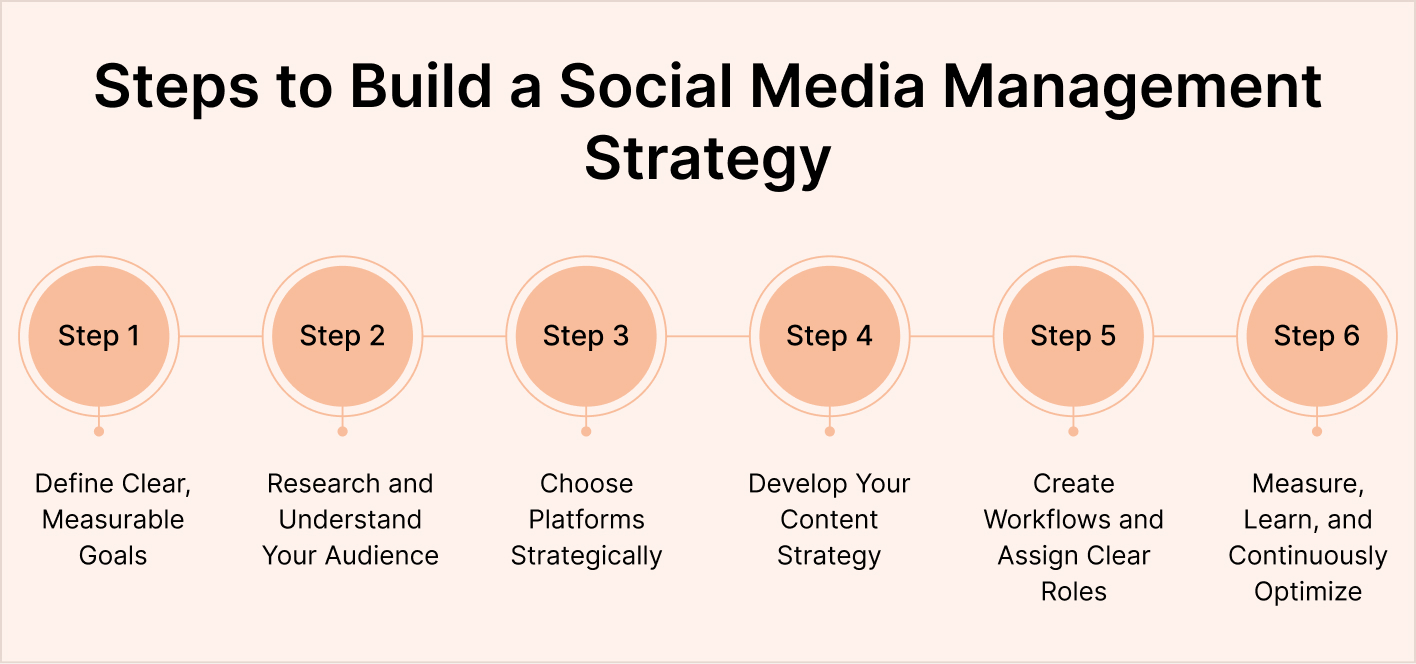
Step 1: Define Clear, Measurable Goals
Start with what you want social media to achieve for your business. Common objectives include increasing brand awareness, driving website traffic, generating qualified leads, supporting customer service, or building a loyal community. Each goal demands different content, metrics, and tactics.
Make your goals specific. “Increase brand awareness” becomes “grow Instagram followers by 25% and increase post reach by 40% within six months.” Specific goals guide daily decisions and make performance evaluation meaningful.
Step 2: Research and Understand Your Audience
Identify where your target audience spends time online and what content they engage with most. Analyze demographic data, interests, pain points, and platform preferences. Build audience personas that inform content creation and platform prioritization.
Use social listening to understand what your audience discusses, what questions they ask, and what competitor content resonates with them. This research prevents the costly mistake of creating content your audience does not want.
Step 3: Choose Platforms Strategically
Not every platform suits every business. A B2B software company may build a strong presence on LinkedIn while gaining little traction on TikTok. A direct-to-consumer retail brand may find Instagram and TikTok deliver the highest engagement.
Focus resources on platforms where your audience is most active and where your content format strengths align with platform dynamics. Managing two platforms well consistently outperforms managing five platforms poorly.
Step 4: Develop Your Content Strategy
Plan what types of content you will create, how frequently you will post, and what themes your content will address. Build a content calendar that maps out daily, weekly, and monthly publishing schedules.
Balance promotional content with educational, entertaining, and conversational posts. A common approach dedicates roughly 80% of content to providing audience value and 20% to direct promotion, though your ideal ratio depends on your audience expectations and industry norms.
Prioritize content formats that your team can produce consistently. A sustainable content strategy beats an ambitious one that collapses after the first month.
Step 5: Create Workflows and Assign Clear Roles
Define who creates content, who reviews and approves it, who publishes it, and who responds to engagement. Clear workflows prevent bottlenecks, ensure consistent quality, and create accountability across your team.
For multi-location businesses, establish exactly how local teams contribute to and execute the social media strategy. Document your processes so they survive staff changes and scale with business growth.
Step 6: Measure, Learn, and Continuously Optimize
Track your defined metrics on a regular cadence and analyze what the data tells you. Identify your highest-performing content types, best publishing times, and most responsive audience segments. Feed these insights back into your strategy to create a continuous improvement cycle.
Social media management is inherently iterative. The best strategies evolve based on real performance data, audience feedback, and platform changes rather than staying locked to assumptions made months earlier.
Essential Social Media Management Tools
The right tools amplify your team’s effectiveness, improve consistency, and enable smarter decisions. Here are the key categories every social media management workflow needs.
1. All-in-One Management Platforms
Social media management platforms like Hootsuite, Buffer, Sprout Social, and Sprinklr combine scheduling, publishing, analytics, and engagement tools in a single interface. These platforms save significant time by managing multiple accounts from one centralized dashboard.
For businesses operating in frontline industries, ContentBridge is a social media management platform specifically built for frontline workers. It provides specialized capabilities that generic tools lack, including centralized content libraries, automated approval workflows, role-based permissions, timezone-aware scheduling, and location-level performance analytics.
2. Content Creation Tools
Canva, Adobe Express, and CapCut simplify graphic design and video editing for social media teams. These tools provide platform-optimized templates that maintain visual quality without requiring professional design skills.
3. Analytics and Reporting Tools
Native platform analytics offer basic performance data. Third-party tools like Google Analytics, Brandwatch, and dedicated social analytics platforms deliver deeper insights, including cross-platform reporting, competitive benchmarking, sentiment analysis, and attribution modeling.
4. Social Listening Tools
Dedicated listening tools monitor brand mentions, industry keywords, and competitor activity across social platforms and the broader web. They surface patterns and insights at a scale that manual monitoring cannot match.
5. Collaboration and Workflow Tools
Platforms like Slack, Asana, and Trello coordinate team communication and task management around social media workflows. Integrating these tools with your management platform keeps teams aligned, reduces miscommunication, and streamlines the content production pipeline.
Social Media Management Trends Shaping 2026
The landscape continues to evolve rapidly. Staying ahead of these trends keeps your strategy competitive and your team prepared.
1. AI and Automation Transform Daily Workflows
AI tools now assist with content ideation, copywriting, image generation, scheduling optimization, and sentiment analysis. Social media managers who leverage AI effectively accomplish more with fewer resources while maintaining the quality their audiences expect.
However, AI augments human creativity and strategic judgment rather than replacing them. The relationship-driven, culturally aware aspects of social media management remain fundamentally human. The most effective teams use AI to handle repetitive tasks and surface insights while dedicating their human energy to strategy, creativity, and genuine engagement.
2. Social Commerce Merges Content and Sales
Social platforms increasingly enable direct purchasing without leaving the app. Instagram Shops, TikTok Shop, and Facebook Marketplace allow brands to convert social engagement into revenue seamlessly. Social media management now extends to managing product catalogs, shoppable posts, and social checkout experiences as part of the content workflow.
3. Short-Form Video Dominates Engagement
Reels, TikTok videos, and YouTube Shorts consistently outperform static images and text posts in engagement metrics. Short-form video drives significantly higher interaction rates, making video production capabilities a non-negotiable part of any serious social media management strategy.
4. Privacy and Data Governance Demand Attention
Evolving regulations and platform policy changes affect how brands collect data, target audiences, and measure campaign performance. Social media managers must stay current with privacy requirements like GDPR and emerging state-level regulations, adapting their tracking and targeting strategies as the rules shift.
4. Employee Advocacy Programs Expand Reach
Brands are increasingly empowering employees to share company content through their personal social accounts. These advocacy programs extend organic reach, add authenticity that branded accounts struggle to achieve, and multiply the impact of corporate social media efforts.
Managing these programs effectively requires clear guidelines, simple sharing tools, and governance frameworks that protect both the brand and the employee.
Common Social Media Management Mistakes to Avoid
Even experienced teams fall into patterns that limit their effectiveness. Recognizing these pitfalls early saves time, budget, and brand reputation.
- Posting without a strategy: Content without clear goals wastes resources and confuses your audience about what your brand stands for.
- Ignoring audience engagement: Treating social media as a one-way broadcast alienates followers who expect genuine interaction.
- Spreading across too many platforms: Dividing resources too thin leads to mediocre performance everywhere instead of strong results somewhere.
- Neglecting analytics: Without data, you cannot identify what works, what fails, or how to improve.
- Inconsistent branding: Mixed messaging, varying visual styles, and irregular posting schedules erode the trust that consistency builds.
- Delaying crisis response: Slow reactions to negative feedback or public issues amplify the damage exponentially.
- Skipping approval workflows: Especially for multi-location businesses, publishing unreviewed content risks brand damage that is far harder to repair than to prevent.
- Failing to adapt: Platform algorithms, audience preferences, and industry trends change constantly. Strategies that worked last year may underperform today.
Avoiding these mistakes does not require perfection. It requires a structured approach, clear accountability, and the willingness to let data guide your decisions rather than assumptions.
Overcome Social Media Challenges at Scale
Break down silos, reduce response delays, and manage compliance with AI-powered governance and collaboration tools.
ContentBridge — Built for Frontline Social Media at Scale
Social media management grows more complex as your business expands across teams, locations, and platforms. What starts as a manageable task for one person quickly becomes a coordination challenge that demands purpose-built solutions.
ContentBridge is a frontline-focused social media management platform designed for businesses operating across multiple locations. It centralizes content distribution so every team works from the same asset library. It automates scheduling across time zones so posts go live at the right local time. And it provides the approval workflows, role-based permissions, and location-level analytics that keep your brand consistent while giving local teams the flexibility to stay relevant.
Local teams access approved content through mobile-first interfaces designed for frontline workers, not just office-based marketers. Designated approvers review submissions before anything is published. Performance analytics break down results by location, region, and team, so you always know what is working and where support is needed.
Request a demo to see how ContentBridge simplifies social media management for distributed teams.
Frequently Asked Questions
How is social media management different from social media marketing?
Social media management handles the ongoing maintenance and growth of your social presence, including daily posting, community engagement, content scheduling, and reputation monitoring. Social media marketing focuses on promotional campaigns, paid advertising, and conversion-driven strategies. Management provides the consistent foundation that makes marketing campaigns more effective when you run them.
How much time does social media management require?
Time commitment varies based on business size, number of platforms, and strategic goals. Small businesses typically invest one to three hours daily managing their social accounts effectively. Larger organizations with multiple platforms and locations often require dedicated team members or departments. Specialized tools like ContentBridge significantly reduce coordination time for multi-location businesses.
When should a business hire a dedicated social media manager?
Consider hiring when social media tasks consistently take time away from core business functions, when inconsistent posting begins affecting brand perception, or when you lack the in-house expertise to execute a strategic approach. Businesses managing multiple locations or scaling their social presence rapidly benefit especially from dedicated social media management resources and purpose-built coordination tools.
Why is social media management important for businesses?
Social media management is crucial for businesses as it helps build a consistent and strategic online presence, engage with customers, and increase brand awareness. It ensures timely responses, fosters customer relationships, and enables businesses to track and optimize performance, all while aligning social media efforts with broader marketing and business goals.
Can small businesses benefit from social media management?
Yes, small businesses can significantly benefit from social media management by building brand recognition, directly engaging with customers, and generating leads even with limited budgets. A structured approach allows small businesses to make the most of their resources, maintain consistent content, and track performance to optimize their efforts over time.
What are the biggest challenges in social media management?
The biggest challenges in social media management include maintaining consistency across multiple platforms, creating engaging content, responding quickly to customer inquiries, managing negative feedback, and staying updated with evolving algorithms and trends. As businesses scale, coordinating teams and maintaining a consistent brand voice can also become more complex.
How do you measure the success of social media management?
The success of social media management is measured through key performance indicators such as engagement rate, reach, follower growth, website traffic, lead generation, and conversions. These metrics provide insights into how well social media efforts are driving business goals, whether for brand awareness, engagement, or revenue generation.