

Your hospital’s social media team created the perfect patient success story. The narrative highlights recovery and hope beautifully. The video shows genuine emotion that resonates with your audience. But before publishing, one critical question emerges: Is this content HIPAA compliant?
Every day, hospitals navigate a complex compliance landscape where one accidental oversight can trigger regulatory enforcement and patient trust loss. Social media platforms amplify the risk because content spreads instantly. Deleted posts leave digital traces. Patient identifiers hide in the backgrounds of photos. Comments and user-generated content create exposure points that teams cannot always control.
A significant number of people now select hospitals based on social media presence. This engagement opportunity carries serious compliance responsibility. Healthcare organizations cannot ignore social media, yet many lack systematic compliance processes.
This blog explains how to build HIPAA-compliant hospital social media operations. Learn the specific compliance framework that protects patient privacy while enabling authentic engagement. You will discover the pre-publishing workflow that catches violations before posts go live. Most importantly, you will understand how to train your team to embed compliance into daily operations.
Why HIPAA Compliance Matters for Hospital Social Media
Hospital social media has unique compliance challenges. Patient privacy regulations do not pause for marketing goals. Understanding these stakes helps justify investment in compliance infrastructure.
- Social media amplifies privacy risks: Protected Health Information covers far more than names, including ages, locations, dates of service, and patient photos. The HHS Office for Civil Rights treats accidental disclosures as seriously as intentional breaches.
- Patient trust depends on privacy protection: A compliance breach damages trust irreversibly, and affected patients share negative experiences that influence hospital reputation for years.
- Regulatory pressure continues increasing: Agencies are monitoring hospital social media more closely than ever, and patient complaints trigger investigations regardless of organization size.
- Financial penalties are significant: Fines for social media violations range from thousands to hundreds of thousands of dollars. Prevention is far more cost-effective than defense.
- Employee confidence is at stake: Staff watches how hospitals handle privacy, and organizations that take compliance seriously attract and retain stronger talent.
Building systematic compliance processes now protects patient trust, avoids costly investigations, and ensures engagement and privacy work together rather than against each other. A strong foundation in healthcare social media management makes that possible without sacrificing engagement.
Understanding HIPAA Identifiers: What Cannot Be Posted
Hospitals cannot post content containing HIPAA identifiers without patient authorization. The HIPAA Privacy Rule defines 18 specific data elements that must be removed for proper de-identification. Understanding these identifiers is the foundation of compliance screening.
1. Personal Information and Demographics
Patient names, initials, birth dates, ages, social security numbers, and medical record numbers must never appear in social media posts without authorization. Even first names alone can re-identify patients in small communities, and combining any two identifiers significantly increases re-identification risk.
2. Location, Contact, and Provider Details
Address information beyond the state level, telephone numbers, email addresses, and patient-identifying URLs are all prohibited. Healthcare provider identifiers, hospital names in background signage, and facility names in captions must also be removed as they create context clues that compromise de-identification.
3. Treatment Dates and Clinical Information
Specific treatment dates, admission and discharge dates, and encounter dates cannot be shared freely. General timeframes work better than exact dates, and a patient’s age, combined with their condition and treatment timeline, can easily re-identify them in a local community.
4. Visual and Digital Identifiers
Examine all visual content for whiteboards with patient information, visible wristbands, facility signage, license plates, tattoos, and reflections in medical equipment. IP addresses, device serial numbers, and medical device identifiers also create tracking pathways, and location metadata on mobile uploads must always be stripped.
5. Third-Party and User-Generated Content
Patient-provided content, reposts, tags, mentions, and comments all require the same systematic screening as hospital-created content. When your hospital shares someone else’s content, you assume full compliance responsibility, and comments under reposted content must be actively moderated.
6. Screening Content for Hidden Identifiers
Every piece of content must go through systematic text, photo, and video screening against all 18 identifiers before publishing. A thorough approach to patient data protection on hospital social media starts at this screening stage. Before-and-after photos deserve particular scrutiny as they often combine identifying characteristics, and backgrounds, reflections, and timestamps frequently contain overlooked PHI.
These 18 identifiers interact and compound risk in ways that are easy to overlook. One identifier alone may not re-identify a patient, but multiple identifiers together create clear pathways. Systematic screening of all content against every potential identifier before publishing is the only reliable way to maintain compliance.
Automate HIPAA Screening for Every Hospital Social Media Post
ContentBridge flags potential HIPAA identifiers before your team publishes anything to Facebook, Instagram, or TikTok.
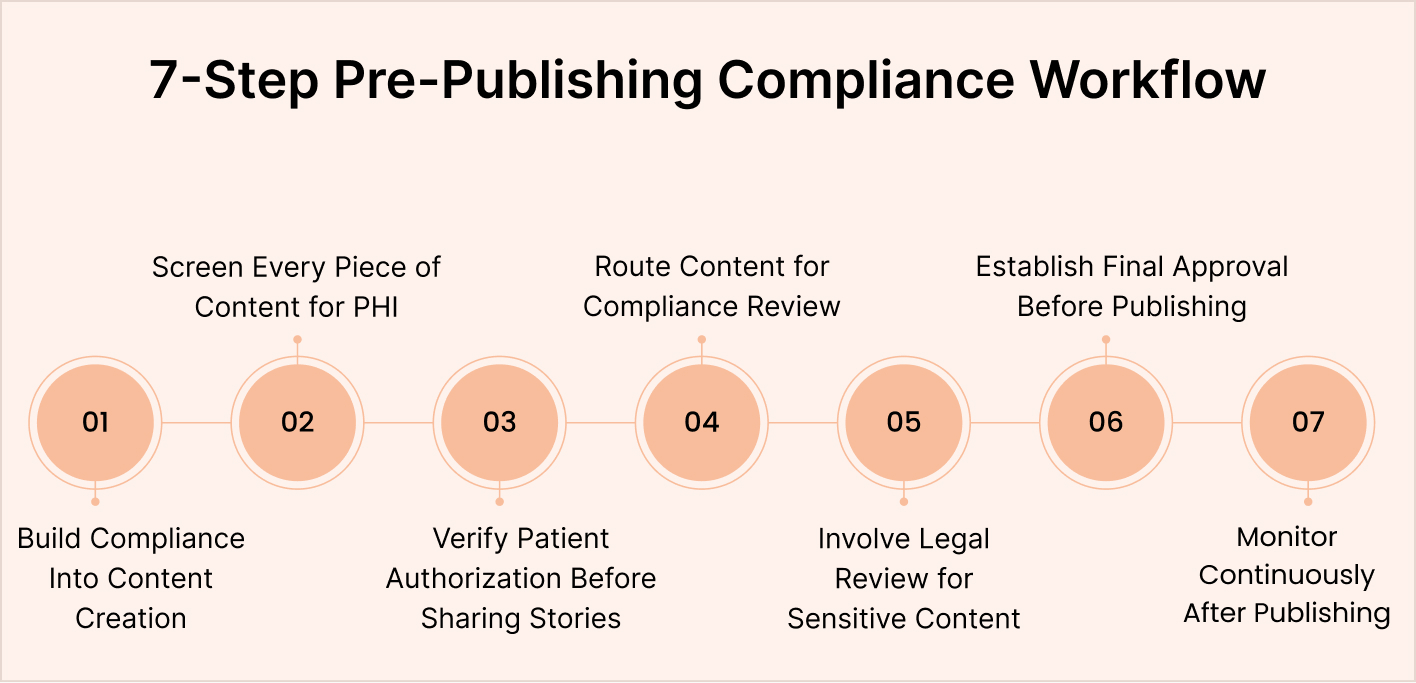
7-Step Pre-Publishing Compliance Workflow for Hospital Social Media
Hospitals need systematic processes that catch compliance issues before posts go live. Ad-hoc review fails at scale, and structured workflows ensure consistent compliance across all content types.
Step 1: Build Compliance Into Content Creation From Day One
Train marketing teams on HIPAA requirements before they write any social content and provide templates that embed compliance guardrails from the start. Organizations that train hospital staff HIPAA compliant social media practices early avoid costly remediation later. Part of this early preparation is to build a compliance-first content calendar for your hospital before your publishing volume grows. Establish content categories with different review requirements, as promotional posts carry minimal risk while patient testimonials require substantial compliance review.
Step 2: Screen Every Piece of Content for PHI
Designated screeners must review all content against the 18 HIPAA identifiers immediately after creation. This screening step is the primary mechanism to prevent HIPAA violations before posting patient content, and it requires trained reviewers who understand how identifiers combine to create risk. Screen text word by word for names, dates, and healthcare identifiers, and examine visual content for background whiteboards, visible equipment, signage, and location metadata. Document every review to create an audit trail.
Step 3: Verify Patient Authorization Before Sharing Stories
Obtain written, signed consent that describes exactly what will be shared, on which platform, and for what purpose. Authorization must be platform-specific, include revocation language, and be retained for the lifespan of the post plus additional years. When you train hospital staff on HIPAA-compliant social media, authorization collection should be a core module, not a side note. Show patients the exact content they are approving whenever possible.
Step 4: Route Content Through Compliance Officer Review
A designated HIPAA compliance officer should review content after PHI screening to assess overall risk and catch screening oversights. Even when no explicit identifiers appear, combinations of elements can enable re-identification. Uncertain or borderline content should always be escalated to legal review.
ContentBridge is a healthcare social media management platform that helps achieve this objective with its tailored healthcare social media approval workflows. ContentBridge enables you to route social media posts for review ot the right team to ensure no unauthorized post goes live.
Step 5: Involve Legal Review for Sensitive Content
Patient testimonials with clinical details, treatment outcome claims, and responses to negative reviews all warrant legal scrutiny. Legal review focuses on potential liability and often catches privacy issues that compliance review missed, adding an essential layer of institutional accountability. As part of this review, legal should ensure treatment claims also meet FDA and FTC requirements, not just HIPAA standards.
Step 6: Establish Final Approval Before Publishing
Use scheduling tools that allow content staging, and create a publishing checklist confirming every approval is documented in writing. Track which team member published each piece of content to ensure accountability. Without this documentation, organizations struggle with maintaining post approval audit trails that regulators expect.
Step 7: Monitor Continuously After Publishing
Compliance does not end at publication. Monitor posts for comments that expose PHI, watch for tags and mentions that reveal patient information, and redirect direct message inquiries containing health questions to secure authorized channels. Document all problematic interactions and actions taken.
A structured compliance workflow protects your organization at every stage of the content lifecycle, and enabling nursing staff to create compliant social media content is one of the highest-impact ways to build both volume and trust within these workflows. Without structured workflows, social media approvals fail frontline teams, leaving compliance gaps that grow over time. Hospitals that invest in these seven steps will publish with confidence, reduce regulatory risk, and build a social media presence that patients and staff trust completely.
Streamline HIPAA Compliance Across Your Hospital Social Media Team
ContentBridge automates multi-step approval workflows so every post goes through a complete compliance review before publishing.
Common Compliance Pitfalls and How to Avoid Them
Hospitals make recurring compliance mistakes across the industry. Learning from common pitfalls prevents errors in your operations. Understanding these risks helps leadership prioritize compliance investment.
Pitfall 1: Assuming First Names Are Safe
Many hospitals mistakenly believe that using only first names protects privacy. First names combined with other details can re-identify patients. A patient’s first name with their diagnosis or location creates identification risk. Even first-name-only posts may constitute violations in small communities.
How to Overcome:
- Remove or generalize all personal identifiers.
- Use job titles rather than names.
- Describe roles rather than specific individuals.
- Generalize locations beyond the city level.
- Avoid combining any personal information that enables re-identification.
Pitfall 2: Overlooking Background Details in Photos
Hospital staff often focus on the main subject while missing background identifiers. Whiteboards with patient information appear frequently in healthcare photos. Patient wristbands show in group photos. Medical equipment displays patient information. Calendars show specific dates. Learning to prevent HIPAA violations before posting requires training every reviewer to scan for these visual details.
How to Overcome:
- Review photo backgrounds with the same scrutiny as the main subjects.
- Blur whiteboards and equipment displays before posting.
- Use generic backgrounds when possible.
- Obtain professional photography that avoids background hazards.
- Review video frame-by-frame for background details.
Pitfall 3: Not Screening Comments and Replies
Hospitals sometimes monitor only their own posts without reviewing user comments. Comments from other users can expose significant PHI. Replies to your posts can reference sensitive information. Third-party content exposes your hospital to compliance risk.
How to Overcome:
- Monitor comments with equal rigor to original posts.
- Remove comments containing PHI immediately.
- Establish a 24/7 comment review.
- Train staff to identify and escalate potential PHI.
- Create clear procedures for comment removal and documentation.
Pitfall 4: Mixing Personal and Professional Accounts
Employees sometimes post hospital information from personal accounts. Personal accounts lack compliance oversight. Hospital leadership cannot audit personal social media. Compliance violations spread beyond organizational reach. This is one of the many reasons frontline teams social media passwords represent a compliance disaster waiting to happen.
How to Overcome:
- Establish clear policies prohibiting hospital content on personal accounts.
- Create hospital-approved social accounts for authorized staff.
- Prohibit sharing of hospital login credentials.
- Train employees about personal account risks.
- Make compliance expectations clear in hiring.
Pitfall 5: Treating De-Identification as Automatic Safety
Hospitals sometimes assume that removing obvious identifiers prevents HIPAA violations. De-identification requires removing all identifiable information. Even heavily redacted photos can be re-identified through analysis. Contextual clues combine to enable re-identification.
How to Overcome:
- Apply the 18-identifier standard systematically.
- Remove not just obvious identifiers but contextual clues.
- Have compliance professionals review de-identification decisions.
- Avoid assuming any information is automatically safe.
- Document de-identification methods applied.
Authorization Best Practices for Hospital Social Media Post
Patient testimonials and success stories create powerful engagement. However, hospitals must obtain proper authorization before publishing patient-identifiable content. Understanding authorization best practices prevents compliance violations.
1. Make Every Authorization Specific and Detailed
Generic permission forms do not satisfy HIPAA requirements. Show patients the exact post, image, or video you want to share and specify the platform, purpose, and duration of posting. Patients deserve full transparency about where their information will appear and how it will be used.
2. Require Written Authorization Only
Verbal agreements, direct messages, and unsecured emails are not sufficient for HIPAA compliance. Obtain formal written authorization with patient or electronic signatures, store documents securely, and link each authorization to its specific post for quick retrieval during audits or investigations.
3. Build Authorization Into Your Content Planning
Treat authorization as part of the process rather than an afterthought. Planning early makes it possible to share patient stories without HIPAA risk at every stage. Allow adequate time for patient consideration, make discussions conversational rather than transactional, and answer all concerns about privacy and visibility.
4. Establish Clear Revocation and Takedown Procedures
Patients have the right to revoke authorization at any time, and hospitals must remove content immediately without requiring additional justification. Create a tracking system that prevents accidental reposting of revoked content and provides patients with prompt confirmation once removal is complete.
5. Retain Authorization Records Indefinitely
Even if posts are deleted, authorization documents must remain accessible. Regulatory investigations may require these records years later, so organize them by patient name and link content with clear marking of any revoked authorizations.
A well-documented authorization process protects both your patients and your organization. Hospitals that build specific, transparent, and easily retrievable authorization practices will maintain compliance confidently while continuing to share the patient stories that drive meaningful engagement.
Manage Patient Authorizations Securely With ContentBridge
Store signed authorizations, track revocations, and link consent forms to specific social posts with complete audit trails.
How ContentBridge Simplifies HIPAA Compliance for Hospital Social Media
Hospital social media compliance requires systematic processes that scale across all team members and locations. ContentBridge is a frontline social media management platform purpose-built for large healthcare organizations. The platform builds the 18-identifier screening standard into every review, flags potential PHI before posts go live, and combines automated screening with guided human review to catch more violations than either approach alone.
ContentBridge streamlines every layer of your compliance workflow. Role-based approval routes content through marketing, compliance reviewers, and final officer approval, so nothing reaches your social accounts without proper authorization. Patient authorization management is built in, allowing teams to store signed consents securely, link them to specific posts, track revocation requests, and document takedowns automatically. After publishing, real-time comment moderation flags potential PHI and removes problematic content with full audit trail documentation.
Request a demo today to see how ContentBridge helps hospital teams maintain HIPAA compliance while building authentic community engagement.
Frequently Asked Questions
What counts as a HIPAA violation in a social media post?
Any disclosure of protected health information without patient authorization may constitute a HIPAA violation. This includes patient names, medical conditions, dates of service, ages in context, location information, and any combination of details enabling patient re-identification. Even acknowledging someone as a patient through likes or replies can be violations. Background details in photos and metadata also count.
Can hospitals share patient testimonials on social media legally?
Hospitals can share patient testimonials only with written patient authorization. The authorization must be specific, showing exactly what content will be posted where. Authorization must describe the patient’s right to revoke permission. Patients must receive the opportunity to review the exact post before it is published. Without proper authorization, testimonial sharing violates HIPAA.
What happens if a hospital accidentally posts PHI?
If a hospital posts protected health information, immediate removal is essential. The post must be deleted from all platforms immediately. Compliance officers must document what was posted and how long it was visible. If significant PHI was exposed to many people, breach notification to affected patients may be required under HIPAA. The hospital should conduct an incident investigation to prevent recurrence.
How often should hospitals audit social media compliance?
Hospitals should establish ongoing compliance monitoring rather than periodic audits alone. Real-time monitoring of posts and comments enables early detection of problems. Formal compliance audits should occur quarterly or semi-annually. Additional audits should follow any incident. Continuous monitoring catches violations faster than annual reviews.
What should a hospital social media compliance policy include?
A comprehensive policy covers content creation standards, review and approval workflows, patient authorization requirements, monitoring procedures, incident response protocols, and training requirements. The policy should address personal account usage, third-party content responsibilities, and comment moderation procedures. Include specific roles and responsibilities. Define escalation procedures for compliance questions. Document policies clearly so all staff understand expectations.
Which team members should receive HIPAA compliance training?
Every team member posting hospital content needs compliance training. This includes marketing staff, communications teams, administrative staff, and frontline employees. Patient-facing staff should understand how to handle social media inquiries. Leadership should understand compliance obligations. New hires need training before posting anything. Annual refresher training keeps compliance top of mind.