

Healthcare marketing departments face overwhelming demand for social media content. Corporate teams struggle to create enough posts to maintain active, engaging hospital social accounts. Traditional marketing approaches produce clinically correct but emotionally disconnected content. Patients skip over generic health information to find authentic advice from real healthcare providers.
The solution is surprisingly simple: empower nursing staff to create patient education content directly. Nurses understand patient fears, know common health misconceptions, and communicate in an accessible language naturally. One nurse explaining post-surgery recovery in plain terms outperforms marketing departments’ spending hours perfecting clinical messaging. Authentic nurse-created content resonates with audiences searching for trustworthy health information online.
According to Media Market, 60% of patients now use social media to research healthcare decisions. Patients actively seek real healthcare providers sharing authentic expertise. Hospital social media accounts with nurse contributors achieve engagement rates 2-3x higher than traditional marketing content.
This guide explains how to enable nursing staff to create social media content at scale across your hospital network. Knowing how nurses capture social media content in the field is the starting point for any effective program.
You will find frameworks for recruiting nurse content creators, building social media policies that protect patient privacy under PIPEDA and provincial health privacy legislation, and establishing approval workflows that scale. Learn to overcome participation barriers, set professional boundaries, and transform nursing expertise into social media content that builds patient trust and drives engagement.
Why Nurse-Created Content Outperforms Marketing Department Posts
Hospital marketing departments create clinically accurate but often sterile patient education content. Nurses spend their careers explaining medical concepts to frightened patients, families, and people with varying education levels. This difference in audience understanding creates dramatically different content quality and engagement.
1. Authentic Expertise Builds Trust Instantly
Patients trust healthcare providers more than hospital marketing teams. A post from an ICU nurse explaining sepsis symptoms carries a different weight than generic marketing content. Real clinicians sharing real experience resonate with audiences seeking genuine health information, and the organic engagement this creates provides more value than any promotion budget could deliver.
2. Accessible Language Reaches Broader Audiences
Nurses speak patient language naturally from daily practice. Marketing professionals, though well-intentioned, often default to clinical terminology that confuses general audiences. Accessible content reaches patients with lower health literacy levels, and video demonstrations from nurses showing actual techniques consistently outperform illustrated guides.
3. Real-Time Patient Questions Generate Responsive Content
Nurses encounter patient questions throughout daily shifts that reveal exactly what patients worry about and what information gaps exist. Nurse-created content addressing these real concerns gets higher engagement because patients recognize the relevance, creating strong signals that algorithms reward. Failing to capture these insights is one reason enterprises miss frontline moments on social media entirely.
4. Diversity of Specialties Expands Content Scope
Large hospitals employ nurses across dozens of specialties, and each brings unique expertise and content creation opportunities. Marketing departments cannot maintain knowledge across all medical areas, but nurse content creators provide specialized depth that attracts different audience segments and improves overall program reach.
When nursing expertise meets social media strategy, the result is patient education content that feels real, ranks better, and earns trust that no amount of polished marketing can replicate. A strong healthcare social media management strategy ensures this advantage translates into sustainable program growth.
Equip Your Nurses to Create Patient Education Content
ContentBridge provides everything nurses need to create compliant, engaging social media content without burdening already-stretched marketing teams.
What Types of Social Media Content Can Nurses Safely Create
Understanding which content types work best helps nursing staff contribute confidently and gives compliance teams clearer review criteria. Not all social media content carries the same risk profile, and categorizing content by type helps nurses, approvers, and privacy officers move faster through the review process.
1. Patient Education and Health Awareness Content
Short-form videos where nurses explain common health concepts perform exceptionally well on platforms like Instagram Reels and TikTok. Nurses can create content covering:
- Condition explainers. Symptoms to watch for, when to seek care, and what to expect during treatment.
- Procedure preparation guides. Step-by-step content that reduces patient anxiety before common procedures.
- Medication education. Dosage timing, common side effects, and tips for adherence.
- Seasonal health campaigns. Flu prevention, heat safety, back-to-school immunizations, and other timely topics that generate consistent engagement year-round.
This content works because nurses use the same plain language they use at the bedside. Frame all posts as general education rather than medical advice, and include a disclaimer in every piece of content published.
2. Behind-the-Scenes and Team Spotlight Content
Audiences respond strongly to content that humanizes healthcare organizations. Nurses can share team celebrations, work milestones, and day-in-the-life content that showcases the dedication behind patient care. Staff spotlight posts featuring a nurse’s career journey or specialty expertise build community connection and support recruitment efforts.
The key constraint is location: film in approved areas only, never in active patient care zones, and ensure no patient information, medical charts, or identifying details appear in the background of any photo or video.
3. Myth-Busting and Health Misinformation Correction
Nurses encounter health misinformation from patients daily. Turning these misconceptions into social media content, where a nurse explains why a common belief is incorrect and provides the evidence-based reality, generates strong engagement and positions your hospital as a credible information source.
This content type also supports public health goals by correcting misinformation before it leads to harm. Keep myth-busting posts focused on one misconception per video or carousel for maximum clarity and shareability.
Content Boundaries Every Nurse Creator Should Know
Certain content types create unacceptable risk regardless of intent. Nurses should never share identifiable patient information, even if the patient gives verbal permission, as documented meaningful consent under PIPEDA and applicable provincial health privacy legislation is required. When patient stories are part of your program, follow a guide to gathering patient stories from nurses with proper consent before any content is drafted.
Avoid photographing clinical areas where patient data may be visible on screens or charts. Never post content that could constitute medical advice for a specific condition. Always cover or blur identification badges in photos to protect personal safety and organizational security. When in doubt, the compliance checklist in your hospital’s social media policy should be the deciding factor.
Clear content categories give nurses a starting framework and reduce the guesswork that prevents participation. Hospitals that define approved content types see higher submission rates and fewer revision cycles, because nurses know exactly what to create and reviewers know exactly what to approve.
6 Barriers That Stop Nurses From Creating Social Media Content
Most hospitals cannot activate 300+ nursing staff for content creation. Not because nurses lack willingness, but because organizational barriers prevent participation. Identifying and removing these barriers transforms potential into action.
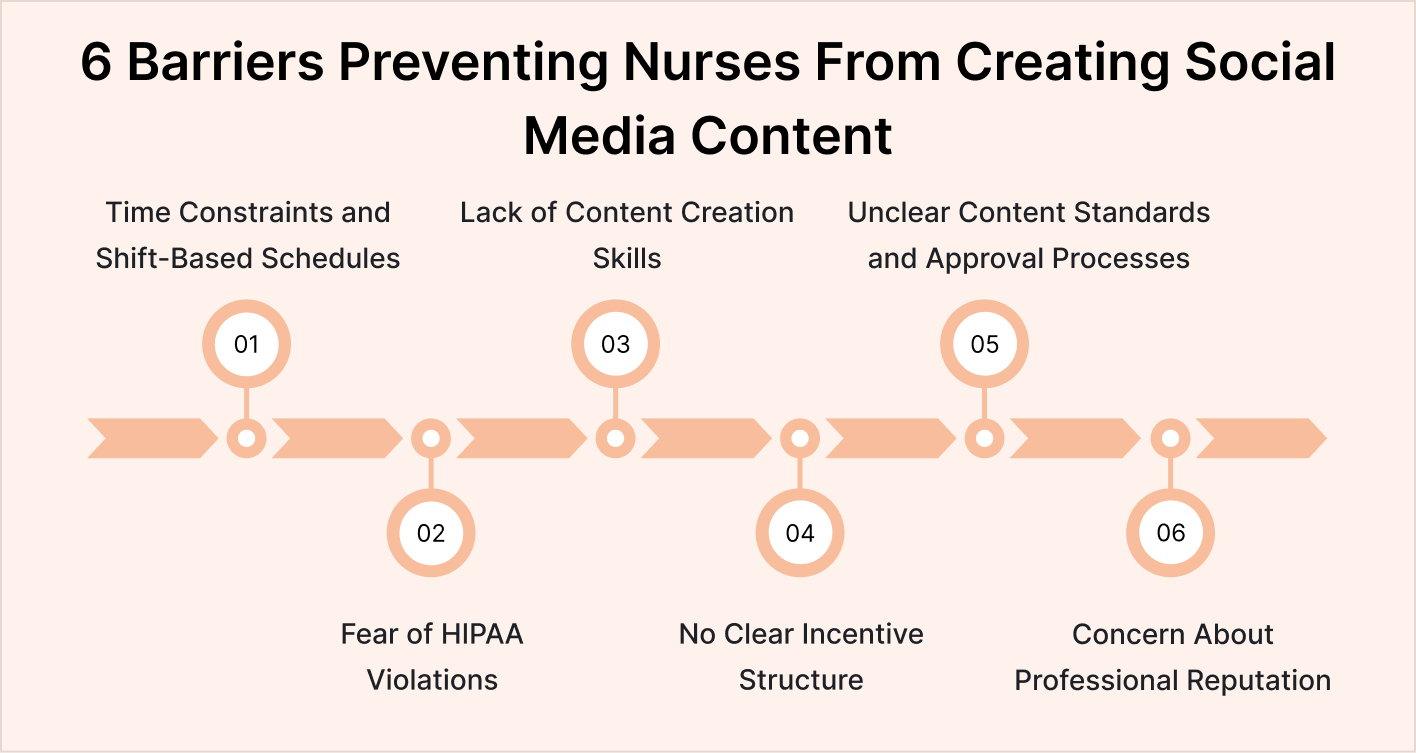
1. Time Constraints and Shift-Based Schedules
Nurses work demanding schedules with limited downtime, and adding content creation to already-full workloads faces natural resistance. Traditional training assumes office hours, but healthcare staff work evenings, nights, weekends, and rotating schedules. Programs must accommodate this complexity and prioritize mobile-first tools that fit into frontline workflows.
2. Fear of Privacy and Compliance Violations
Without clear guidelines explaining what is permissible under PIPEDA and provincial health privacy legislation, nurses default to caution that prevents participation entirely. One compliance mistake creates liability concerns that far exceed any content benefit. Knowing how to prevent HIPAA violations before posting patient content removes the single biggest barrier to nurse participation.
A well-defined social media policy with specific examples of what can and cannot be shared, clear compliance checklists, and rapid approval processes build the confidence nurses need to participate safely.
3. Lack of Content Creation Skills and Confidence
Most nurses received no training in video production or social media content creation, and technical fears about platform navigation create real participation barriers. Hands-on training during work hours, short video tutorials, and peer mentoring from nurse champions solve these skill gaps quickly and build confidence among watching colleagues.
4. No Clear Incentive Structure
Hospitals often ask nurses to contribute unpaid labour beyond their job descriptions, and without recognition or compensation, motivation fades quickly. Connecting content creation to continuing education credits, recognition programs, or performance evaluations shifts participation from an unpaid favour to a valued contribution.
Without these incentives, frontline teams struggle with content creation regardless of their expertise.
5. Unclear Content Standards and Approval Processes
Vague guidelines about what content is acceptable create paralysis, and slow approval timelines discourage future submissions. A streamlined submission portal for frontline healthcare content removes both problems by giving nurses a clear path from capture to approval. Streamlined workflows with clear decision criteria, fast turnaround, and constructive feedback when content gets revised reduce rejection rates and keep nurses motivated to contribute.
6. Concern About Professional Image and Reputation
Nurses worry about maintaining their professional reputation on platforms where mistakes circulate widely. Social media posts have led to disciplinary action, job loss, and regulatory complaints against nurses in Canada and internationally. These consequences are well known within the profession, and they make many nurses cautious about any social media participation, even through official hospital channels.
Training on professional boundaries addresses these fears directly. Nurses should understand the distinction between personal social media accounts and content created through an institutional program with compliance review.
Guidelines on maintaining boundaries with patients online, avoiding connections that blur the nurse-patient relationship, and separating personal opinions from institutional content give nurses the clarity they need. Peer support networks and a culture that respects those who choose not to participate help address remaining concerns without creating resentment among less-digital staff.
Every barrier preventing nurse participation has a practical solution. These barriers mirror the broader reasons frontline teams avoid social media programs even when they want to. Hospitals that proactively address time constraints, compliance fears, skill gaps, and incentive structures will unlock a content creation workforce that no marketing department can replicate on its own.
A Framework for Scaling Nurse Content Programs Across Staff
Successfully scaling programs across 300+ staff requires systematic frameworks addressing participation barriers. This proven approach works across different hospital sizes and specialties.
Phase 1: Launch a Nurse Social Media Ambassador Program
Start by recruiting 10 to 15 digitally savvy nurse ambassadors representing different departments and shifts. This core group forms your social media ambassador program, a structured initiative that gives nurse content creators clear roles, training, and organizational support.
This core group forms your social media ambassador program, a structured initiative that gives nurse content creators clear roles, training, and organizational support. Learn more about how hospitals build safe content sharing programs for all staff, not just nursing teams.
Phase 2: Create Branded Content Templates
Invest in Canva or Adobe Express templates that reduce creation barriers for common content types like condition explainers, procedure guides, and medication education. Pre-formatted templates with hospital branding and built-in prompts transform content creation from intimidating to manageable without requiring design skills.
Phase 3: Establish Clear Clinical Review Processes
Create streamlined workflows where clinical, compliance, and brand reviews happen in parallel rather than sequentially, with most reviews completing within 24 hours. Without this parallel approach, frontline content often dies in approval bottlenecks before it ever reaches your audience. Clear decision criteria, quick feedback loops, and constructive revision notes build participation confidence and increase submission rates over time.
You can use a healthcare-focused social media management tool like ContentBridge to streamline content review and approvals. ContentBridge’s custom approval workflows help nursing staff to easily share their content for review and compliance teams to review the content and approve/reject it.
Phase 4: Launch Peer Mentoring and Support Systems
Champions mentor peers one-on-one through their first submissions, providing personal support that reduces anxiety and normalizes content creation as expected hospital practice. Creating digital and in-person communities where nurses discuss ideas and celebrate high-performing posts transforms content creation from an individual task into a team activity.
Phase 5: Develop Ongoing Training and Reinforcement
Deliver quarterly refresher training through recorded modules, in-person sessions, and on-demand materials that accommodate shift schedules. Resources that train staff on compliant social media practices help standardize expectations across departments. Cover platform-specific best practices, trending health topics, and engagement strategies to maintain participation momentum and onboard new hires seamlessly.
Phase 6: Establish Recognition and Incentive Programs
Publicly celebrate contributors through monthly recognition, tie participation to continuing education credits, and share program metrics widely. When nurses see hundreds of colleagues participating and leaders acknowledging success, content creation shifts from an extra task into a valued contribution.
A phased approach ensures your program scales without overwhelming staff or sacrificing content quality. Hospitals that commit to each phase build a self-sustaining content engine powered by the clinical expertise that only frontline nurses can provide.
Build a Sustainable Social Media Content Program With ContentBridge
ContentBridge handles templates, training, clinical review workflows, and staff recognition, making program scaling manageable and successful.
Privacy Compliance Framework for Nurse-Created Social Media Content
Clinical accuracy matters less than compliance in healthcare social media. One privacy breach creates liability exceeding any engagement benefit.
In Canada, PIPEDA governs the collection, use, and disclosure of personal information in commercial activities, while provincial health privacy legislation such as PHIPA in Ontario, HIA in Alberta, and PHIA in Manitoba adds additional protections for personal health information. Organizations should consult legal counsel to verify their specific obligations under both federal and provincial legislation.
Understanding the compliance risks of frontline social media helps hospitals establish clear compliance frameworks that enable confident content creation.
1. Essential Compliance Principles
Never include any patient-identifiable information without documented meaningful consent as required under PIPEDA and applicable provincial health privacy legislation.
- Use only stock photography or staged scenarios.
- Avoid filming actual clinical settings unless fully cleared by your privacy and communications teams.
- Never diagnose, prescribe, or recommend specific treatments. Frame all content as general education, not medical advice.
- Include disclaimers: “This content is for educational purposes only and is not medical advice.”
These principles create safe boundaries for nurse content creation. Clear guidelines reduce uncertainty. Templates incorporating compliance language prevent inadvertent mistakes. Nurses who are confident about what is permissible create more content.
2. Content Approval Checklist
Create a simple compliance checklist for nurses to complete before submission:
- No patient names, medical record numbers, birthdates, or other personal health information as defined under PIPEDA and applicable provincial legislation.
- Content presents general information, not specific diagnosis or treatment recommendations.
- Footage shows staged scenarios or approved clinical areas only.
- Content falls within the nurse’s scope of practice and specialty area.
- Claim sources cite evidence-based references or peer-reviewed research.
- Disclaimer language appears in the post description or video.
- Content aligns with hospital clinical standards and guidelines.
Checklist completion becomes a content submission prerequisite. Visual simplicity increases compliance. Nurses gain confidence reviewing their own work against clear criteria.
3. Tiered Review Process
Tiered review speeds processing without sacrificing safety. Simple content (symptom awareness, self-care tips, general health promotion) receives a basic compliance review. Moderate content (procedure preparation, medication education, lifestyle management) receives a clinical plus compliance review. Complex content (treatment comparisons, disease management, medical claims) receives a three-layer review.
Clear criteria determine tier assignment. Nurses submitting pre-checked content meet expectations. Tiered review handles volume better than identical review processes for all content.
4. Feedback and Revision Process
When content requires changes, provide specific feedback explaining issues. Offer revision suggestions demonstrating exactly what requires change. Fast revision turnaround keeps submission momentum strong. Tracking revisions shows which content types commonly need changes, informing future template improvements.
Constructive feedback encourages future submissions. Harsh rejection discourages participation. Framing feedback as an improvement opportunity rather than failure builds a culture of continuous learning.
5. Building a Social Media Policy for Nurse Content Programs
A formal social media policy is the foundation of any nurse content program. Without one, nurses rely on informal guidance that varies by department and creates inconsistent expectations. Your policy should define who is authorized to create content, which platforms are approved, what content types are permitted, and how the approval workflow operates.
Include clear guidance on professional boundaries: whether nurses may connect with patients on personal social media accounts, how to handle patient inquiries that arrive through social channels, and the distinction between personal posts and institutional content.
Address posting during work hours explicitly, as many nurses assume all social media use during shifts is prohibited when the real restriction applies only to personal accounts.
The policy should reference PIPEDA and your province’s health privacy legislation by name, explain the consent requirements for any content involving identifiable individuals, and outline consequences for violations. Review the policy annually and update it as platforms, regulations, and organizational needs evolve.
Distributing the policy during onboarding and requiring annual acknowledgement ensures every nurse understands the expectations before creating content. A platform like ContentBridge can enforce policy requirements directly within the submission workflow, so compliance checks happen before content ever reaches a reviewer.
How to Measure Nurse Content Program Success and Scale Impact
Metrics track program performance and identify scaling opportunities. Clear measurement shows impact and justifies continued investment.
1. Track Engagement to Prove Content Performance
Track posts submitted and published monthly, and compare engagement rates for nurse-created content against marketing department posts. Most hospitals find nurse content outperforms corporate posts by two to three times. Declining submissions signal emerging barriers, while increasing engagement confirms authentic content is resonating.
2. Monitor Compliance to Build Participation Confidence
Monitor approval rates, revision requirements, and approval timeframes to identify template gaps or workflow bottlenecks. Publishing a strong safety record with zero compliance violations builds confidence among hesitant staff considering participation.
3. Measure Reach to Show Impact Beyond Engagement
Track follower growth correlated with nurse content introduction and monitor hashtag performance to identify trending topics. Analysing which specialty areas generate the strongest community response reveals impact beyond basic engagement numbers.
4. Watch Scaling Indicators That Predict Long-Term Growth
Survey participating nurses quarterly to monitor satisfaction and identify barriers. Track cross-departmental growth rates to identify best practices and underperforming areas.
Knowing how to prove healthcare social media ROI strengthens the case for continued investment. When nurses begin recruiting peers without formal encouragement, your program culture has shifted from initiative to movement.
Consistent measurement turns anecdotal success into data that leadership trusts. Programs that track the right metrics at every stage will scale faster, secure ongoing resources, and prove the real value of nurse-created content.
Remove Participation Barriers With ContentBridge Social Media Management Platform
Simplify compliance, streamline approvals, and publish confidently with ContentBridge, designed to eliminate bottlenecks and empower teams to share impactful stories.
How ContentBridge Helps You Enable Nursing Staff to Create Social Media Content
ContentBridge is a frontline social media management platform built for organizations with frontline workers. The platform removes participation barriers with drag-and-drop content templates, mobile-first training modules, and preset compliance language that supports PIPEDA and provincial health privacy obligations. Nurses create professional content between patient care without needing design expertise.
Streamlined approval workflows run clinical, compliance, and brand reviews in parallel, with most submissions receiving feedback instantly. Built-in guardrails like patient identification flagging and scope-of-practice guidance catch potential issues before submission.
Recognition dashboards, continuing education credit integration, and analytics tracking keep nurses engaged while giving leadership full visibility into program performance.
Request a demo today to see how ContentBridge empowers your nursing staff to create authentic social media content that builds trust, drives engagement, and strengthens your hospital’s digital health presence.
Frequently Asked Questions
Can nurses legally create health education content for hospital social media?
Yes, absolutely. The nursing scope of practice includes patient education. Nurses create educational content in clinical settings daily. Social media represents an extension of existing educational authority.
Clear guidelines and compliance frameworks make content creation safe and appropriate. Hospitals benefit from directing nursing expertise toward patient education rather than limiting clinician communication to one-on-one interactions.
What types of content work best for nurse-created social media programs?
Short-form video content (TikTok, Instagram Reels) performs exceptionally well when created by nurses explaining health concepts, procedure preparation, recovery guidance, and medication education. Carousel posts with step-by-step care instructions engage followers seeking practical guidance.
Live Q&A sessions featuring nurses answering real patient questions build community. Myth-busting content addressing health misinformation currently trending shows authentic clinician expertise. Seasonal health campaigns (flu prevention, heat safety, back-to-school health) generate consistent engagement year-round.
How do hospitals ensure nurse-created content meets privacy compliance standards?
A documented social media policy referencing PIPEDA and applicable provincial health privacy legislation creates the foundation. Compliance checklists completed before submission catch potential violations before review. Approval workflows incorporate privacy and compliance specialists reviewing every post.
Using stock photography rather than real clinical photos eliminates identification risks. Tiered review processes dedicating specialist attention to higher-risk content balance safety with efficiency. Training nurses on compliance principles builds a compliance culture where everyone understands why standards exist.
How long does it take to scale a nurse content program across a hospital network?
Timeline depends on hospital size and starting point. Hospitals with existing patient engagement programs typically scale to hundreds of active contributors in 3-6 months. Starting with 10-15 nurse ambassadors, training them thoroughly, then expanding through peer mentoring accelerates growth.
Many hospitals find that after the initial 8-12 weeks, peer-to-peer recruitment creates organic growth requiring less formal promotion. Core scaling happens within the first year for most organizations.
What should a hospital social media policy include for nurse content creators?
A comprehensive social media policy should define who can create content, which platforms are approved, what content types are permitted, and how the approval process works. Include professional boundary guidelines, privacy compliance requirements under PIPEDA and provincial legislation, clear examples of acceptable and unacceptable content, and rules about posting during work hours. Require annual acknowledgement from all participating staff and review the policy as platforms and regulations evolve.
How do hospitals measure ROI for nurse-created content programs?
Direct ROI comes from engagement metrics (higher engagement rates reduce cost-per-impression for paid promotion). Indirect ROI includes improved patient education, reducing preventable complications, stronger community trust, enhanced institutional reputation, and improved nursing recruitment when nurses see hospitals valuing their expertise.
Some hospitals track patient satisfaction improvements correlating with program launch. Others monitor social media follower growth and appointment request volume. A comprehensive ROI assessment typically shows nurse-created programs delivering 2-3x better engagement at lower cost than traditional marketing approaches.