
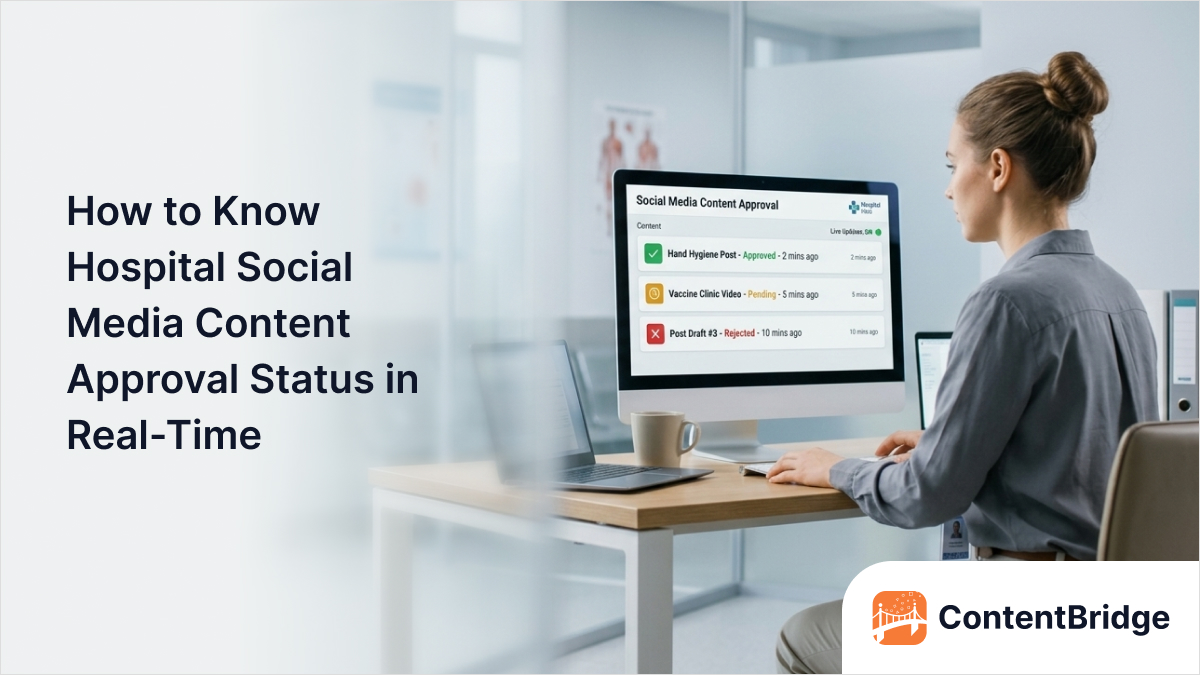

Your nurse submits a patient success story to your hospital’s social media program. Days pass with no update on whether the story was received, reviewed, or rejected. The nurse moves on, assuming it disappeared. Meanwhile, the story sits in a compliance review queue that nobody is monitoring.
This scenario repeats daily at hospitals across the country. Frontline staff submits valuable content with zero visibility into what happens next. Without approval status tracking, submitters never know if their content was lost, rejected, or simply forgotten in a queue somewhere. This uncertainty kills participation rates and disrupts content operations.
Real-time approval status tracking solves this crisis. When submitters can see exactly where their content is in the approval workflow, participation increases dramatically. Bottlenecks become visible before they become problems. Accountability improves because reviewers know their review queues are being monitored. Many hospitals that struggle with slow turnaround times could speed up hospital social media approvals by making every stage of the process visible.
This guide explains why real-time approval status matters for hospital social media. You will learn what approval stages to track, how to design dashboards that work for frontline staff, and which tools deliver the real-time visibility your teams need. Most importantly, you will discover how real-time status tracking transforms hospital content operations from chaotic to coordinated.
Why Frontline Staff Stop Submitting When Approval Status Is Invisible
Hospital social media programs depend on authentic content from frontline staff. Nurses, doctors, and clinicians see compelling patient stories daily that resonate far more powerfully than corporate messaging. Yet most hospitals struggle to retain contributors because invisible approval processes quietly destroy trust in the system.
1. Invisible Approval Processes Kill Participant Motivation
A nurse submits a patient story that gets routed through marketing triage, PHI screening, compliance review, brand editing, and final approval. That nurse has no idea any of this is happening, and weeks of silence lead them to assume the story was rejected or lost. Real-time visibility changes everything because a simple dashboard showing “In Clinical Review” keeps the contributor engaged and trusting the system.
2. Bottlenecks Go Undetected Until Deadlines Pass
Without visibility, content gets stuck at approval stages without anyone noticing. A reviewer takes a week off, and their queue accumulates silently until seasonal or time-sensitive stories miss their publication windows entirely. Real-time tracking with automated alerts flags overloaded queues and approaching deadlines before backlogs become problems.
3. Compliance Issues Become Hidden Liabilities
When approvals happen through scattered email chains, spreadsheets, and informal conversations, no centralized record exists showing who reviewed what or when decisions were made. Real-time tracking creates automatic audit trails where every stage documents the reviewer, the timestamp, and the decision, making compliance demonstrable rather than assumed.
4. Contributors Lose Emotional Connection to Their Content
By the time a story finally publishes weeks after submission, the nurse who submitted it has moved on emotionally. The moment of pride and connection to that patient experience has faded. Faster, visible workflows keep contributors emotionally invested so that publication still feels rewarding when it happens.
5. Silent Rejection Discourages Future Participation
When submitted content is declined without explanation, staff interpret the silence as indifference. They stop submitting because the effort feels unrecognized and the outcome feels uncertain. Constructive feedback delivered promptly through the same tracking system turns rejections into learning moments and keeps contributors engaged for next time.
Invisible approval processes do not just slow down content publication. They quietly erode the trust and motivation that frontline staff need to keep contributing. Making every stage visible, timely, and communicative is what transforms a struggling program into a sustainable one. Striking the right balance between authentic frontline social media content quality and editorial oversight starts with giving contributors visibility into the process.
Give Frontline Staff Visibility Into Approval Progress
ContentBridge shows submitters exactly where their content is in the review process, from submission to publication on social media.
The Critical Approval Stages Hospitals Need to Track
Hospital content requires specialized reviews that commercial social media tools never anticipated. Understanding which stages need real-time tracking helps design dashboards that matter to your teams.
Clinical Content Review Stages Based on Risk Category
Hospital content falls into distinct risk categories based on medical claims and patient safety implications. Each category requires a different review depth, and real-time tracking must show which tier each submission falls into so contributors understand why approval times vary.
Tier 1: Low-Risk Content
Staff celebration posts, facility announcements, and educational tips using standard medical information fall into this category. These submissions move quickly through triage and brand editing with minimal clinical involvement.
- No medical claims or patient-specific details requiring clinical verification.
- Moves directly from PHI screening to brand editing in most cases.
- The total approval target is 24 hours from submission to scheduled publication.
- This tier covers the majority of routine frontline staff submissions.
Tier 2: Medium-Risk Content
Treatment success stories, patient testimonial videos, and clinical best practice insights require clinical review beyond basic accuracy checking. A qualified clinician must verify that all medical references align with accepted protocols.
- Patient stories in this tier need documented consent under applicable privacy legislation before clinical review begins.
- Clinical review focuses on the accuracy of health claims and the appropriateness of shared details.
- The total approval target is 48 hours from submission to scheduled publication.
- Most patient storytelling content falls within this category.
Tier 3: High-Risk Content
Claims about specific treatments, patient outcome data, and comparisons to competitor facilities require formal clinical review, compliance review, and sometimes legal sign-off. This tier demands multiple reviewers coordinating across departments.
- Compliance officers review for Health Canada, Competition Bureau, and hospital-specific regulatory alignment.
- Outcome data must be verified against clinical records before publication.
- The total approval target is 72 hours from submission to scheduled publication.
- Content in this tier should never bypass any review stage, regardless of urgency.
Tier 4: Highest-Risk Content
Regulatory claims, Health Canada–regulated device information, and content involving potential legal liability require the most thorough review process. Multi-stage clinical, compliance, and legal review ensures every detail meets regulatory standards.
- Legal counsel must sign off before this content moves to final approval.
- Claims involving Health Canada–regulated products carry penalties that extend beyond hospital reputation to financial liability.
- The total approval target is 72 to 96 hours from submission to scheduled publication.
- Only a small percentage of submissions reach this tier, but each one demands full diligence.
Clearly labelling each tier within your tracking system helps frontline staff understand that a Tier 1 post approves in hours while a Tier 4 submission takes days. This transparency prevents frustration and builds confidence that the system is working as designed rather than ignoring their contribution.
Key Approval Stages Every Healthcare Content Submission Should Track
Tracking each approval stage gives frontline submitters precise visibility into where their content stands and how long remaining steps will take. A solid understanding of healthcare social media management principles helps hospitals design workflows where every stage is visible, contributors stay engaged, and bottlenecks surface before they cause delays.
Stage 1: Submitted
Frontline staff submits content through the portal and receives automatic confirmation within 60 seconds. This immediate acknowledgement signals that the system is active and the submission has been captured successfully.
Stage 2: Triage
A marketing coordinator reviews the submission, categorizes it by risk tier, and routes it to the appropriate reviewers. This stage should be completed within two hours to maintain momentum and set the pace for the rest of the workflow.
Stage 3: PHI Screening
Content is scanned for personal health information (PHI) that could breach PIPEDA or provincial health privacy laws. Patient names, dates of birth, health card numbers, and any other identifiers must be flagged and removed before the submission moves forward. Standard submissions complete this stage within four hours.
Stage 4: Clinical Review
Content containing medical claims requires a clinician to verify accuracy and alignment with clinical protocols. This review protects both the hospital and the audience from misinformation. Complex clinical content may take 12 hours or longer, depending on the subject matter.
Stage 5: Compliance Review
Higher-tier content requires a compliance officer to ensure alignment with Health Canada, Competition Bureau, and hospital-specific regulatory requirements. This stage can take up to 24 hours for complex submissions and serves as the primary safeguard against regulatory violations.
Stage 6: Brand and Editing
Content is refined for brand voice, platform optimization, and overall quality. Hashtags, captions, and platform-specific formatting are applied during this stage, which typically takes four to six hours.
Stage 7: Final Approval
Marketing leadership provides the last sign-off before scheduling. This checkpoint confirms that all prior reviews have been completed satisfactorily and typically takes two to four hours.
Stage 8: Scheduled
Content is queued for publication at the optimal time based on platform analytics. The system handles time zone conversion and platform-specific scheduling automatically, making this stage nearly instant.
Stage 9: Published
Content goes live, and the system automatically confirms publication in the submitter’s dashboard. This final notification closes the loop and gives the contributor visible proof that their effort made it to the audience.
A 9-stage workflow may seem extensive, but real-time visibility into each step is what keeps contributors trusting the process. When frontline staff can see their content moving forward rather than disappearing into silence, they stay motivated to submit again.
Stages Where Bottlenecks Most Commonly Occur
Hospital approval workflows are complex, and bottlenecks predictably emerge at certain stages. Real-time tracking should flag these high-risk stages with special attention:
- Clinical Review Stage is the most common bottleneck. Hospital systems typically have fewer clinicians available for review than the clinical content being submitted. During busy clinical periods, Tier 2 and Tier 3 content accumulates faster than it can be reviewed.
- The Compliance Review Stage creates secondary bottlenecks. Compliance officers often manage other responsibilities beyond content review. A single compliance officer managing 50+ submissions per week is bound to fall behind.
- The PHI Screening Stage sometimes becomes a bottleneck during high-volume periods. PHI screeners must read every submission carefully. Missed PHI issues create liability, so the work cannot be rushed.
- The Final Approval Stage can block publication even when earlier reviews are complete. If the marketing director is in back-to-back meetings, approved content sits waiting for final sign-off. This bottleneck is particularly frustrating because earlier reviewers have completed their work.
Real-time dashboards should highlight these high-risk stages with escalation alerts when content approaches SLA deadlines at these specific stages. When legal review is the primary delay, hospitals can explore specific strategies to speed up legal reviews for social media without compromising thoroughness.
Alert Your Team to Approval Bottlenecks Instantly
ContentBridge flags when content is approaching SLA deadlines and notifies your team of bottlenecks before deadlines slip entirely.
Designing Real-Time Dashboards That Frontline Staff Actually Use
Most hospital content management tools were designed for office-based marketing teams. Dashboards prioritize features marketers value, not what frontline clinical staff need. This design gap is a key reason why frontline adoption remains low. Real-time approval dashboards must serve three distinct audience groups, each with different information needs.
Dashboards for Submitters: Making Progress Visible
Frontline staff who submit content need simple, mobile-first dashboards showing only their own submissions. Complexity confuses users and reduces adoption, so the interface must prioritize clarity over features.
Submission List View
Each submission should display four pieces of critical information at a glance: current approval stage with a visual status icon, time spent at the current stage, total time since submission, and a quick action button to view details or contact the assigned reviewer.
- Green indicates on-track approvals, yellow signals approaching SLA deadlines, and red flags overdue items.
- This universal colour system requires no training and makes status instantly visible without reading text.
- Mobile-first layout ensures nurses and clinicians can check progress between shifts on their phones.
- Clean design with minimal elements keeps the interface fast and intuitive for non-technical users.
Submission Detail View
Tapping on a submission reveals the full approval timeline, showing when it was received, which reviewer is currently handling it, and the estimated time to the next stage. For rejected or returned content, this view displays specific feedback about what needs to change.
- Generic feedback like “PHI issue” frustrates submitters because it offers no clear path to fix the problem.
- Specific feedback like “patient name visible in video background at timestamp 2:15” tells the submitter exactly what to correct.
- A complete timeline builds transparency and trust in the approval process.
- Clear revision guidance increases resubmission rates and improves content quality over time.
Notification Centre
Push notifications alert submitters immediately when content moves to a new stage or when feedback is provided. The notification centre consolidates all updates in one archive so submitters can review past messages if they forget the current status.
- Instant alerts keep contributors engaged and aware without requiring them to check the dashboard manually.
- Archived notifications prevent information from getting lost across busy shifts.
- Timely updates reinforce that the system is active and working on their submission.
- Consistent communication builds the trust needed for long-term participation.
Dashboards for Reviewers: Prioritizing Queues
Reviewers need queue-focused dashboards that emphasize workload management and SLA compliance. Their interface should help them prioritize work automatically without extra effort.
Review Queue
All content assigned to the reviewer is sorted by SLA urgency. Items with critical deadlines appear at the top, and items with time remaining sit at the bottom. This automatic prioritization removes guesswork from the reviewer’s workflow.
- The same green, yellow, and red colour coding used for submitters keeps the visual language consistent.
- Quick action buttons allow reviewers to approve, request a revision, or escalate directly from the queue view.
- No need to open separate interfaces or switch between tools to take action.
- Streamlined interactions increase processing speed and reduce approval delays.
Workload Overview
Displaying throughput metrics showing how many items a reviewer completed today, this week, and this month motivates productivity. Monthly patterns also help identify predictable bottlenecks on specific days or during seasonal surges.
- Visible productivity data encourages consistent review pacing across the team.
- Historical patterns reveal recurring bottlenecks that can be addressed proactively.
- Balanced workload visibility prevents reviewer burnout and uneven distribution.
- Throughput tracking gives operations managers data to support staffing decisions.
Dashboards for Operations Managers: Monitoring the Entire Pipeline
Operations managers need a holistic view of the entire approval workflow. Their dashboards emphasize bottleneck detection, SLA compliance, and resource allocation across all stages. Organizations that treat their content operations as a single source of truth for frontline social media gain the centralized visibility that makes pipeline management far more effective.
Pipeline Overview and Bottleneck Alerts
A visual pipeline displays how many submissions sit at each approval stage. When content accumulates at a specific stage beyond normal thresholds, the system automatically alerts the operations manager for quick resolution.
- If clinical review normally holds 5 to 8 submissions but suddenly contains 20 or more, the alert triggers immediately.
- Proactive notifications prevent small backlogs from becoming major delays.
- Visual accumulation patterns make problem stages obvious at a glance.
- Early detection keeps the entire workflow moving within target timelines.
SLA Compliance and Throughput Reporting
Stage-level SLA reporting reveals which stages consistently miss target timelines. Throughput metrics tracking submissions received, reviewed, approved, rejected, and published across daily and weekly timeframes uncover trends that inform long-term improvements.
- If clinical review consistently breaches SLA, it signals the need for additional reviewers.
- Weekly trends show whether submission volume is growing or approval times are improving.
- Data-driven insights replace guesswork when making staffing and process decisions.
- Regular reporting keeps leadership informed and justifies ongoing program investment.
Reviewer Workload Distribution
Visibility into individual reviewer workloads enables fair distribution and prevents burnout. If one clinical reviewer consistently carries twice the load of peers, the imbalance becomes immediately clear and correctable.
- Load balancing ensures no single reviewer becomes a bottleneck for the entire pipeline.
- Even distribution improves review quality by preventing fatigue-driven mistakes.
- Capacity visibility helps managers reassign work during vacations or absences.
- Fair workloads support reviewer retention and long-term program sustainability.
Well-designed dashboards do not just display data. They give each audience exactly the information they need to take action without overwhelming them with irrelevant details. When submitters see progress, reviewers manage queues efficiently, and managers catch bottlenecks early, the entire approval workflow runs faster and earns the trust of every person involved.
Eliminate Approval Visibility Guesswork with Real-Time Dashboards
ContentBridge provides submitter, reviewer, and operations dashboards for complete approval visibility across your hospital’s social media program.
Implementing Effective SLA Frameworks for Hospital Content Approval
Service level agreements define expected approval timelines and create accountability across the review process. Without clear SLAs, reviewers have no targets, managers cannot measure performance, and submitters have no idea when to expect their content to go live. Hospital content approval requires risk-based SLAs because low-risk content should move faster than high-risk content.
SLA Timelines by Content Risk Tier
Each content submission falls into a risk tier that determines how many review stages it passes through and how long approval should take. Assigning the correct tier at triage sets expectations for both the submitter and the review team from the start.
Tier 1: Low-Risk Content
General announcements, staff celebrations, and educational tips using standard medical information require only triage and brand editing. These submissions carry minimal compliance risk and should move through the workflow quickly.
- No clinical or compliance review required for this tier.
- The total SLA target is 24 hours from submission to publication.
- This tier covers the majority of routine frontline submissions.
- Fast turnaround on low-risk content keeps contributors motivated and engaged.
Tier 2: Medium-Risk Content
Patient stories, clinical tips, and treatment success narratives require clinical review to verify accuracy beyond basic screening. A qualified clinician must confirm that all medical references align with accepted protocols.
- Clinical review adds time but protects the hospital from publishing inaccurate health information.
- The total SLA target is 48 hours from submission to publication.
- Most patient storytelling content falls within this category.
- Documented consent under applicable privacy legislation must be in place before clinical review begins.
Tier 3: High-Risk Content
Claims about specific treatments, patient outcome data, and competitor comparisons require both clinical and compliance review. Multiple reviewers must coordinate across departments before this content moves forward.
- Compliance officers review for Health Canada, Competition Bureau, and hospital-specific regulatory alignment.
- The total SLA target is 72 hours from submission to publication.
- Content in this tier should never bypass any review stage, regardless of urgency.
- Outcome data must be verified against clinical records before approval.
Tier 4: Highest-Risk Content
Regulatory claims, Health Canada–regulated device information, and content involving potential legal liability require the most thorough multi-stage review. Clinical, compliance, and legal teams must all sign off before publication.
- Legal counsel must approve before this content reaches final sign-off.
- The total SLA target is 72 to 96 hours from submission to publication.
- Only a small percentage of submissions reach this tier, but each demands full diligence.
- Penalties for errors at this level extend beyond reputation to financial and regulatory liability.
P1: Urgent Content
Time-sensitive stories that will lose relevance if delayed bypass normal queues and follow an expedited review path. These require pre-identified fast-track reviewers who can respond within a condensed window.
- The total SLA target is 2 to 4 hours for urgent approvals.
- Only content with a clear time-sensitivity justification qualifies for this designation.
- Fast-track reviewers must be available and assigned before urgent situations arise.
- Overuse of the urgent tier undermines its effectiveness and should be monitored closely.
Breaking SLAs Into Stage-Specific Targets
Hospital-wide SLAs must break down into individual stage targets to create accountability at the reviewer level. When a submission misses its overall SLA, stage-level data pinpoints exactly where the delay occurred.
Tier 1 Stage Breakdown
Triage completes within 2 hours, PHI screening within 4 hours, brand editing within 6 hours, and final approval within 4 hours. This breakdown ensures the 24-hour total target is distributed fairly across each step.
- Each stage owner knows their specific time commitment clearly.
- Delays at any single stage become visible immediately through dashboard tracking.
- Stage targets prevent one reviewer from consuming the entire SLA window.
- Consistent stage pacing builds a predictable rhythm across the workflow.
Tier 2 and Tier 3 Stage Breakdown
Tier 2 adds clinical review at 12 hours to the standard flow, bringing the total to 48 hours. Tier 3 adds compliance review at 24 hours on top of clinical review, extending the total to 72 hours.
- Each additional review layer has its own dedicated time allocation.
- Higher tiers allow more time per stage to account for the complexity of review.
- Stage-level tracking makes it obvious which review layer is causing delays.
- Granular targets enable managers to allocate resources precisely where they are needed.
Using SLA Data to Drive Continuous Improvement
SLA compliance data should inform operational decisions, not punish individual reviewers. When targets are missed, the goal is to identify systemic problems and allocate resources appropriately rather than assign blame. These principles apply beyond healthcare — any large organization managing content at scale can benefit from aligning SLA frameworks with a broader enterprise social media management strategy.
- If clinical review consistently exceeds its target, the root cause is likely insufficient reviewer capacity, not slow performance.
- If brand editing regularly breaches SLA, it may signal that content needs more editing than expected or that the editor is overloaded with other responsibilities.
- Track SLA compliance weekly and share performance data openly with the review team.
- Celebrate weeks when the team exceeds targets and discuss root causes constructively when targets are missed.
A well-structured SLA framework gives every person in the approval workflow a clear expectation and a measurable standard. When timelines are transparent, accountability is fair, and data drives decisions, the entire content approval process becomes faster, more predictable, and easier to scale.
Set and Enforce Approval SLAs With Real-Time Tracking
ContentBridge automatically tracks approval SLAs by stage and tier, flagging delays before they impact content relevance and publication timelines.
Best Practices for Implementing Real-Time Approval Status Visibility
Implementing real-time approval tracking requires more than deploying a new tool. Hospitals must establish practices that maximize the value of real-time visibility and build trust in the system.
1. Acknowledge Every Submission Immediately
Send automated confirmation within 60 seconds of submission receipt. This immediate response signals that the system is active and working. Silence kills trust. An early confirmation message might read: “Your story has been submitted and is being reviewed by our team. You will receive updates as it moves through the approval process.”
This simple confirmation has an outsized impact. Submitters stop worrying whether their submission was lost. They know the system received it.
2. Communicate Using Colour Coding and Simple Language
Status indicators should use universal colour coding: green for on-track, yellow for approaching deadline, red for overdue. Submitters should understand the status instantly without reading explanatory text.
Use simple language to describe approval stages. “In Clinical Review” is clearer than “Stage 4 Review Queue.” Frontline staff should understand what is happening without needing to learn healthcare-specific jargon.
3. Make Dashboards Mobile-First for Frontline Staff
Frontline nurses check dashboards on hospital phones during shift breaks. Desktop dashboards fail in this context. Invest in mobile-first design.
Mobile dashboards should load quickly, even on older devices or spotty hospital WiFi. Tap targets should be large enough for quick interaction. The interface should require minimal scrolling.
Test your dashboard on the actual devices your frontline staff use. A beautiful desktop dashboard that fails on Android phones alienates the exact audience you need to engage.
4. Provide Proactive Updates, Not Just Decision Notifications
Send updates when content moves between approval stages. “Your story is now in brand editing” is valuable even if it is not a final decision. These intermediate updates show progress and build confidence.
Without intermediate updates, submitters hear silence for days, followed by sudden “approved” or “rejected” notifications. This pattern feels arbitrary. Regular updates show the system is working methodically.
5. Show Estimated Time Remaining at Each Stage
When a submission enters a new stage, show the estimated time for that stage to complete. “Estimated clinical review: 10 hours” sets expectations. Without this information, submitters have no idea whether approval will happen tomorrow or next week.
These estimates should be based on your historical SLA data. After reviewing your approval process for a month, you will have accurate historical timelines. Share these realistic estimates with submitters.
6. Provide Specific, Actionable Feedback on Rejections and Revisions
Generic feedback kills submitter motivation. “PHI issue — please fix” frustrates someone who does not know what the PHI issue is. Specific feedback like “Patient name visible in background of video at timestamp 2:15 — please edit or resubmit a different video” tells the submitter exactly what to change.
Assign a person to provide this detailed feedback. Do not generate generic rejection templates. Clinical and compliance reviewers should include specific comments explaining why the content was returned. Many of these operational habits align with established social media management best practices that apply across industries.
7. Celebrate Successful Submissions
When content completes the entire approval journey and publishes, celebrate with the submitter. “Your patient story is now live! Thank you for sharing this authentic perspective.”
Recognition sustains participation. Submitters who feel appreciated will continue submitting. Submitters who feel ignored eventually stop.
Build a Culture of Transparent Content Approval with ContentBridge
ContentBridge helps hospital teams implement best practices for real-time approval visibility, from acknowledgement to publication celebration.
How to Choose Tools That Deliver Real-Time Approval Visibility
Hospital teams have several options when selecting approval tracking tools. Each approach has distinct strengths and limitations depending on your organization’s size, technical capacity, and compliance requirements. Understanding the different types of social media management tools available helps hospitals narrow down solutions that match their specific needs.
- Start by identifying whether your hospital needs a healthcare-specific platform or a general-purpose tool. Healthcare-specific platforms handle PHI screening, privacy compliance, and frontline mobile access out of the box, while general tools require manual configuration for these features.
- Evaluate the mobile experience before committing to any tool. Frontline staff submits content on their phones between shifts, so a clunky mobile interface will kill adoption regardless of how powerful the desktop version is.
- Check whether the tool offers built-in SLA tracking with automated alerts. Without native SLA features, your team will spend time manually monitoring deadlines and chasing reviewers instead of focusing on content quality.
- Confirm that the platform creates automatic audit trails for every approval decision. Compliance documentation should generate itself through normal use, not require separate manual record keeping.
- Test how the tool handles role-based dashboards for submitters, reviewers, and operations managers. Each group needs different information, and a one-size-fits-all dashboard will frustrate all three audiences.
- Assess the technical resources required for setup and ongoing maintenance. Purpose-built platforms require minimal configuration, while custom-built solutions demand dedicated technical staff for updates, bug fixes, and feature additions.
- Request a pilot period before full rollout. Test the tool with one or two departments first to measure frontline adoption, reviewer efficiency, and SLA compliance before scaling across your entire organization.
The right tool should make approval tracking effortless for every person involved. If setup feels complicated or frontline staff struggle to use it within the first week, the tool is not the right fit for your hospital.
How ContentBridge Makes Real-Time Approval Tracking Simple for Healthcare Teams
ContentBridge is a frontline social media management platform purpose-built for healthcare teams and other hierarchical organizations. It handles approval automation, mobile dashboards, and compliance tracking so your hospital can focus on content strategy, not building technology. Unlike generic tools built for small marketing teams, ContentBridge supports organizations with 100 to 5,000+ employees with unlimited approval workflow levels.
The platform gives every role a tailored experience. Frontline staff capture and submit content through native iOS and Android apps. Reviewers manage approvals through multi-level workflows with inline feedback. Operations managers track the full pipeline with complete audit trails. Built-in features help organizations meet PIPEDA and provincial health privacy obligations through role-based access, audit trails, and department-level isolation. Learn more about how ContentBridge supports healthcare organizations specifically.
ContentBridge replaces scattered email chains and spreadsheets with a fully visible, trackable workflow. Content creators never access social accounts directly. They submit, your team approves, and the platform auto-publishes to Facebook, Instagram, X, LinkedIn, and TikTok. The result is faster approvals, higher submission volumes, and complete audit readiness at a fraction of the cost of traditional social media management tools.
Book a demo today to see how ContentBridge transforms your healthcare social media operations from invisible to transparent.
Frequently Asked Questions
What exactly is real-time approval status tracking?
Real-time approval status tracking shows submitters where their content is in the approval workflow at any given moment. Dashboards display the current approval stage, how long the submission has been at that stage, estimated time remaining, and who is responsible for the current review. Updates happen instantly as content moves between stages.
Why do hospitals need real-time approval status tracking?
Hospital social media content must pass through multiple specialized reviews: PHI screening, clinical review, compliance review, and brand editing. Without status visibility, content gets stuck at stages without anyone noticing. Bottlenecks accumulate, deadlines slip, and submitters stop contributing. Real-time tracking makes bottlenecks visible and accountability clear.
What approval stages should hospitals track for social media content?
Hospital workflows typically include: submission receipt, triage, PHI screening, clinical review, compliance review, brand and editing, final approval, and scheduling. Some hospitals add additional stages, like legal review for high-risk content. Track the stages that exist in your specific hospital workflow.
How quickly should hospitals acknowledge content submissions?
Hospital teams should send automated confirmation within 60 seconds of submission. This immediate response signals that the system is active and the submission was received. Delayed acknowledgements leave submitters uncertain about whether the system is working.
What SLA timelines should hospitals set for content approval?
SLAs depend on content risk. Low-risk content (announcements, general tips) can be approved in 24 hours. Medium-risk content (patient stories, clinical tips) should be approved in 48 hours. High-risk content (treatment claims, outcome data) needs 72 hours. Urgent content should have expedited SLAs of 2 to 4 hours.
How do hospitals balance real-time visibility with approval quality?
Real-time visibility does not compromise quality. In fact, it improves quality by making bottlenecks obvious so hospitals can allocate sufficient resources. When approval stages have clear SLA targets and visibility, reviewers are accountable for meeting timelines while maintaining thorough review standards.