
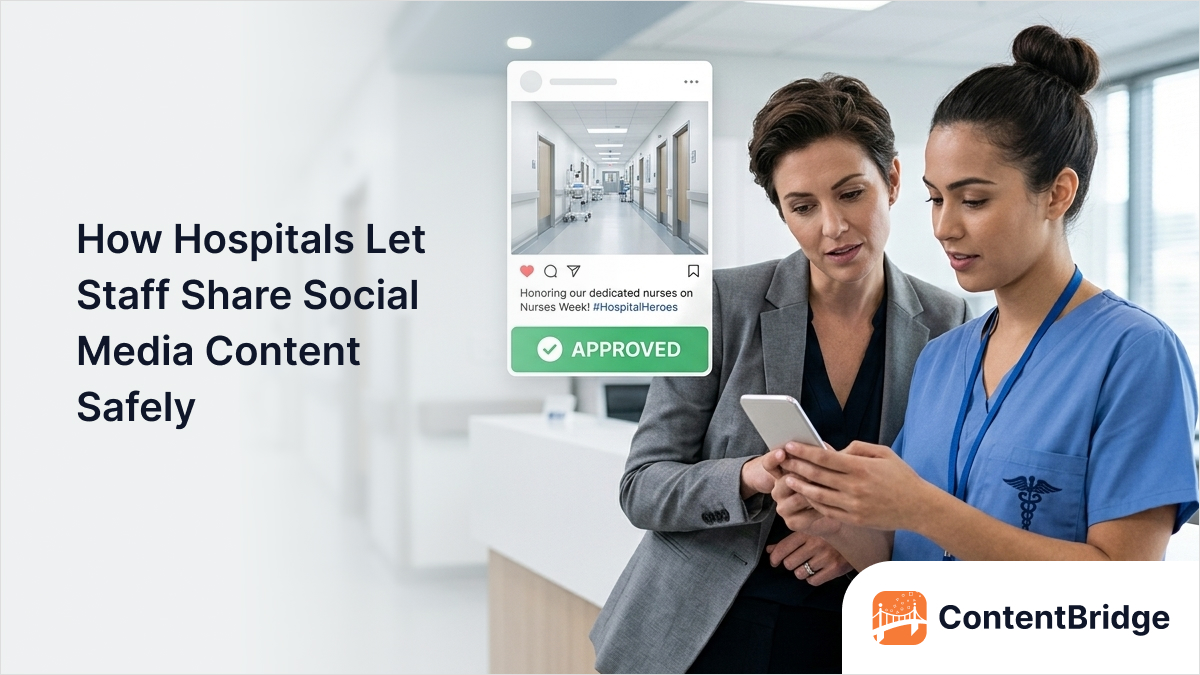

Your hospital has passionate employees who love where they work. Nurses want to celebrate their department. Physicians share wellness insights with their followers. Administrative staff take pride in organizational achievements. Yet hospital leaders hesitate to encourage employee social media activity.
The concern is understandable. Patient privacy violations carry serious consequences. Breaches of health privacy legislation damage institutional trust and invite regulatory enforcement from the Office of the Privacy Commissioner or provincial regulators.
One employee’s careless post can expose patient information instantly. How do hospitals harness employee enthusiasm while protecting privacy? A growing number of organizations are turning to structured programs, and understanding the fundamentals of healthcare social media management is the first step.
This blog explains how hospitals let staff share social media content safely through structured programs and approval workflows. Learn the two primary models for employee social media sharing and understand what staff can safely share on personal accounts. More importantly, discover the systems that successful hospitals use to scale participation across their workforce.
Why Hospital Employee Social Media Participation Matters
Community members, job seekers, and prospective patients increasingly use social media to evaluate hospitals before making decisions. Traditional marketing reaches a limited audience, but employee voices carry authenticity that corporate channels cannot replicate.
When a nurse shares a patient success story or a physician posts health education content, credibility follows naturally. However, this participation also introduces compliance risks that hospitals must manage carefully.
- Community members research hospitals on social media when evaluating local healthcare options.
- Social media algorithms favour individual accounts, so employee shares expand reach far beyond corporate pages.
- Job applicants evaluate hospital culture through staff posts, making advocacy a strong recruitment tool.
- Community members trust real healthcare workers more than polished corporate messaging.
- A single careless post from a clinical area can expose patient information and trigger privacy investigations.
- Hospitals need structured systems that encourage participation while preventing violations before content goes public.
Many hospitals find that the most effective way to start is to build community trust with patient stories shared by the people who witness those moments firsthand.
Enable Safe Employee Advocacy Without Compliance Risk
ContentBridge manages approval workflows and compliance guardrails, making employee social media sharing safe. Hospitals gain confidence, enabling advocacy at enterprise scale.
Two Proven Models for Compliant Staff Social Media Participation
Successful hospitals implement two complementary approaches to staff social media participation. The first model reaches broad employee participation through pre-approved content that staff can share with a single click.
The second model empowers selected employees to create original content within hospital guardrails. Most hospitals benefit from running both models simultaneously to balance scale with authenticity.
1. Pre-Approved Content Distribution
Hospital marketing teams develop and review content for health privacy compliance, brand voice, and messaging alignment before loading it into an employee advocacy platform.
Employees receive mobile notifications about new shareable posts relevant to their department and can share directly to their personal social media accounts with minimal effort. Staff do not need marketing skills or training to participate, and pre-written captions ensure consistent messaging across all posts.
Compliance teams review everything before it becomes available, so the risk of violations is managed before content ever reaches a personal feed.
2. Guided Employee Content Creation
Selected content champions across departments receive training on brand guidelines, health privacy compliance, and content creation basics. For example, healthcare workers submit original content through pre-approved social media content submission workflows first before posting. Once reviewed, they can post to personal accounts or official hospital channels.
Organizations looking for a practical starting point can explore how to enable nursing staff to create content within structured guardrails.
This model works because frontline employees tell stories more effectively than marketing teams since they experienced them firsthand. Authentic voices drive higher engagement, stronger audience connections, and surface real patient concerns that corporate messaging often overlooks.
Together, these two models create a participation structure that works for every level of staff involvement. Pre-approved distribution gives the entire workforce an easy entry point, while guided content creation unlocks the authentic frontline stories that resonate most with patients and communities.
What Hospital Staff Can Safely Share on Social Media
Hospital employees can amplify positive messages when they understand clear boundaries around what is safe to share. The rules are not mysterious or overly restrictive, and thousands of healthcare workers participate safely in employee advocacy programs every day.
Clear guidelines help staff make confident decisions about participation without second-guessing every post.
Content Hospital Employees Can Share
Hospital staff have a wide range of content options that carry no compliance risk when handled properly. Pre-approved hospital content is the safest option since it has already been reviewed for compliance and brand alignment.
Beyond that, employees can confidently share workplace pride, professional achievements, public event coverage, and general health education that positions them as trusted voices in their communities.
- Pre-approved hospital content can be shared with one click and requires no additional review from the employee.
- General workplace pride posts, like celebrating team culture or expressing enthusiasm for the organization, build goodwill without exposing patient details.
- Professional milestones such as certifications, promotions, and awards inspire colleagues and attract talent.
- Public hospital event photos from health fairs or open houses amplify community outreach without privacy concerns.
- General health education content, like flu prevention tips or wellness guidance, positions staff as credible and helpful sources.
Content Hospital Staff Must Never Share
Patient information is absolutely forbidden in any form, including names, conditions, treatments, images, or even vague references that could identify someone. The OPC’s Interpretation Bulletin on Sensitive Information confirms that health data requires the highest degree of protection under PIPEDA.
Photos and videos from clinical areas like operating rooms, ICUs, or patient rooms are strictly off-limits. Background details such as whiteboards, monitors, and charts can contain personal health information even when no patient is visible.
- Patient details in any form violate health privacy legislation, regardless of intent or how vague the reference appears.
- Confidential business information, including strategic plans, financial data, and operational changes, must stay private until officially announced.
- Negative comments about patients, coworkers, or leadership damage the hospital’s reputation and create legal liability.
- Photos from patient care areas are prohibited, even when patients are not in the frame.
- Workplace incidents and investigations must remain private until appropriate disclosure is authorized.
Understanding these boundaries gives hospital employees the confidence to participate actively without fear of making a costly mistake. When staff know exactly what is encouraged and what is off-limits, participation increases, and compliance risks drop significantly. For a deeper look at maintaining these boundaries at scale, see patient data protection on social media.
How to Build Your Hospital’s Safe Content Sharing Program
Hospitals that succeed with employee advocacy implement structured programs with clear policies and training. Random encouragement of social media activity without systems creates compliance risks. Strategic programs that define expectations and provide guardrails enable safe scale.
1. Develop Clear Social Media Guidelines
Written policies eliminate confusion about what is acceptable. Include specific examples of acceptable and prohibited content. Define consequences for policy violations to establish serious intent. Address platform-specific issues since LinkedIn differs from Instagram and TikTok.
Health privacy compliance must be explicit and thorough. Explain what constitutes personal health information under PIPEDA and applicable provincial legislation, and use social media context examples to make the rules concrete.
Provincial labour relations legislation and employee rights under applicable employment law must also be respected in policy language. Legal review ensures policies comply with labour and employment law while protecting patient privacy. Without clear policies, organizations face the compliance risks of frontline social media that can escalate quickly.
2. Select and Implement an Employee Advocacy Platform
Purpose-built employee advocacy platforms reduce compliance risk significantly by putting pre-approved content directly in employees’ hands. Look for platforms with content libraries organized by department and role, suggested captions for consistent messaging, mobile-first design for frontline accessibility, and analytics dashboards to track participation patterns.
3. Implement Approval Workflows for User-Generated Content
When employees create their own content, hospitals need approval processes. Designated reviewers from marketing and compliance teams check submissions. Clear approval criteria and timelines prevent frustrating delays.
Role-based permissions ensure that appropriate people control different approval levels. Automated notifications alert approvers when new content arrives for review. Employees receive feedback within established timeframes.
Fast turnaround encourages continued participation and content submission. Slow approval processes discourage employee enthusiasm and reduce submissions.
A frontline social media management platform like ContentBridge provides healthcare organizations with the workflow infrastructure for safe employee social media content sharing. The platform centralizes content submission, approval, and distribution in one mobile-friendly interface.
4. Train All Employees on Social Media Guidelines
Effective training prevents the vast majority of policy violations. Employees want to follow rules when they understand them. Annual training is essential because staff turnover creates constant new employees. Training should be engaging and scenario-based rather than lecture-style.
Training should explain specific consequences for policy violations with real cases. Discussing healthcare workers who faced discipline or termination creates a practical understanding. Real examples make abstract rules concrete and memorable. For a framework on building this kind of training, see how hospitals train hospital staff for social media participation.
Content champions need deeper training than general employees. They should understand content creation techniques beyond regulatory compliance. Training should cover mobile photography, video basics, storytelling fundamentals, and authentic narrative construction.
Annual refresher training keeps compliance awareness current as regulations and platforms change. New employees require complete training before participating in advocacy programs. Orientation training ensures that participation requires compliance from day one.
5. Encourage Authentic Employee Storytelling
Authenticity is the greatest advantage employees bring to hospital social media. Real stories from real people drive engagement that corporate content cannot match, and frontline perspectives build trust faster than polished marketing messages. Understanding how nurses capture content from field settings is a practical starting point.
The strongest employee stories fall into four categories:
- Patient care moments create the strongest emotional connection with audiences.
- Workplace culture content showing team dynamics appeals directly to job applicants.
- Professional growth stories about certifications or promotions inspire others in healthcare.
- Recovery stories shared with proper consent celebrate outcomes that communities care about.
Before submitting any content, employees should run through the safety boundaries covered earlier in this guide:
Check for visible patient information — scan whiteboards, monitors, charts, and wristbands in every photo or video frame.
Confirm the location is not a patient care area — operating rooms, ICUs, and patient rooms are always off-limits, even without patients visible.
Review content tone — keep posts positive, focused on impact and teamwork, and free of complaints.
Verify consent — every identifiable person in the content must have provided consent, with patients requiring documented consent under applicable health privacy legislation.
Check for confidential business information — unreleased plans, financial data, and pending announcements must stay private.
When staff have both compelling story types to pursue and a clear safety checklist to follow, participation becomes confident rather than hesitant.
Scale Employee Advocacy with Built-In Compliance Training
ContentBridge includes comprehensive templates and compliance documentation your hospital needs to launch a safe and successful advocacy program.
How to Measure Success and Scale Your Employee Advocacy Program
Hospitals need clear metrics to understand whether employee advocacy programs deliver real value. Measurement validates the investment, identifies areas for improvement, and helps leadership allocate resources effectively.
Without tracking the right data, hospitals cannot distinguish between programs that are growing and programs that are stalling.
1. Key Metrics That Matter
Tracking the right metrics gives hospitals a complete picture of program health across adoption, engagement, reach, compliance, and employee satisfaction. Adoption rate measures the percentage of employees who join the advocacy platform, with first-year targets of 40 to 60 percent representing strong success.
Active sharing rate reveals how many enrolled employees actually share content each month, and reach amplification shows how much further employee-shared content travels compared to official hospital posts. For guidance on presenting these numbers to leadership, see healthcare social media ROI reporting.
- Adoption rate should focus on roles where employees already maintain a personal social media presence.
- Active sharing rates of 25 to 35 percent indicate healthy and sustainable engagement levels.
- Employee-shared content typically reaches three to five times further than posts from official hospital channels.
- Engagement rate on employee posts tends to outperform hospital account posts, confirming the value of authentic voices.
- Compliance incidents should be tracked by severity level, with zero health privacy violations as the non-negotiable standard.
- Employee satisfaction surveys reveal whether participants feel supported, valued, and likely to continue contributing.
2. Strategies to Increase Participation and Engagement
Sustaining momentum requires a mix of recognition, friendly competition, fresh content, and data-informed decisions about what employees actually want to share.
Monthly highlights featuring active participants build positive peer influence, while department-level competitions create healthy rivalry that drives sharing without requiring additional budget. Keeping the content library updated weekly signals ongoing investment and gives employees new reasons to check the platform regularly.
- Recognition programs that publicly acknowledge top sharers motivate continued participation across teams.
- Department competitions around content sharing or audience reach create engagement without heavy resource investment.
- Refreshing the advocacy library with new content every week prevents the platform from going stale.
- High-impact content categories like employee culture, facility announcements, and health awareness days consistently drive the most sharing.
- Use platform data to identify which content types perform best and produce more of what employees naturally favour.
- Small rewards or public acknowledgment for top contributors reinforce that participation is noticed and appreciated.
A strong measurement framework turns employee advocacy from a hopeful initiative into a scalable growth strategy. When hospitals track the right metrics and consistently invest in keeping participation rewarding, the program builds its own momentum over time.
Track Employee Advocacy Performance Like Enterprise Brands Do
ContentBridge delivers detailed analytics showing which content resonates, which employees engage most, and reach amplified across regions and departments consistently.
Enable Safe Employee Advocacy With ContentBridge
Hospital staff social media participation strengthens community trust, talent acquisition, and institutional reputation when managed properly. Yet unmanaged participation introduces liability and compliance risk that hospitals cannot ignore.
Traditional tools like email and spreadsheets cannot enforce compliance at scale. Hospitals need purpose-built platforms designed specifically for social media management for healthcare organizations.
ContentBridge is a frontline-first social media management platform designed specifically for healthcare organizations. The platform centralizes employee advocacy through pre-approved content libraries and submission workflows. Compliance guardrails prevent violations before they happen.
Mobile-first design ensures nurses, physicians, and administrative staff can participate from anywhere. Pre-approved content libraries eliminate employee guesswork about what can be shared.
Hospital marketing teams create and review all content before making it available. Employees access approved content on their phones and share to personal accounts with one click. Compliance review happens once, not repeatedly for each employee.
Analytics dashboards show which content resonates and which employees are most active. Performance data informs future content strategy based on what actually drives engagement. Compliance tracking documents everything shared for potential audit purposes.
Request a demo today to see how ContentBridge helps hospitals enable employee advocacy while protecting patient privacy and maintaining regulatory compliance.
Frequently Asked Questions
How do hospitals handle unauthorized employee social media posts?
Hospitals should have progressive discipline procedures. First violations often result in coaching. Serious violations involving patient information can result in suspension or termination.
What is the difference between employee advocacy platforms and general social media tools?
General tools manage brand accounts only. Employee advocacy platforms add pre-approved content libraries, one-click sharing, and compliance guardrails. Healthcare-specific platforms include privacy compliance features and mobile interfaces.
Can hospitals require employees to participate in advocacy programs?
Participation should be voluntary. Mandatory programs create resentment and lower content quality. Hospitals see better results by making participation easy, recognizing contributors, and showing staff how sharing benefits both the organization and their professional visibility.
Do employees need to disclose their hospital affiliation when sharing?
Yes. Transparency builds credibility and avoids misleading audiences. Employees sharing hospital content should identify themselves as staff members. Most advocacy platforms include standard disclosures automatically, so employees do not need to add them manually.
What happens to shared content when an employee leaves the hospital?
Content shared to personal accounts remains under the employee’s control. Pre-approved content posted to official channels stays with the organization. Offboarding procedures should include revoking platform access and reviewing any pending submissions still in the approval queue.