
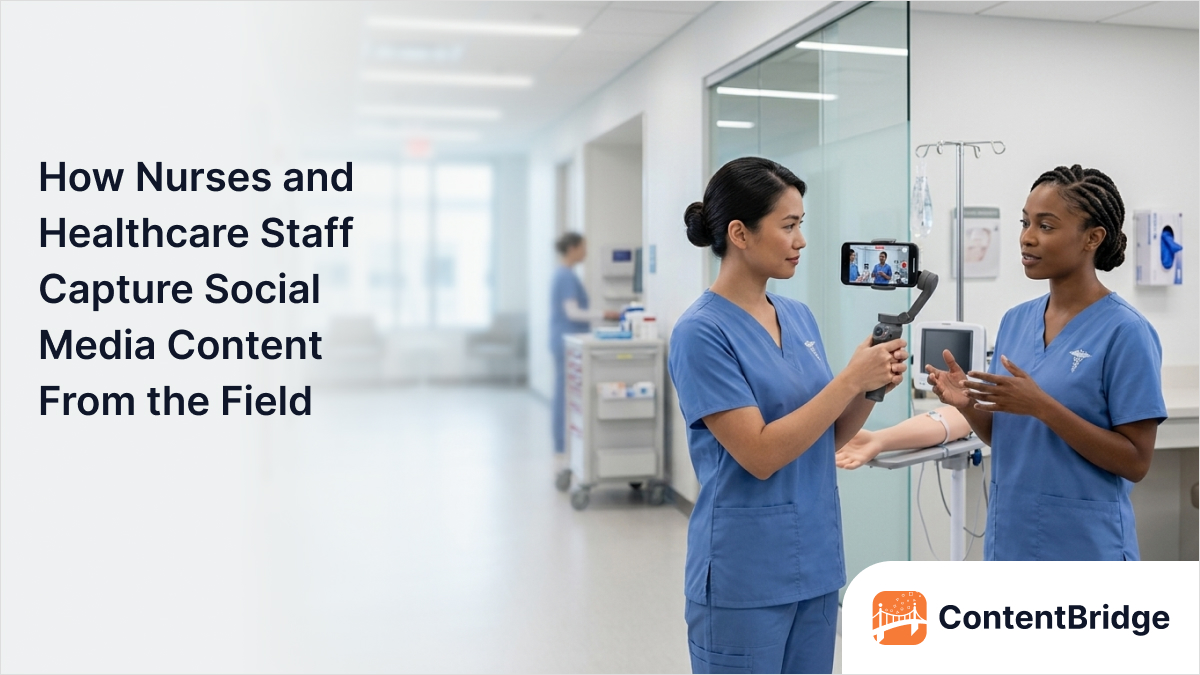

Your hospital’s marketing team creates professional content. Yet employee-shared content consistently outperforms brand-channel posts in engagement, reach, and trust. The 2024 Edelman Trust Barometer confirms that employees are seen as more credible spokespeople than CEOs or official company pages. Patients trust authentic voices on the frontline far more than polished corporate posts.
Healthcare organisations are increasingly empowering nurses and frontline staff to capture genuine social media content directly from the field. This approach builds trust, increases engagement, and shows the real human side of your organisation. Effective healthcare social media management requires balancing that authenticity with the serious compliance challenges that corporate marketing teams rarely face.
The stakes are high. Nurses who breach patient privacy by posting personal health information face termination, referral to their provincial nursing regulatory college, and regulatory penalties. Healthcare organisations face similar consequences for enabling non-compliant content creation. Yet the benefits of authentic frontline content are enormous.
This guide explains how healthcare organisations can safely implement frontline content capture programmes. You will learn the compliance requirements nurses must follow, the workflows that protect patient privacy, and the training necessary to empower staff. Discover proven strategies to scale content capture across departments while managing submissions effectively and maintaining brand consistency.
Why Frontline Nurse Content Matters for Healthcare Marketing
Authentic content created by nurses resonates far more powerfully than corporate messaging. Understanding why this content works helps justify the investment in proper systems and training.
Patients Trust Nurses More Than Marketing Teams
Patient decision-making relies heavily on opinions from healthcare professionals. When patients see content from actual nurses, they recognise genuine expertise. Marketing-produced content feels like advertising, while nurse-created posts feel like trusted advice.
The Canadian Medical Association’s 2025 Health and Media Tracking Survey found that Canadians actively use online platforms, search engines, and social media as primary sources for health information. Statistics Canada reported in 2023 that over half of Canadians (51%) accessed electronic health information in the prior 12 months, and this figure continues to grow. International research supports the trend — a peer-reviewed study in Digital Health (Bussey & Sillence, 2019) found that a significant majority of internet users search online for illness, treatment, and medical procedure advice. These patients distinguish between corporate messaging and authentic professional voices. They actively seek information from people who work in healthcare daily.
Nurse spotlights and patient stories featuring real staff members achieve significantly higher engagement rates. Comments shift from sceptical to engaged when the content comes from actual healthcare providers. Followers feel they are getting real perspective rather than curated marketing narratives.
Social Media Algorithms Favour Authentic Engagement
Social platforms increasingly reward authentic content and engagement from real people. Posts created by your staff generate more comments and shares than corporate posts. The algorithm recognises this engagement and amplifies content further.
When your staff shares hospital posts on their personal accounts, the reach extends far beyond your official accounts. Their networks interact with content differently from your existing followers. This organic amplification happens naturally when staff genuinely care about content.
Investment in frontline content creators multiplies your organic reach at minimal cost. The production expense remains similar to corporate content, yet the organic distribution increases exponentially. Healthcare organisations that master this approach dominate their local social media conversations.
Competitive Advantage Through Authentic Storytelling
Competitors investing only in professional content production miss the trust-building advantage of authentic voices. Your organisation can differentiate by showing the real people behind clinical care. This positioning creates lasting competitive advantages in building community trust and institutional reputation.
Healthcare consumers increasingly want to know the people treating them. They research doctor bios and staff credentials before appointments. Social content introducing your team members builds familiarity and trust before patients ever visit.
Build Trust Through Authentic Nurse-Created Content
ContentBridge gives frontline teams mobile tools to share authentic stories while protecting patient privacy through automated compliance checking.
Understanding Privacy Compliance When Nurses Capture Content
Compliance with Canada’s health privacy legislation is not optional for healthcare content creation. Every nurse must understand what information they cannot capture. One careless post can expose a patient’s identity, trigger a regulatory investigation, and damage organisational trust.
Personal Health Information You Cannot Photograph
In Canada, personal health information (PHI) is protected under federal legislation (PIPEDA) and provincial health privacy laws such as PHIPA in Ontario, HIA in Alberta, and similar statutes in other provinces. Unlike the prescriptive 18-identifier list under US HIPAA rules, Canada’s privacy framework is principles-based, requiring organisations to protect any information that could identify a patient in connection with their health care.
The types of information nurses must avoid capturing include patient names, health card numbers, medical record numbers, and dates of birth. They include patient photos where faces are visible and identification bands in frames. Phone numbers, email addresses, and Social Insurance Numbers fall under protection. Even addresses, dates of service, and health insurance information cannot appear in captures.
Geolocation metadata automatically attached to photos can also identify patients indirectly. A photo timestamp combined with a patient’s appointment date could enable identification. This subtle violation is easily prevented by disabling geolocation tagging before capture.
What Triggers a Privacy Violation
Violations occur when staff capture and share content containing personal health information. The intent behind the violation does not matter legally. An innocent post about a rare case or unusual patient condition is still a violation.
Healthcare organisations and individual nurses face serious consequences for violations. Under PIPEDA, penalties can reach up to $100,000 per violation for specific offences such as failing to report breaches or obstructing investigations. Provincial legislation carries additional penalties — for example, Ontario’s PHIPA authorises fines of up to $1 million for individuals, while Quebec’s Law 25 permits penalties of up to $25 million or 4% of global revenue. Provincial nursing regulatory colleges can discipline nurses, suspend or revoke registration, or mandate retraining.
Beyond legal consequences, unauthorised patient information sharing destroys organisational trust. Patients read about their information being shared online. They become reluctant to disclose symptoms or share sensitive details with staff. Without strong patient data protection on hospital social channels, this erosion of trust harms clinical outcomes and patient satisfaction.
Real Cases That Ended Careers
The Canadian Nurses Protective Society (CNPS) has documented Canadian cases where nurses faced serious consequences for social media violations. An Ontario nurse was found guilty of professional misconduct by the College of Nurses of Ontario (CNO) after posting personal health information about a client to a publicly accessible website, including negative comments about that client’s behaviour. In another case, a hospital employee was terminated after posting information about a patient’s death on social media — even though the patient’s name was not included, the post contained enough detail to identify the circumstances, age, and location.
These nurses did not intend harm. They were sharing what they believed were educational or professional reflections. Yet each violation cost them their careers and resulted in regulatory consequences. Some faced formal disciplinary proceedings before their provincial nursing college.
These cases are not anomalies. They represent increasing enforcement as healthcare organisations and regulators across Canada take social media compliance seriously. New nurses entering the profession learn these cautionary stories early in training. The CNO’s updated 2026 Professional Boundaries standard now explicitly addresses social media platforms including TikTok, Instagram, and discussion forums.
Prevent Compliance Violations with Built-In Privacy Screening
ContentBridge includes automated PHI detection that catches compliance risks before content goes live, protecting your organisation and your staff.
What Content Nurses Can Safely Capture From the Field
Nurses can create plenty of compelling social content without risk. Understanding what is safe to capture empowers staff to contribute confidently. Clear guidelines help teams focus on appropriate content categories.
Low-Risk Content Categories
Team photos in common areas require no patient identifiers or clinical context. Breakroom celebrations, team huddles, and hallway moments humanise your organisation. Staff feel valued seeing themselves represented on hospital social accounts.
Behind-the-scenes content showing daily work routines works well if clinical areas remain out of frame. Nurses walking between departments, reviewing schedules, or preparing supplies tell authentic stories. The key is ensuring no patient information appears in backgrounds or signage.
Equipment and technology features provide educational content without patient involvement. Showcasing new diagnostic tools or updated patient monitoring systems highlights your organisation’s advancement. These posts appeal to both patients and healthcare professionals evaluating your facility.
Event coverage from health fairs, community outreach, and award ceremonies creates positive content. Nurses photographing your team members at health education events demonstrate community commitment. Staff recognition for certifications and work anniversaries celebrates your people.
Medium-Risk Content Requiring Authorisation
Patient stories with signed consent create powerful testimonials. Patients who agree to share their experiences provide authentic voices that build trust. The ability to share patient success stories without risk depends on meaningful consent under PIPEDA and provincial health privacy laws being obtained and documented before any content featuring identifiable patients is published.
Day-in-the-life content showing typical nursing activities works well when carefully curated. Shifts in routine, patient interactions, and problem-solving moments humanise clinical work. These posts must exclude any content visible on patient whiteboards, monitors, or medical records. Patient story content requires an additional layer, and a clear framework to safely capture patient stories with nursing staff involvement keeps consent documentation consistent from the first conversation to final publication.
Department spotlights featuring team capabilities and specialties build reputation. Maternity units, trauma centres, and rehabilitation programmes each have unique stories. Highlighting specialised skills and team expertise builds community awareness of the services you offer.
Content Categories to Avoid Completely
Selfies or videos captured inside patient rooms create inherent compliance risk. Even empty patient rooms contain whiteboards with patient information and treatment plans. Clinical areas should be off-limits for all content capture.
Operating rooms, intensive care units, and emergency departments present multiple compliance barriers. Multiple patients in proximity, visible monitors displaying vital information, and critical care activities create unavoidable risks. These high-acuity areas should never be photographed.
Content venting about shifts, patients, or work conditions damages organisational reputation. Frustrated posts about difficult patients or challenging shifts violate professional boundaries. Even without patient names, these posts reflect poorly on your organisation’s culture.
Train Staff With Content Guidelines and Templates
ContentBridge includes guided training modules and content prompt cards to help nurses understand exactly what they can capture safely.
The Five-Point PHI Sweep: Compliance Before Every Capture
Nurses should perform a quick mental checklist before taking every photo or video. This five-point review prevents most compliance violations from ever happening. Frontline staff who internalise this process capture safely and confidently.
Step 1: Check the Background
Look carefully at what appears behind your subject. Patient name bands, whiteboards with information, and computer screens must not be visible. Room numbers and identifying signage can reveal patient location indirectly.
Step 2: Check for Patient Faces
No patients should be identifiable in the frame. If patients appear in the background, their faces must not be visible. Side profiles or distant images still create identification risk in small communities.
Step 3: Check the Audio
Video content must not contain patient names or conversations. Background conversations mentioning conditions or treatments create violations. Ensure only intended audio appears in recordings.
Step 4: Check the Metadata
Disable geolocation tagging on personal devices before capturing. Timestamp combined with appointment records could identify patients. Mobile devices allow automatic metadata stripping through settings or apps.
Step 5: Check the Context
Ask whether this content could identify a patient even without explicit identifiers. Unusual conditions, rare treatments, or specific timestamps combined might enable identification. When in doubt, do not capture.
This five-point process takes less than 30 seconds. Making it automatic prevents almost all compliance violations. Training should repeat this checklist until the staff performs it instinctively.
Building a Sustainable Nurse Content Champion Programme
Healthcare organisations cannot scale frontline content creation without formal programmes. Ad hoc contributions result in inconsistent quality and compliance gaps. Structured programmes with clear expectations produce reliable content pipelines.
Phase 1: Recruit and Train Initial Champions
Select 10 to 15 volunteer nurse champions across different departments. Look for staff who are enthusiastic, digitally savvy, and respected by peers. Ensure geographic distribution across your facility or multiple locations.
Provide a focused two-hour training covering privacy compliance fundamentals, content guidelines, and submission processes. Include real examples of violations and why they happened. Train on the five-point PHI sweep until staff can perform it automatically.
Equip champions with branded template libraries using Canva or Adobe Express. Simple templates allow nurses to create professional-looking content without design skills. Provide content prompt cards suggesting weekly capture ideas and techniques.
Phase 2: Activate Champions and Gather Feedback
Champions begin capturing and submitting content weekly to your internal submission portal. Marketing teams review submissions within 24 hours and provide feedback whether accepted or rejected. Rejected content receives specific reasons and suggestions for improvement.
Host monthly champion meetups where volunteers share wins, troubleshoot issues, and exchange ideas. These gatherings build community and motivate continued participation. Successful submissions are highlighted and celebrated internally.
Begin tracking key metrics: submissions per champion, approval rates, published content, and engagement performance. Share these metrics back to contributors so they understand their impact. Recognition becomes motivation for continued participation.
Phase 3: Scale Through Train-the-Trainer Model
Champions begin training peers in their departments using the train-the-trainer methodology. This distributed training approach scales faster than marketing team training. Champions understand department-specific compliance needs and communication styles.
Expand the programme to 50 to 100 contributors across all departments. Create department-specific content guides since emergency department content differs from maternity or rehabilitation. Without this tailored approach, organisations often discover why frontline content fails to scale. Tailor guidelines to department workflows and patient populations.
Introduce incentive structures recognising contributions in internal communications. Quarterly recognition awards for top contributors, continuing professional development (CPD) credits for participation, or small monetary rewards drive engagement. Incentives should feel like genuine appreciation rather than transactions.
Phase 4: Institutionalise Into Organisational Culture
At scale, integrate content capture expectations into regular department communication plans. New staff hire onboarding includes content capture training alongside privacy compliance training. Content creation becomes an expected professional responsibility for all staff.
Publish quarterly content performance reports showing engagement metrics and impact. Demonstrate how frontline content drives website traffic, community engagement, and social media reach. Data-driven reporting justifies continued programme investment.
Refine incentive programmes based on participation data and feedback. Some staff respond to public recognition while others prefer quiet acknowledgment. Flexible incentive structures accommodate different motivation styles.
Launch Your Nurse Content Programme With Proven Systems
ContentBridge provides the infrastructure to recruit, train, and manage hundreds of frontline content creators across your organisation safely.
Mobile Tools and Submission Workflows for Frontline Staff
Healthcare staff need mobile-first workflows since they work on hospital floors. Desktop-based processes create friction and limit participation. Mobile submission portals make contributing content effortless. These tools work best within the broader hospital framework for safe staff content sharing, where policy, training, and accountability systems support every submission.
Device Management and Policies
Organisations must decide whether to allow bring-your-own-device (BYOD) or require hospital-issued devices. BYOD policies reduce costs but require mobile device management (MDM) controls. Hospital-issued devices provide more compliance oversight but increase equipment costs.
BYOD policies require staff to disable geolocation tagging on personal devices. IT can provide quick guides for common phone models. Some organisations provide MDM profiles, ensuring metadata stripping happens automatically.
Hospital-issued devices should include MDM enrolment, disabled geolocation, and pre-loaded content templates. Staff receive simple devices with only the necessary apps. This approach minimises compliance risk and ensures all submission equipment meets standards.
Content Submission Portal Features
Mobile submission portals should include a simple upload interface. Staff photograph content, write captions, select content categories, and submit instantly. The interface requires minimal training and works with slow internet connections. For environments where connectivity is inconsistent, capturing social media content in low-connectivity environments requires offline drafting tools and queued uploads that transmit automatically when connection is restored.
Automated PHI screening flags content containing potential identifiers for human review. Machine learning models can detect visible whiteboards, faces, and medical equipment. This technology catches obvious violations before reaching marketing team reviewers.
Submission tracking allows staff to monitor where their content stands in the review process. Status updates on acceptance or rejection provide feedback that improves future contributions. Staff feel valued when they see their submissions progress toward publication.
Branded Template Libraries
Canva and Adobe Express allow hospitals to create branded template libraries. Staff can customise templates with minimal effort on mobile devices. Professional templates ensure visual consistency even when created by non-designers.
Templates should include categories for common content types: team photos, educational content, event coverage, and spotlights. Pre-designed layouts with brand colours, fonts, and logos guide staff toward consistent quality.
Include built-in prompts and space for captions within templates. Guidance text suggests caption lengths and emotional tone. This subtle direction improves content quality without requiring written guidelines.
Securing Content Review Communications
Content review feedback should travel through secure internal channels, never personal text messages. Discussions about patient-related content should remain confidential. Encrypted communication platforms protect privacy while providing audit trails.
Feedback should be specific and constructive. Instead of simply rejecting content, explain what worked and what needs adjustment. Staff learn faster with actionable feedback than with simple approvals or denials.
Simplify Content Submission and Approval
ContentBridge’s mobile app makes submission easy for frontline staff while giving marketers powerful review and approval tools.
Scaling Content Capture Across Multiple Departments
Organisations with hundreds or thousands of healthcare staff face scaling challenges. Coordinating contributions from numerous departments while maintaining compliance requires systematic approaches. Scaling success transforms content creation from a marketing initiative into an organisational culture.
Department-Specific Content Guidelines
Emergency departments, operating rooms, and rehabilitation teams need different guidance. Customise training and content prompts to department workflows and patient populations. ER staff capture different content types than maternity or surgery departments.
Create department heads of content who champion the programme locally. These leaders manage peer recruitment, share best practices, and troubleshoot compliance questions. Distributed leadership scales faster than central marketing team oversight.
Department-specific content calendars suggest seasonal and timely topics. Flu season content differs from holiday content, which differs from back-to-school health tips. Seasonal planning ensures diverse content throughout the year.
Managing High Submission Volumes
Hospitals with active content programmes receive dozens of submissions weekly. Review processes must scale without creating bottlenecks that discourage participation. Organisations that fail to speed up hospital social media approvals see abandoned programmes as staff lose interest.
Assign specific marketing team members to review submissions within defined timeframes. Clear ownership prevents submissions from falling through the cracks. Establish target review times of 24 to 48 hours maximum.
Use categorisation and tagging to route submissions efficiently. Privacy concerns route to compliance, clinical accuracy questions route to clinicians, and brand consistency questions route to marketing leads. Parallel review processes move content through faster.
Automate routine approvals using predefined criteria. Content meeting all brand guidelines, compliance standards, and template requirements can be auto-approved. This automation reserves human review for content requiring judgement.
Tracking and Performance Reporting
Dashboard reporting shows submissions by department, approval rates, and published content volume. Transparency encourages departments to participate since they see their contributions tracked. Performance data identifies high performers worthy of recognition.
Monitor engagement metrics for published content. Track likes, comments, shares, and website clicks for each post. Demonstrate ROI by connecting content engagement to community outreach outcomes and institutional reputation.
Share results back to contributors. Staff who see their content performing well feel motivated to contribute more. Recognition for popular posts drives continued participation.
Manage Hundreds of Contributors With Centralised Oversight
ContentBridge’s analytics dashboard helps you track submissions, approvals, and performance across your entire organisation in real time.
Training Healthcare Staff for Effective Content Creation
Effective training ensures staff understand both compliance requirements and content quality standards. Well-trained contributors produce better content and rarely create compliance issues. Investment in training reduces review burden and improves results.
Core Training Curriculum
Training should cover privacy compliance fundamentals specifically applied to social media. Explain what personal health information is under PIPEDA and your province’s health privacy legislation, review the categories of protected information, and share real violation case studies. Teach the five-point PHI sweep until staff can perform it automatically.
Include a module on photography and videography basics relevant to mobile devices. Lighting, composition, framing, and audio quality matter for professional content. Simple techniques dramatically improve perceived quality.
Train staff on using branded templates and content prompt systems. Demonstrate how to customise templates while maintaining brand consistency. Show where to access template libraries and download materials.
Walk through the submission process step-by-step. Show exactly where to upload, how to tag content, what to write in descriptions, and where to find status updates. Reduce friction in the process through clear procedural training.
Discuss boundaries between personal social media and hospital content. Staff must understand that different rules apply to their personal accounts versus organisational content. Making this boundary explicit prevents confusion.
Ongoing Reinforcement and Refresher Training
Initial training fades over time without reinforcement. Quarterly refresher sessions introduce new content examples, updated guidelines, and policy clarifications. Regular reminders keep compliance top-of-mind.
Create quick reference guides and laminated cards for easy access. Nurses on busy floors need reminders they can consult quickly. Digital checklists accessible from smartphones work equally well.
Share compliance violations from other organisations as cautionary examples. These real-world cases make the stakes tangible. Staff learn more from other organisations’ mistakes than from abstract rules.
Celebrate successful content and contributors. Positive reinforcement teaches what works better than repeated warnings about what not to do. Highlight exemplary submissions in training sessions.
Training Measurement
Track training completion rates and comprehension through simple assessments. Quiz participants on privacy rules and submission processes. Ensure understanding before authorising content contributions.
Monitor content quality and compliance metrics post-training. Look for correlations between training engagement and content quality. Training programmes that produce better outcomes justify continued investment.
Conduct staff surveys about training effectiveness. Ask what information was most helpful and what remaining questions exist. Use feedback to improve future training sessions.
Deliver Compliant Training to Your Entire Team
ContentBridge includes built-in training modules that teach nurses exactly what they need to know about privacy compliance and content creation.
Measuring Success of Frontline Content Programmes
Demonstrating ROI justifies continued investment in frontline content infrastructure. Clear metrics show whether programmes achieve objectives. Data-driven reporting helps defend programmes against budget cuts.
Engagement Metrics for Published Content
Track engagement on all published staff-created content separately from corporate posts. Monitor likes, comments, shares, and website clicks. Compare engagement rates between staff-created and corporate-created content.
Research consistently shows that employee-shared content significantly outperforms brand-channel content. The 2024 Edelman Trust Barometer found that employees are viewed as more credible and trustworthy spokespeople than executive leaders or official brand accounts, which translates directly to higher engagement when staff share content through their own networks. This performance differential demonstrates why frontline programmes matter. Share this data with leadership to justify programme expenses.
Measure how often staff-created content ranks higher in social media algorithms. Posts with higher engagement receive greater organic reach. Track reach metrics showing how staff networks amplify content beyond official followers.
Business Outcome Metrics
Track website traffic and community engagement driven by social media referrals. Measure whether staff-created content drives more website visits or community interactions than corporate content. Connect social media activity to your organisation’s outreach goals.
Monitor brand sentiment in social media comments. Track mentions of authenticity, trust, and staff expertise. Qualitative shifts toward positive sentiment indicate programme success.
Measure changes in community engagement after implementing frontline content programmes. If organic social reach increases alongside stronger community connection, staff content programmes clearly drive value. These metrics speak directly to healthcare leadership and decision-makers.
Programme Health Metrics
Track submission volumes showing growth in participation over time. Monthly submission increases indicate growing programme adoption. Plateaus suggest the need for renewed recruitment or incentives.
Monitor approval rates, showing what percentage of submissions get published. Consistently high approval rates suggest either excellent training or insufficient review. Very low approval rates suggest unrealistic expectations or insufficient guidance.
Measure contributor retention, showing how many staff remain active in programmes. High retention indicates satisfaction and sustainable programmes. Declining participation signals problems requiring investigation.
Get Analytics That Prove Your Programme’s Value
ContentBridge provides detailed performance reporting that demonstrates engagement, reach, and ROI of your frontline content programmes.
Implementing Nurse Content Capture With ContentBridge
Healthcare organisations need platforms specifically designed for frontline content creation. General social media tools miss the compliance and workflow requirements of healthcare settings. Purpose-built solutions eliminate friction and reduce risk.
ContentBridge is a social media management platform built specifically for frontline workers. The platform includes mobile content submission designed for busy healthcare staff. Built-in privacy screening protects against compliance violations.
Staff use simple mobile apps to capture, describe, and submit content instantly. Marketing teams access the platform to review submissions, request edits, and approve for publication. Nothing goes live without flowing through defined approval workflows.
Branded template libraries help staff create professional content without design skills. Content prompt systems suggest weekly capture ideas aligned with your marketing calendar. Approval notifications keep staff engaged with feedback on their contributions.
Analytics dashboards show submission volumes, approval rates, and performance metrics by department. Identify top contributors and high-performing content. Share results with staff so they understand the impact.
Training modules teach privacy compliance and content creation best practices directly within the platform. Staff complete training and certification before accessing submission features. Ongoing reinforcement keeps compliance top-of-mind.
Request a demo today to see how this frontline social media management platform helps healthcare organisations empower frontline staff to create authentic, compliant social content safely.
Frequently Asked Questions
Can nurses legally capture social media content from hospital floors?
Yes, nurses can legally capture content if they follow privacy compliance rules under PIPEDA and applicable provincial health privacy legislation, as well as organisational policies. The content must not identify patients, display patient information, or occur in clinical areas. Written institutional policies should clearly define what staff can and cannot capture, and training ensures understanding. Organisations that establish clear guidelines, provide training, and implement approval workflows enable safe frontline content creation.
What happens if a nurse posts privacy-violating content?
The nurse can face termination, disciplinary action from their provincial nursing regulatory college (such as the CNO in Ontario or BCCNM in British Columbia), and potential suspension or revocation of registration. The healthcare organisation can face penalties under PIPEDA of up to $100,000 per violation, with provincial penalties potentially reaching much higher — up to $1 million under Ontario’s PHIPA. Affected patients may pursue legal action for privacy violations. Beyond legal consequences, violations damage organisational reputation and erode patient trust. This is why clear training, approval workflows, and automated PHI screening are essential.
How do hospitals balance authenticity with compliance requirements?
The five-point PHI sweep helps staff capture authentic moments while avoiding compliance risks. Nurses can photograph team celebrations, equipment, non-clinical activities, and meaningful moments without patient identifiers. Pre-approved templates and content prompts guide staff toward compliant content categories. Patient consent agreements allow carefully controlled patient stories. This approach maintains authenticity while protecting privacy.
What training do nurses need before creating social content?
Training should cover privacy compliance fundamentals under PIPEDA and your province’s health privacy legislation, the categories of protected information to avoid, the five-point PHI sweep, submission processes, and basic photography techniques. Include real case studies of violations and their consequences. Train on brand guidelines and template usage. Quarterly refreshers introduce new guidelines and reinforce existing rules. Most organisations find two-hour initial training sufficient with annual refreshers afterward.
How many nurses typically participate in content programmes?
Pilot programmes start with 10 to 15 volunteers. Successful programmes scale to 50 to 100 active contributors within months. Large healthcare systems with multiple locations can reach 200 to 300 contributors. Participation levels depend on organisational size, programme incentives, and workflow integration. Making content creation part of standard job responsibilities increases participation rates significantly.