

Social media is no longer just a marketing channel. It is where brands are discovered, evaluated, and trusted. According to DataReportal, there are over 5.66 billion social media users worldwide, making it one of the most powerful platforms for business growth.
Yet many organizations still post reactively instead of strategically. Content goes live without clear goals, teams operate in silos, and performance metrics fail to connect back to business outcomes.
That is where a social media management strategy becomes critical.
A strong strategy aligns content with objectives, clarifies ownership, standardizes workflows, and ensures every post contributes to measurable impact. In this guide, we will break down what a social media management strategy is, how to create one, best practices to follow, and common challenges to avoid.
What Is a Social Media Management Strategy?
A social media management strategy is a plan that defines how your brand will use social platforms to achieve specific business goals. It goes beyond a content calendar or a posting schedule. A complete strategy outlines your target audience, platform priorities, content approach, workflow processes, measurement framework, and optimization cadence.
The distinction matters. Many businesses confuse having active social media accounts with having a strategy. Accounts without strategic direction generate activity, not results. A strategy ensures that every piece of content serves a defined purpose, every platform choice reflects audience research, and every metric you track connects to a business objective.
Think of your strategy as the bridge between what your brand wants to achieve and the daily actions your team takes on social media. Without it, those daily actions become disconnected tasks rather than coordinated steps toward growth.
How to Create a Social Media Management Strategy: 8 Steps
Building an effective strategy follows a logical progression. Each step builds on the previous one, creating a framework that guides execution and evolves with your business. Here is how to build yours from the ground up.
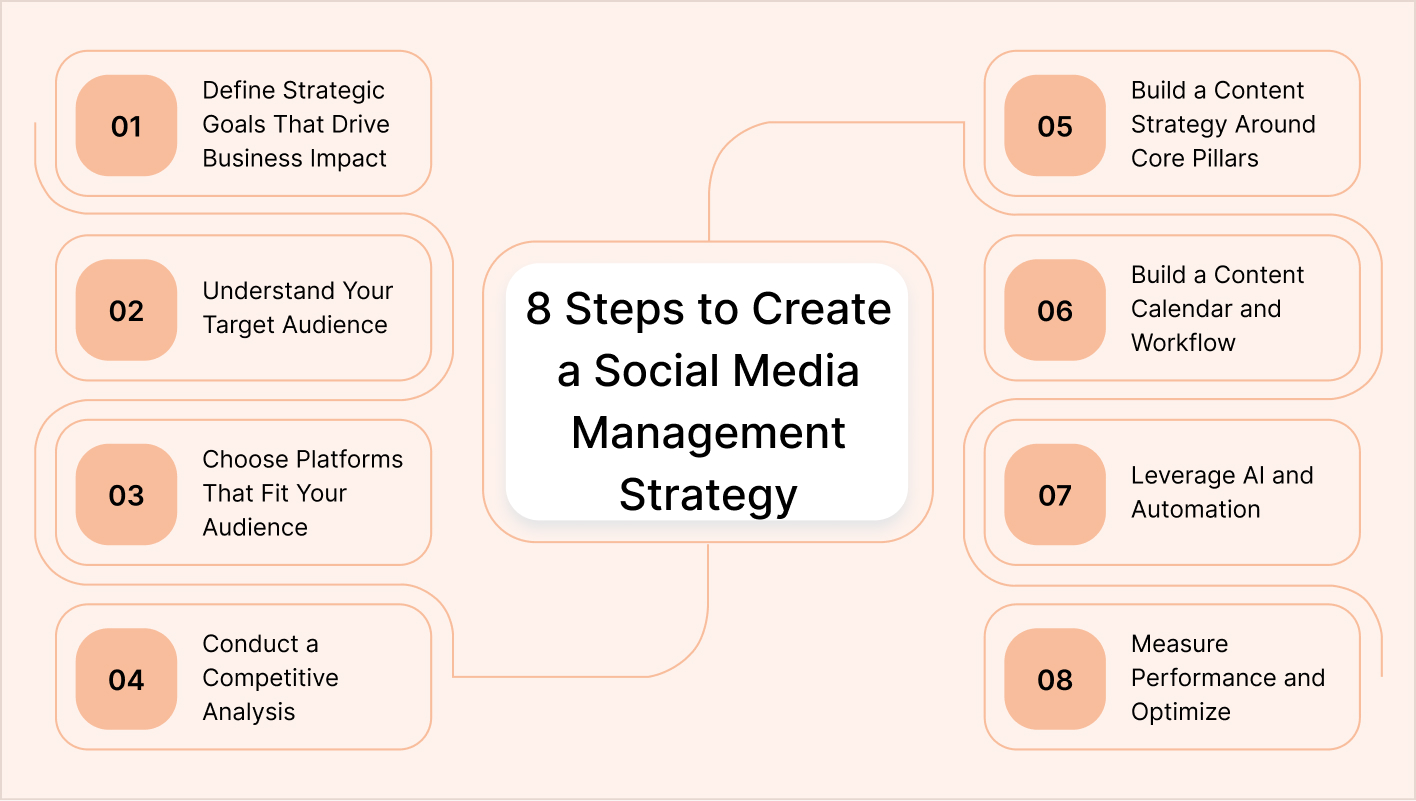
1. Define Goals That Align With Business Outcomes
Every strategy starts with clarity about what success looks like. Your social media goals should connect directly to broader business objectives rather than existing as standalone vanity metrics.
Start by identifying what your business needs most from social media right now. Common goals include increasing brand awareness in new markets, driving qualified traffic to your website, generating leads for your sales team, improving customer retention through consistent engagement, or building thought leadership in your industry.
Then make those goals specific and measurable. “Grow our audience” becomes “increase LinkedIn followers by 30% and average post engagement rate by 15% within Q3.” Specific goals give your team clear targets and make performance evaluation meaningful rather than subjective.
Limit yourself to two or three primary goals per quarter. Pursuing too many objectives simultaneously fragments your team’s focus and makes it impossible to allocate resources effectively. Concentrate your efforts where they will drive the greatest impact, then expand as your strategy matures.
2. Research and Understand Your Target Audience
Your strategy is only as strong as your understanding of the people you are trying to reach. Audience research reveals where your customers spend time online, what content they engage with, and what motivates their purchasing decisions.
Begin with platform analytics. Every major social network provides demographic and behavioral data about your existing followers. Examine age ranges, geographic distribution, active hours, and the content types that generate the most interaction. These insights reveal whether your current audience matches your ideal customer profile.
Build detailed audience personas that go beyond demographics. Document their professional challenges, content preferences, platform habits, and the questions they ask at different stages of the buying journey. Use social listening to track what your target audience discusses, what competitors’ content resonates with them, and what gaps exist in the conversations your brand could fill.
Revisit this research quarterly. Audience behaviors shift as platforms evolve and new trends emerge, and strategies built on outdated assumptions lose effectiveness quickly.
3. Choose Platforms Based on Audience and Content Fit
Trying to maintain an active presence on every platform spreads your team thin and guarantees mediocre results everywhere. Strategic platform selection focuses your resources where they generate the highest return.
Match each platform to your audience data and content strengths:
- LinkedIn works best for B2B brands, thought leadership, and professional services.
- Instagram excels at visual storytelling, product showcases, and lifestyle branding.
- TikTok rewards authentic, trend-driven short-form video content that connects with younger demographics.
- Facebook provides a broad reach, community-building tools, and sophisticated advertising capabilities.
- YouTube functions as both a social platform and a search engine, ideal for educational and long-form video content.
- Pinterest drives product discovery and purchase intent, especially among planners and visual searchers.
Managing two or three platforms with consistent quality and genuine engagement outperforms spreading effort across six platforms with sporadic activity. Evaluate platform performance quarterly and reallocate resources based on what your data reveals about where your audience actually engages.
4. Conduct a Competitive Analysis
Understanding what your competitors do well on social media, and where they fall short, sharpens your own strategy. Competitive analysis reveals content gaps you can fill, audience needs that remain unaddressed, and tactical approaches worth testing.
Identify three to five competitors and audit their social presence. Examine their posting frequency, content formats, engagement rates, audience growth patterns, and the themes that generate the most interaction.
Look beyond imitation. The goal is not to copy competitors but to identify differentiation opportunities. If every competitor publishes polished promotional content, your audience may respond better to behind-the-scenes authenticity. If competitors neglect video content on a specific platform, that gap represents your opportunity.
Document your findings and revisit them quarterly. The competitive landscape shifts constantly, and a one-time audit loses relevance within months.
5. Build a Content Strategy Around Core Pillars
Content pillars are the recurring themes that anchor your social media presence. They give your team clear creative direction while ensuring content consistently addresses what your audience cares about.
Define three to five content pillars based on your audience research and business goals. A B2B software company might organize content around product education, industry thought leadership, customer success stories, company culture, and practical tips. Each pillar serves a specific purpose within your content mix and maps to a stage in your audience’s journey.
Balance your content types to maintain audience interest:
- Educational content positions your brand as a trusted resource and answers questions your audience actively searches for.
- Entertaining and relatable content humanizes your brand and drives shares, expanding your organic reach.
- User-generated content builds social proof and community engagement simultaneously.
- Promotional content drives conversions but should represent a smaller portion of your overall mix, typically around 20%.
- Thought leadership establishes authority in your industry and attracts high-value followers.
Prioritize short-form video across every platform where it is supported. Reels, TikTok videos, and YouTube Shorts consistently outperform static content in engagement metrics. Investing in even basic video production capabilities gives your strategy a significant competitive advantage in 2026.
6. Create a Content Calendar and Scheduling Workflow
A content calendar transforms your strategy from an abstract plan into a concrete execution framework. It maps out what gets published, when, where, and by whom. Build your calendar around your content pillars, assigning themes to specific days or weeks to maintain a balanced mix.
Include key dates, industry events, product launches, and seasonal moments that your content should address. Leave room for reactive content that responds to trends or timely conversations your audience cares about.
Establish a realistic posting cadence for each platform. Consistency matters more than volume. Posting three quality times per week on every platform outperforms daily posting that sacrifices relevance or creative quality.
Use scheduling tools to automate publishing at optimal times. For businesses managing multiple locations, scheduling tools that handle timezone coordination automatically eliminate the errors that manual scheduling inevitably creates.
7. Leverage AI and Automation Strategically
AI has moved from an experimental novelty to an essential component of effective social media management. The brands seeing the strongest results in 2026 use AI to amplify their team’s capabilities without sacrificing the authenticity that audiences demand.
AI tools assist with content ideation by generating topic suggestions based on trending conversations and audience interests. They draft caption variations in different tones, helping teams overcome creative blocks and produce content faster. Image generation and video editing tools powered by AI reduce production time significantly while maintaining the visual quality your brand requires.
Automation handles the repetitive tasks that consume disproportionate time. Automated scheduling, response templates for common inquiries, social listening alerts, and performance report generation free your team to focus on strategy, creative development, and genuine audience engagement.
However, AI amplifies your strategy rather than replacing human judgment. Audiences quickly recognize and disengage from purely automated interactions. The most effective approach uses AI for efficiency and pattern recognition while keeping strategic decisions, creative direction, community engagement, and crisis response firmly in human hands.
8. Measure Performance and Optimize Continuously
Measurement separates strategic social media management from guesswork. Define your key performance indicators based on the goals you established in step one, then track them with discipline.
Essential metrics to monitor include:
- Engagement rate: How actively your audience interacts with content through likes, comments, shares, and saves.
- Reach and impressions: How many unique people see your content and how frequently it appears.
- Click-through rate: How effectively content drives traffic to your website or landing pages.
- Conversion rate: How social media activities translate into leads, sales, or other business outcomes.
- Follower growth rate: Whether your audience is expanding and at what pace relative to benchmarks.
- Response time: How quickly your team replies to comments and messages.
Establish a monthly reporting cadence that analyzes performance trends, identifies top-performing content, and flags underperforming areas. Use A/B testing to experiment with different formats, captions, posting times, and creative approaches. Let data guide your optimization rather than assumptions.
According to a Gartner Survey, 59% of CMOs report insufficient budget to execute their strategy, with marketing budgets holding flat at 7.7% of company revenue. When budgets are constrained, measurement becomes even more critical. Proving ROI through clear data protects your social media investment and demonstrates the business value your team delivers.
Unlock the Full Value of Your Social Media Management Strategy
Enable consistent execution and real-time visibility with ContentBridge’s AI-powered frontline social media management solution.
How to Integrate Paid and Organic Social Media
A complete social media management strategy combines organic and paid efforts rather than treating them as separate channels. Each serves a distinct purpose, and the most effective strategies use them in coordination.
Organic social media builds your foundation. It nurtures relationships with existing followers, establishes brand voice and authority, generates long-term audience growth, and creates the content library that fuels your paid efforts. Strong organic content validates what resonates with your audience before you invest advertising budget to amplify it.
Paid social media extends your reach beyond your existing audience. It targets specific demographics, accelerates lead generation, promotes time-sensitive campaigns, and retargets people who have already engaged with your brand. Paid distribution also overcomes the reach limitations that platform algorithms impose on organic content.
Allocate budget strategically by using organic performance as your testing ground. Content that generates strong organic engagement typically delivers better paid results because the messaging has already been validated by real audience response. This approach prevents the common mistake of spending advertising budget on content that fails to connect.
Track performance separately for organic and paid efforts while measuring their combined impact on your business goals. UTM parameters help attribute website traffic and conversions accurately across both channels, giving you a clear picture of where each dollar produces results.
How to Align Your Strategy Across Teams and Locations
Social media management does not operate in isolation. The strongest strategies integrate social insights and execution across departments and, for multi-location businesses, across every office, store, or franchise location.
1. Cross-Departmental Collaboration
Your social media strategy improves when it connects with other business functions. Customer service teams provide insights into common questions and complaints that inform content creation. Sales teams share feedback about prospect pain points that shape messaging. Product teams surface feature updates and roadmap priorities that fuel announcement content. HR teams leverage social channels for employer branding and recruitment.
2. Multi-Location Strategy Coordination
For businesses operating across multiple locations, strategy alignment presents unique challenges. Each location needs to execute the brand’s social strategy consistently while adapting content for local relevance.
The frontline teams at these locations often produce authentic, high-performing stories that never reach corporate marketing without the right systems to capture and scale local content. Without centralized coordination, local teams improvise with outdated assets, miss campaign timelines, and create inconsistent brand experiences that erode customer trust.
ContentBridge solves this coordination challenge with purpose-built capabilities for multi-location social media management for frontline workers. The platform centralizes content libraries so every location accesses approved assets. his combination of centralized strategy with localized execution separates brands that scale their social presence effectively from those that fragment as they grow.
Keep Your Social Accounts Secure at Scale
ContentBridge uses five-level role-based access control and department isolation so teams can create and publish content without ever sharing social media account credentials.
Common Social Media Management Strategy Mistakes to Avoid
Even well-intentioned strategies fail when teams repeat avoidable errors. Watch for these patterns and correct them before they become habits.
- Setting vague goals: “Get more followers” is not a strategy. Without specific, measurable objectives, your team lacks direction and accountability.
- Ignoring audience research: Creating content based on assumptions rather than data produces low engagement and wastes creative effort.
- Chasing every platform: Spreading resources across too many networks dilutes your impact everywhere instead of building strength somewhere.
- Neglecting community engagement: Treating social media as a broadcast channel rather than a conversation alienates the followers who drive your growth
- Skipping competitive analysis: Operating in a vacuum means missing differentiation opportunities and repeating mistakes your competitors already made.
- Resisting data-driven changes: Clinging to strategies that performance data shows are underperforming wastes budget that could fuel growth
- Operating without clear workflows: Undefined roles and approval processes create bottlenecks, quality issues, and accountability gaps that worsen as teams grow
- Treating your strategy as static: Social media evolves constantly. Strategies that are not reviewed and updated at least quarterly lose relevance and effectiveness
The difference between brands that grow their social presence and those that stall is not the size of their budget. It is the discipline to avoid these mistakes, measure honestly, and adapt when data demands it.
Turn Your Social Media Strategy Into Scalable Execution With ContentBridge
Building a strategy is essential. Executing it consistently across teams and locations is where most brands struggle. As your business grows, the coordination challenges multiply, and tools designed for single-account management simply cannot keep pace.
ContentBridge is a frontline-focused social media management platform built for businesses that operate across multiple locations. It centralizes your content strategy, so every team works from the same playbook. Automated scheduling handles timezone complexity. Approval workflows ensure nothing is published without proper review. Performance analytics break down results by location, region, and team so you know exactly where your strategy succeeds and where it needs refinement.
Local teams access content and publish through mobile-first interfaces designed for frontline workers, not office-based marketers. Campaign distribution happens automatically. Brand consistency is protected through configurable permissions and approval chains. The result is a social media management strategy that actually scales with your business rather than breaking under its weight.
Request a demo to see how ContentBridge turns your social media strategy into a consistent, measurable execution across every location.
Frequently Asked Questions
How do I create a social media management strategy?
Start by defining specific business goals your social media efforts should achieve. Research your target audience to understand their platform preferences and content interests. Choose platforms strategically based on audience fit, build content pillars that address your audience’s needs, create a content calendar, and establish workflows for content creation, approval, and publishing. Set key performance indicators tied to your goals and review performance monthly to optimize your approach continuously.
What are the key components of a social media management strategy?
A complete strategy includes clearly defined goals, audience research and personas, strategic platform selection, a content strategy built around defined pillars, a content calendar with scheduling workflows, a measurement framework with specific KPIs, and a plan for integrating paid and organic efforts. For multi-location businesses, the strategy must also include coordination processes and tools that maintain execution consistency across every team and region.
How often should I update my social media strategy?
Review performance metrics monthly and conduct a comprehensive strategy review quarterly. Major updates should happen whenever business goals shift, audience behaviors change significantly, new platforms gain traction, or algorithm changes affect your results. Treat your strategy as a living document that evolves with your business and the social media landscape rather than a static plan created once and revisited only when results decline.
What is the difference between a social media strategy and a content calendar?
A strategy defines your goals, audience, platforms, content approach, and measurement framework. It answers the “why” and “what” behind your social media efforts. A content calendar is a tactical execution tool within that strategy. It schedules the specific posts, timing, and responsibilities that bring your strategy to life day by day. A content calendar without a strategy lacks direction, while a strategy without a calendar lacks the structure needed for consistent execution.
How do I measure the success of a social media management strategy?
Track metrics that connect directly to your defined goals. Brand awareness strategies measure reach, impressions, and follower growth. Engagement strategies track likes, comments, shares, and engagement rate.
Lead generation strategies monitor click-through rates, conversions, and cost per lead. Customer retention strategies measure response time and sentiment. Regular reporting that ties these metrics to business outcomes demonstrates ROI and builds the case for continued investment in your social media efforts.