


Your social media followers want to hear from real people. They crave authentic experiences over polished marketing messages. Patient stories deliver exactly what communities seek. Healthcare providers sharing real patient narratives achieve measurable results in engagement and trust.
The healthcare industry is shifting toward patient-centered storytelling on social media. Patients increasingly influence healthcare decisions based on stories they encounter online. When people see themselves reflected in patient narratives, they develop emotional connections to your organization. This connection transforms into loyalty and referrals that marketing budgets cannot purchase. Yet too often, enterprises miss frontline moments on social media that could strengthen these connections.
This guide explores how hospitals build community trust through authentic patient stories. Learn frameworks for identifying willing patients, obtaining proper consent, and structuring narratives that resonate. Discover content formats that maximize engagement and community impact. Most importantly, understand how patient storytelling drives measurable business results.
Why Authentic Patient Stories Matter More Than Ever
In an era of information overload and growing skepticism toward corporate messaging, patients trust other patients far more than they trust branded advertisements. Authentic patient stories humanize your healthcare brand, build emotional connections, and demonstrate real-world outcomes that no amount of polished marketing copy can replicate. When shared compliantly and thoughtfully, these narratives become your most powerful social proof.
- Build trust and credibility. Real experiences from real patients carry more weight than any tagline, helping prospective patients feel confident in choosing your practice or facility.
- Drive higher engagement. Social media posts featuring patient stories consistently outperform generic health tips and promotional content in likes, shares, and comments.
- Simplify complex services. A patient explaining how telemedicine changed their life communicates value more effectively than a feature list ever could.
- Support decision-making. Prospective patients often look for relatable experiences before booking appointments, and authentic stories guide them through that journey.
- Strengthen community connection. Sharing diverse patient voices shows that your organization genuinely cares about the people it serves, not just the services it sells.
- Improve SEO and content longevity. Story-driven content earns more backlinks, longer dwell time, and higher organic visibility compared to standard promotional posts.
Patient stories also serve as a direct counter to the growing wave of health misinformation on social media. The 2025 Edelman Trust Barometer found that 38% of adults aged 18 to 34 have ignored a healthcare provider’s advice in favour of information found on social media. Separate research has shown that nearly 45% of medical advice on TikTok is inaccurate or misleading, yet over half of younger users turn to the platform for health guidance. This creates a trust vacuum that healthcare organizations must fill with verified, compliant content.
When hospitals share authentic patient stories through official channels, they provide an authoritative alternative to unvetted health content circulating online. Real people sharing real outcomes carry inherent credibility that generic health tips and anonymous social media posts cannot match. Patient narratives grounded in documented care experiences cut through the noise because they are specific, verifiable, and emotionally resonant.
Healthcare organizations that remain silent on social media cede this space to unreliable sources. Patient storytelling is not just a marketing advantage. It is a public health responsibility. Organizations that understand why no social media is the riskiest compliance decision recognize that silence carries its own reputational cost. By proactively sharing accurate, consent-based patient experiences, hospitals position themselves as trusted voices in an environment where misinformation erodes community confidence in healthcare providers.
The bottom line is that patient stories are not just feel-good content. They are a strategic asset. Healthcare organizations that prioritize authentic storytelling in their social media marketing will build deeper patient loyalty, stand out in crowded feeds, and create a brand reputation rooted in trust rather than transactions. The key to manage healthcare social media is to capture these stories ethically, share them compliantly, and let the patient’s voice lead the narrative.
The Patient Storytelling Framework That Builds Trust
Effective patient stories follow a proven structure that resonates with audiences and drives engagement. Understanding this framework helps hospitals create narratives that feel authentic rather than manufactured. The best patient stories maintain a consistent arc from problem through outcome.
The Problem: Starting With Challenge
Every compelling patient story begins with a genuine health challenge. Avoid clinical jargon when describing the problem. Instead, communicate the patient’s experience in everyday language. Describe what the condition meant for their daily life. Explain the emotional weight of their situation. Share the fears they experienced.
A powerful opening makes audiences care about the patient’s journey. When listeners understand what someone faced, they invest emotionally in the outcome. The problem section answers a simple question. What brought this patient to your hospital or healthcare provider? Make this relatable rather than technical.
The Journey: Documenting Care and Treatment
The journey section forms the story’s heart. This is where the patient describes their treatment experience. Focus on interactions with staff, personal moments of compassion, and critical care decisions. Include quotes that capture the patient’s voice authentically. Use their words rather than paraphrasing experiences.
The journey reveals how your organization delivered care. It shows empathy in action rather than describing it abstractly. Share specific moments where staff members went above and beyond. Include details about how providers explained complicated medical information. Highlight moments when the patient felt truly cared for.
This section naturally connects to your service lines and departments. Mention specific teams or physicians by name when patients approve. Show how different specialists collaborated to deliver comprehensive care. The narrative demonstrates your organization’s depth and expertise through patient experience rather than promotional language.
The Outcome: Demonstrating Impact and Hope
The outcome section completes the narrative arc. Share the patient’s current health status and how treatment changed their life. Describe activities they can do again. Share their emotions about recovery or improved management. Let the patient articulate what matters most about their results.
The strongest outcomes emphasize what patients gained rather than clinical metrics. Did they return to work? Play with grandchildren? Travel somewhere meaningful? These details communicate the true impact of care far more powerfully than laboratory values or imaging results. Audiences want to understand how treatment affected the quality of life.
Gather and Manage Patient Stories at Scale
ContentBridge streamlines patient story collection from initial identification through final publication on social channels.
How to Share Patient Stories While Protecting Patient Privacy
Sharing patient stories requires careful legal and ethical consideration. Healthcare providers must protect patient privacy while enabling meaningful storytelling. The good news is that privacy compliance in patient storytelling is entirely achievable with proper processes and documentation. In Canada, PIPEDA and provincial health privacy legislation govern how organizations collect, use, and disclose personal health information, including on social media. For organizations with operations in both Canada and the United States, you also need to know how to share patient success stories without HIPAA risk, where the 18-identifier framework adds additional specificity to the consent process.
1. Follow Proper Authorization Requirements for Social Media
Privacy legislation in Canada requires meaningful consent before sharing patient stories on social media. Verbal agreements or informal text messages do not constitute valid consent under PIPEDA or provincial health privacy acts such as Ontario’s PHIPA or Alberta’s HIA. Written, signed consent forms must clearly identify social media as the intended use and specify which platforms the content will appear on.
Effective consent documentation should describe the exact content being shared, whether that includes the patient’s full name, photo, video, or specific diagnoses. Each element requires explicit permission. Unlike prescriptive authorization forms used in other jurisdictions, Canada’s consent framework is principles-based, meaning organizations must demonstrate that consent was meaningful, informed, and voluntary. Patients should have the right to approve the final content before publication and withdraw consent at any time.
2. Protect Patient Privacy and Dignity at Every Step
Some hospitals share stories with anonymized patient details to protect privacy while still enabling storytelling. Using first names only or implementing pseudonyms with patient approval are effective strategies that keep the story powerful without full identifying information.
Never assume that repurposing patient-generated content carries the same status as company-created content. When patients share their own stories on social media, your hospital’s reposting that content is treated as company-authored content by regulators. Always obtain specific authorization before amplifying patient posts.
3. Maintain Centralized Consent Tracking Systems
Create audit-ready records that prove you have proper consent for every piece of patient content. Include dates of authorization, specific content approved, platforms authorized, and revocation information.
These records demonstrate compliance if the Office of the Privacy Commissioner of Canada or provincial privacy commissioners ever question your practices. They also help your marketing team stay organized and avoid accidentally publishing content without valid authorization. Having this documentation also helps prove social media is brand safe to leadership and regulators.
4. Build Diverse and Inclusive Patient Narratives
Patient storytelling programs must intentionally represent your community’s diversity. Highlight stories from different demographics, health conditions, and departments while ensuring equitable representation of historically underrepresented communities.
Avoid reducing patients to their medical conditions. Present them as whole people with rich lives beyond their health challenges, including diverse family structures, professions, and backgrounds, to show your organization serves all community members.
5. Ensure Language Accessibility Across All Content
Translate key patient narratives into languages your community speaks and provide captions on all video testimonials. This ensures content reaches multilingual populations in your service area.
Accessibility enhances engagement while demonstrating genuine respect for community diversity. It also expands your content’s reach and strengthens trust among patients who may feel overlooked by English-only marketing.
Content Formats That Maximize Patient Story Impact
Different content formats serve different audiences and platforms. Strategic variety in storytelling formats extends reach and engagement. Understanding format options helps hospitals create comprehensive patient story programs.
1. Video Testimonials Deliver Unmatched Engagement
Video patient testimonials represent the most powerful storytelling format. Short emotional clips ranging from 60 to 90 seconds work best for social media, and featuring the patient speaking creates authenticity that narration cannot match. Striking the right balance between raw authenticity and professional standards is key, especially when producing authentic frontline social media content at scale.
- Produce videos in various lengths for different platforms, including extended versions for your website and YouTube.
- Develop short clips optimized for Instagram Reels and TikTok with vertical formatting designed for mobile viewing.
- Prioritize authenticity over overly polished production that feels corporate and loses credibility.
- Shoot in comfortable, familiar settings with natural lighting and let the patient’s story drive the content.
Each social platform rewards different video approaches, so tailor your patient story content accordingly. TikTok and Instagram Reels favour 30 to 60 second clips with strong emotional hooks in the first three seconds. Use text overlays and captions since most mobile users scroll with sound off. Facebook performs well with slightly longer testimonials of 90 seconds to three minutes and supports community discussion through comments. LinkedIn is the strongest platform for provider-perspective videos where physicians or nurses reflect on meaningful patient outcomes, reaching healthcare decision-makers and referral partners.
Consider hosting live Q&A sessions on Facebook or Instagram where patients and their care teams discuss treatment experiences in real time. Live formats eliminate the perception of scripting and give community members the chance to ask questions directly. Announce sessions at least one week in advance so followers can prepare questions and share the event with others. Record every live session so your team can repurpose highlights into short-form clips for other platforms.
2. Long-Form Blog Posts Build Narrative Depth
Detailed blog posts allow comprehensive storytelling without platform limitations. Long-form narratives accommodate complex healthcare journeys, explain treatments, and serve educational purposes beyond simple emotional connection.
- Incorporate patient photos and quotes throughout blog content to maintain reader engagement.
- Link to relevant service pages or physician profiles naturally within the narrative.
- Optimize blog posts for search by naturally incorporating patient story keywords.
- Use blog posts as cornerstone content that helps prospective patients evaluate healthcare options and discover your organization.
3. Social Media Carousels Tell Stories Visually
Instagram and LinkedIn carousels enable step-by-step visual storytelling where each slide moves the narrative forward through images and brief text. Carousels work especially well for showing the patient’s journey from diagnosis through recovery.
- Design carousel graphics that maintain brand consistency using your organization’s colors, fonts, and visual style.
- Include compelling patient quotes throughout the carousel to keep readers engaged.
- Use visual progression across multiple slides to maintain attention and tell a complete story.
- End with a clear call to action directing readers to your website or scheduling information.
4. User-Generated Content Amplifies Authentic Voices
Patients sharing their own stories on social media create powerful third-party validation that feels more authentic than any corporate-created content. Audiences recognize the difference between patient-originated content and company messaging.
- Encourage patients to tell their stories using branded hashtags that build community over time.
- Provide simple frameworks that guide patient storytelling without restricting authenticity.
- Amplify patient-generated content with hospital accounts only when proper authorization exists.
- Transform storytelling into community building through participatory hashtag campaigns.
5. Photo Essays Document Visual Journeys
Visual storytelling through carefully sequenced photos shows patient journeys without requiring video production. Photo essays combine images with patient quotes and contextual information to drive emotional connection through visual impact.
- Feature interactions between patients and clinical staff to document meaningful moments throughout the care experience.
- Share complete essays on blogs and break them into individual images for daily social media posting.
- Create print versions for hospital newsletters and waiting areas to extend reach beyond digital channels.
- Use photography to show the physical environment where care occurs and humanize clinical spaces.
6. Live Social Media Sessions Create Real-Time Engagement
Patients and providers discussing experiences during live social media sessions create authentic interaction. Live formats eliminate editing and scripting, making real conversations feel more genuine than pre-produced content.
- Schedule recurring live sessions featuring different patient-provider pairs to keep content fresh.
- Announce sessions in advance so followers can plan attendance and prepare questions.
- Use live sessions to address common questions about specific conditions or treatments.
- Record all sessions for reuse across platforms and future reference.
Consider pairing patient stories with staff and team achievement content to build a complete picture of your organization’s culture. Hospitals that highlight nurses, pharmacists, and clinical staff alongside patient narratives create a dual trust signal. Audiences see both the quality of care received and the dedication of the people providing it. Feature staff milestones, certifications, community volunteer efforts, and behind-the-scenes moments that humanize your clinical teams. When frontline staff see their contributions recognized publicly, it also strengthens internal morale and encourages broader participation in your storytelling program. Organizations that enable nursing staff to create social media content find that staff achievement posts naturally complement patient story campaigns.
Choosing the right mix of content formats ensures your patient stories reach the widest possible audience across every platform. The most effective healthcare social media strategies combine multiple formats to tell the same story in different ways, meeting patients where they already spend their time. Start with the formats that align with your team’s strengths and expand from there as your storytelling program matures. Following proven social media management best practices will help you scale your storytelling program effectively.
Create Consistent Patient Stories Across All Platforms
ContentBridge helps hospitals repurpose patient stories into multiple formats automatically, maintaining consistency while maximizing reach.
How to Build a Patient Storytelling Program That Lasts
Sporadic patient stories generate minimal impact. Sustainable programs require systems, processes, and consistent resource allocation. Strategic planning transforms patient storytelling from occasional content into reliable trust-building assets.
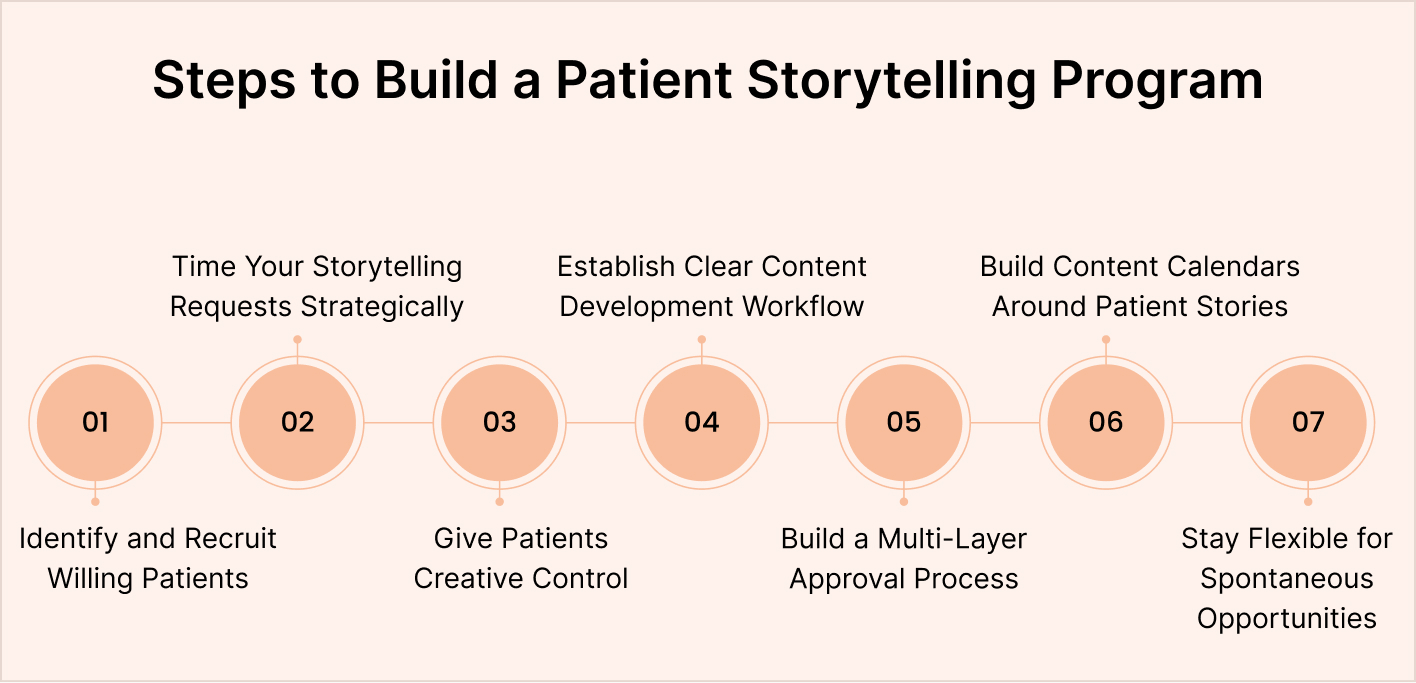
Step 1. Identify and Recruit Willing Patients
Successful patient story programs begin with identifying enthusiastic participants. Not every patient wants to share their story publicly, so respect patient preferences while creating clear pathways for willing participants. Engage patient experience officers or customer advocates who interact with satisfied patients regularly and can extend personal invitations that increase participation willingness.
Step 2. Time Your Storytelling Requests Strategically
Approach patients after they have completed active treatment successfully. Patients in recovery or experiencing positive outcomes feel more comfortable sharing their experiences publicly. Those still struggling with conditions may hesitate to discuss their journey, so timing the request carefully improves participation rates significantly.
Step 3. Give Patients Creative Control
Offer patients ownership throughout the process by letting them decide what details to share. Show them the final content before publication and demonstrate that you respect their boundaries. This collaborative approach builds trust, encourages authentic storytelling, and increases the likelihood of future participation.
Step 4. Establish a Clear Content Development Workflow
Define roles and responsibilities for each stage from idea to publication. Create standardized templates that maintain consistency across stories and build in quality review and compliance checkpoints. Assign trained staff members to conduct patient interviews using compassionate listening techniques and record interviews to capture authentic patient language.
Use a healthcare social media management tool like ContentBridge to ensure a streamlined development workflow. ContentBridge helps hospitals streamline social media content creation, review, approval, and posting to guarantee speed and compliance.
Step 5. Build a Multi-Layer Approval Process
Establish approval processes that ensure compliance before content goes live. Medical review should verify clinical accuracy without changing patient language. Legal review should confirm proper consent documentation and compliance with PIPEDA and applicable provincial health privacy legislation. Brand review should ensure consistency with organizational messaging, and all reviews should happen before final content creation. Organizations that speed up hospital social media approvals see faster content pipelines without sacrificing compliance.
Step 6. Plan Content Calendars Around Storytelling Themes
Plan patient storytelling programs like any editorial calendar by identifying themes and conditions you want to highlight. Coordinate patient stories with awareness campaigns, seasonal initiatives, service line launches, or facility expansions. Distribute storytelling across months to maintain a consistent content flow and ensure representation from various departments, demographics, and community members.
Step 7. Stay Flexible for Spontaneous Opportunities
Balance planned content with timely stories reflecting current patient experiences. When remarkable patient outcomes occur, capture them quickly while the emotion and details are fresh. Flexibility keeps your storytelling program feeling authentic rather than rigid, and prevents your content from becoming predictable or formulaic.
Plan for active post-publication engagement as well. Patient stories generate more comments and questions than standard content, and how your team responds determines whether those interactions build trust or erode it. Assign a dedicated team member to monitor comments and reactions on patient story posts within the first 24 hours of publication. Respond to community questions with accurate, helpful information. Acknowledge supportive messages to reinforce positive sentiment. Address concerns promptly and transparently.
Community management on patient story posts also serves a misinformation correction function. When commenters share inaccurate health advice or questionable claims in response to your patient stories, your team has an opportunity to provide factual guidance from a position of clinical authority. Respond with empathy rather than dismissiveness, directing people toward verified resources and encouraging them to consult their care providers. This positions your organization as a reliable voice in an environment where misinformation spreads rapidly.
Treat every comment thread as an extension of the patient story itself. When community members see your team engaging authentically, answering follow-up questions, and providing additional context, they develop stronger connections to your organization. This ongoing interaction transforms a one-way broadcast into a genuine conversation that deepens community trust. Over time, consistent engagement builds a reputation for responsiveness that attracts new followers and encourages more patients to share their own experiences.
Building a sustainable patient storytelling program is not a one-time effort. It requires ongoing commitment, dedicated resources, and a genuine respect for the patients who share their experiences. Organizations that invest in structured storytelling systems will consistently produce content that resonates with audiences, strengthens community trust, and sets their brand apart in an increasingly competitive healthcare landscape.
How to Measure the Impact of Patient Stories on Community Trust
Patient storytelling impact extends beyond traditional engagement metrics. Measuring trust requires multiple data points and qualitative feedback, and understanding program impact helps justify continued resource investment.
- Track engagement metrics across platforms: Monitor engagement rates for patient story content and compare performance against non-patient content. Use these insights to identify which story formats generate the highest engagement by platform.
- Match content formats to platform strengths: Video content typically generates the highest engagement on Facebook and Instagram, while blog posts drive search traffic. Carousels perform well on LinkedIn, and user-generated content often outperforms company-created content.
- Measure community trust and perception: Conduct surveys measuring community perception changes following patient story initiatives. Monitor sentiment in online reviews and track what influences prospective patients’ provider choices.
- Implement Net Promoter Score tracking: Use NPS surveys to track referral likelihood and correlate storytelling expansion with score improvements. Interview new patients to understand the direct impact of storytelling on acquisition.
- Connect storytelling to business outcomes: Monitor appointment scheduling and patient volume from storytelling campaigns. Track conversion rates on patient story content versus other content types.
- Calculate employee engagement benefits: Staff members watching patient stories often feel energized about their work. Measure how storytelling programs enhance recruitment, improve retention, and boost team morale.
Consistently measuring storytelling impact ensures your program continues to grow. Organizations that treat patient stories as measurable marketing assets will secure stronger leadership buy-in and build lasting community trust that translates into real results. Quantifying these outcomes highlights the social media management benefits that justify continued investment in patient storytelling.
Measure Patient Story Impact and Community Trust
ContentBridge provides detailed analytics showing how patient stories drive engagement, referrals, and community trust across all channels.
Overcoming Common Challenges in Patient Storytelling
Healthcare organizations often hesitate to implement patient storytelling programs due to perceived challenges. Most obstacles have straightforward solutions when addressed systematically. Understanding common barriers and how to overcome them helps prevent these challenges from derailing your program. A practical starting point is learning how to safely collect patient stories from nursing staff, since nurses are often the first point of contact for willing patient storytellers.
1. Managing Consent and Privacy Concerns
Medical teams worry extensively about privacy compliance under PIPEDA and provincial health privacy legislation when considering patient storytelling. Patient concerns about privacy and public recognition add another layer of hesitation that can slow down program momentum. Understanding compliance risks of frontline social media helps organizations address these concerns proactively.
How to Overcome
- Work with healthcare attorneys to develop bulletproof consent documentation that covers all platforms and content types.
- Conduct regular compliance audits to verify that processes remain compliant as your program evolves.
- Offer complete anonymity options for willing storytellers who prefer not to be publicly identified.
- Explain exactly how the organization will use their story and provide examples of similar content already published.
- Address every patient’s question and concern thoroughly before requesting signatures.
2. Finding Motivated Patient Participants
Some organizations struggle to identify patients willing to share their stories publicly. Not every patient will embrace public storytelling, and that is perfectly acceptable. Your goal is to find willing, enthusiastic participants rather than forcing reluctant ones.
How to Overcome
- Expand your outreach approach to multiple recruitment channels beyond clinical staff referrals.
- Connect with patient advocacy groups and support groups where patients regularly discuss their experiences.
- Partner with patient experience officers who interact with satisfied patients on a daily basis.
- Offer thoughtful incentives like gift cards or donations to charities patients support.
- Focus on quality over quantity, as fewer genuine stories always outperform numerous reluctant narratives.
3. Allocating Resources and Staff Time
Initiating patient storytelling programs requires upfront resource investment. These requirements are real, but they return dramatic engagement benefits when managed with a shared responsibility model.
How to Overcome
- Designate specific staff responsible for identifying patients, conducting interviews, and managing timelines.
- Budget for professional video production or photography that balances quality with authenticity.
- Distribute responsibilities across departments so patient experience officers identify candidates, marketing develops content, and social media teams manage publication.
- Allocate dedicated time for content development, multi-layer approval, and publication scheduling.
- Prevent single-person burnout by building a cross-functional team that shares the storytelling workload.
4. Managing Staff Social Media Conduct and Personal Accounts
When frontline staff participate in patient storytelling programs, their personal social media presence becomes an extension of your organization’s reputation. A single inappropriate post from a staff member’s personal account can undermine months of trust-building patient content. Healthcare organizations must address this proactively as part of their storytelling program governance.
How to Overcome
- Establish clear social media conduct guidelines that define expectations for staff who participate in official patient storytelling initiatives.
- Provide training that explains how personal posts can affect organizational credibility, using real examples of reputational damage from other healthcare organizations.
- Create a supportive culture rather than a punitive one, helping staff understand that professionalism on personal accounts protects both them and the patients whose stories they help share.
- Include social media conduct expectations in onboarding for any staff member involved in content creation or patient recruitment.
- Use a platform like ContentBridge where frontline staff contribute content through official channels without accessing social media credentials directly, reducing the risk of unauthorized or off-brand posts.
Every challenge in patient storytelling has a practical solution. Organizations that proactively address consent concerns, build diverse recruitment pipelines, distribute resources strategically, and set clear conduct expectations will create storytelling programs that run smoothly and deliver consistent results over time.
Launching Your Hospital’s Patient Story Program
Starting a patient storytelling program requires clear planning and stakeholder alignment. Begin with a small pilot before expanding to comprehensive programming. This phased approach builds confidence and demonstrates value before scaling investment.
Phase 1: Foundation and Planning
Secure leadership support and allocate initial resources. Develop PIPEDA-compliant consent forms with legal review, ensuring they also meet applicable provincial health privacy requirements. Establish content development workflow and approval processes. Train clinical staff on patient identification and recruitment approaches.
Create a calendar with target stories for the first 90 days. Identify five to ten willing patients from successful recent cases. Plan content formats, including at least one video, one blog post, and social media content. Begin production process for initial stories.
Phase 2: Pilot Launch and Learning
Release initial patient stories across social platforms. Monitor engagement closely and gather audience feedback. Conduct internal retrospectives examining what worked well and what to improve. Make adjustments based on learning from initial experiences.
Share pilot results with leadership to build support for expansion. Demonstrate engagement metrics by comparing patient stories to other content. Share qualitative feedback from community members encountering the stories. Build enthusiasm for program scaling.
Phase 3: Program Expansion and Scale
Expand patient identification and recruitment to additional departments. Increase storytelling frequency from monthly to weekly or more frequent. Develop additional content formats based on pilot learning. Establish systems that enable consistent program operation.
Build patient storytelling into regular organizational workflows. Incorporate storytelling into departmental marketing plans. Train additional staff members on program processes. Create feedback loops enabling continuous improvement.
Start Building Community Trust Today
ContentBridge simplifies patient storytelling program management from identification through publication. Get your program launched in days, not months.
Elevate Community Trust With Patient Storytelling
Patient stories transform how communities perceive healthcare organizations. Authentic narratives build trust more effectively than any marketing campaign. Real patients sharing real experiences communicate sincerity that resonates deeply with audiences.
Healthcare providers embracing patient storytelling programs see measurable results in engagement and community trust. Patient success stories generate three times more engagement than promotional content. Video testimonials create viral potential with 1,200 percent more shares. Communities seeing themselves reflected in patient narratives develop stronger connections to your organization.
Successful patient storytelling requires planning and sustainable processes. Structure narratives following the proven problem-journey-outcome framework. Secure proper documented consent under PIPEDA and provincial health privacy legislation for every story. Create diverse and inclusive patient programs representing your entire community. Develop multiple content formats, maximizing reach across platforms.
ContentBridge, a frontline social media management platform, enables hospitals to build and scale patient storytelling programs efficiently. The platform streamlines patient identification, consent collection, and content management. Automated workflows ensure compliance while reducing administrative burden. Analytics demonstrate how patient stories drive engagement and community trust.
Begin your patient storytelling program today. Identify your first willing patients. Develop compelling narratives that showcase your organization’s compassionate care. Share authentic patient voices across your social platforms. Watch as patient stories transform community perception and build trust that lasts.
Frequently Asked Questions
How Do Hospitals Share Patient Stories on Social Media While Maintaining Privacy Compliance?
Privacy compliance under PIPEDA and applicable provincial health privacy legislation requires specific written consent from patients identifying social media as the intended use. Consent forms must clearly describe which platforms will host the content and exactly what will be shared. Patients must be able to withdraw consent at any time with clear instructions for requesting content removal. Maintain centralized consent records for audit purposes.
What makes a patient’s story authentic and trustworthy on social media?
Authenticity comes from using the patient’s own words and voice rather than corporate language. Share genuine human experiences, including challenges and emotions, not just positive outcomes. Include specific details about care interactions that demonstrate compassion. Feature actual patient quotes and ideally patient photos or video. Avoid overly polished production that feels artificial or corporate.
How do you find and recruit patients willing to share their stories?
Train clinical staff to identify satisfied patients showing enthusiasm about their care experiences. Approach patients after successful treatment when they feel positive about outcomes. Partner with patient advocacy groups and support communities. Offer complete anonymity options for patients concerned about privacy. Respect patient preferences while creating multiple pathways for participation.
What content formats work best for patient stories on social media?
Video testimonials generate the highest engagement, ideally 60-90 seconds of patient speaking authentically. Blog posts allow comprehensive storytelling with deep narrative exploration. Social media carousels work well for visual step-by-step journeys. User-generated content where patients share their own stories often outperforms company-created content. Diversify formats across platforms to maximize reach and audience preference matching.
How Do Patient Stories on Social Media Improve Hospital Reputation and Community Trust?
Patient success stories achieve two to three times higher engagement than promotional content and create social proof that reduces anxiety about seeking care. In an environment where nearly half of health advice on platforms like TikTok is inaccurate, authentic patient stories from official hospital channels provide a trusted alternative. Community members seeing people like themselves treated successfully develop stronger confidence in your organization.
How Do Canadian Privacy Laws Like PIPEDA Affect Hospital Patient Storytelling?
PIPEDA and provincial health privacy legislation require meaningful consent before sharing personal health information on social media. Consent forms must describe the specific content, platforms, and purposes. Patients can withdraw consent at any time. Organizations should consult legal counsel to verify their obligations under both federal and applicable provincial legislation.