
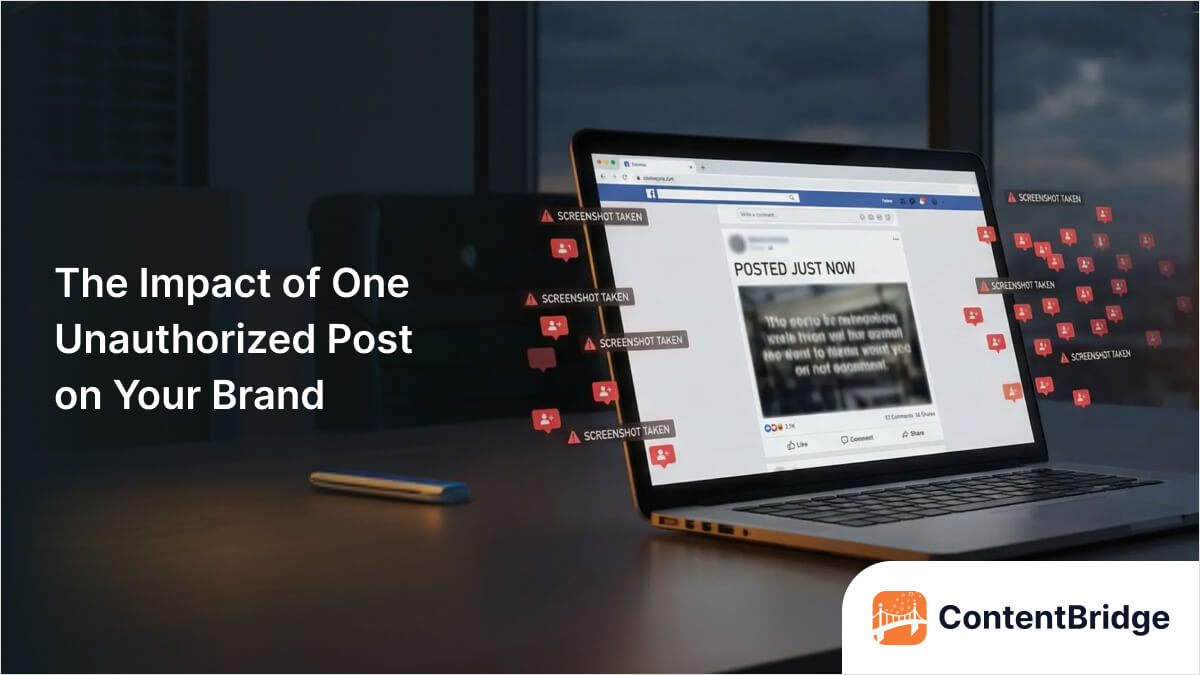

You spend years building trust, credibility, and a carefully crafted public image. On social media, all of that effort can unravel in seconds. One post, published without approval or context, is often enough to trigger backlash, screenshots, and conversations you cannot control.
Social media functions as a trust signal. An estimated 78% of consumers say a brand’s social media presence directly affects their trust, and that number rises to 88% among Gen Z. A single unauthorized post reaching even a fraction of your audience can undo months of careful brand building.
Every unauthorized social media post is preventable. The organizations that avoid these incidents are not luckier than the ones that suffer them; they have structured approval workflows that stop unapproved content before it reaches a public channel.
Why unauthorized posts are a growing risk for brands
The risk of unauthorized posts is not static. Several trends are making these incidents more frequent and more damaging than they were even two years ago.
1. The speed of viral exposure
Bad content travels fast. A controversial or embarrassing post can reach millions of users within hours of publication. Screenshots spread across platforms before you can assess the situation. Algorithms amplify controversial content because engagement signals reward it, regardless of whether the attention is positive or negative.
Deleting the post rarely contains the damage. Screenshots preserve the original content permanently. The deletion itself becomes a secondary story about attempted cover-ups. Your response timeline shrinks to minutes, not hours.
2. Multiple contributors create chaos
Your brand’s social media presence involves more people than ever. Content creators, regional managers, customer service teams, franchise operators, and executives all play a role. Each additional contributor increases the probability that something goes out without proper review.
Frontline employees frequently lack formal brand guideline training. Account-switching errors remain common, especially on mobile devices where selecting the wrong profile takes one mistaken tap. The more people who can post, the higher the risk that uncontrolled employee content creates brand exposure your communications team never anticipated.
3. Scheduled posts ignore context
Automated posting creates unique risks. Content scheduled weeks in advance cannot account for breaking news, natural disasters, or national tragedies. A cheerful promotional post that publishes during a crisis appears callous and tone-deaf, even though no one intended it.
Automation removes the human judgment that catches contextual problems. The post was approved when it was written, but the world changed between approval and publication. Organizations with high posting volumes across multiple time zones face this risk daily.
4. Third-party access multiplies exposure
You rarely manage social media entirely in-house. Agencies, freelancers, and vendors often have access to your accounts. Each external party adds a layer of risk that your internal processes cannot fully control.
Contractors may post to the wrong client account. Shared credentials eliminate accountability because you cannot trace who did what. Vendor turnover creates security gaps when departing staff retain access to your publishing tools. Every additional party with credentials widens your exposure window.
5. Regulatory and legal consequences escalate
Unauthorized posts can trigger compliance violations in regulated industries. Healthcare organizations risk exposing patient information in violation of PIPEDA and provincial health privacy legislation like Ontario’s PHIPA. Government agencies face access to information obligations that apply to every post, including deleted ones.
Under the Competition Act, advertising claims made on social media carry the same legal weight as claims made in any other channel. CASL governs commercial electronic messages, including promotional social media direct messages. For franchise networks and multi-location brands, a single unauthorized promotional claim from one location can create regulatory exposure for the entire organization. The penalties are not theoretical; the Competition Bureau and the Office of the Privacy Commissioner actively enforce these obligations.
6. Audience expectations have intensified
Consumers hold brands to higher standards than they did five years ago. Social media users expect authenticity, consistency, and accountability from every brand they follow. A single misstep can trigger organized backlash that spreads across platforms within hours.
Gen Z and millennial consumers research brands extensively before purchasing. A viral unauthorized post becomes a permanent data point in that research. Competitors capitalize on your mistakes by positioning themselves as the more responsible alternative.
The real costs of unauthorized social media posts
The damage from an unauthorized post extends far beyond the initial embarrassment. Three cost categories hit organizations harder than most leadership teams anticipate.
1. Immediate revenue loss
Customer trust correlates directly with purchasing decisions. When an unauthorized post contradicts your brand values, a measurable segment of your audience reassesses their relationship with your organization. Publicly traded companies face additional exposure; stock prices can drop within hours of a viral incident.
Crisis recovery marketing drains resources from growth initiatives. The budget you spend containing damage is budget you cannot spend on campaigns that generate revenue. Recovery costs consistently exceed the cost of prevention workflows that would have stopped the incident.
2. Long-term reputation damage
Balenciaga lost over 100,000 Instagram followers during their 2022 controversy. That loss represents real audience reach that took years to build and cannot be recovered through a single apology. Search engine results surface old incidents for years after they occur, ensuring that prospects and partners encounter the story long after your organization has moved on.
Competitors capitalize on brand crises by positioning themselves as alternatives. Market share lost during a reputation crisis often remains lost because customers who switch during a crisis rarely return voluntarily.
3. Employee and partner consequences
Internal morale drops when employees see their organization in a public crisis they had no part in creating. Partners and sponsors distance themselves from brands facing backlash, sometimes terminating relationships permanently. Top talent evaluates an organization’s public reputation before accepting offers, and a recent viral incident becomes a factor in that decision.
The cumulative effect touches every part of the business. Revenue, reputation, partnerships, recruiting, and employee retention all take hits from a single incident that proper approval processes would have prevented.
Common causes of unauthorized or accidental posts
Understanding why incidents happen is the first step toward preventing them. Three patterns account for the majority of unauthorized posts.
1. Posting from the wrong account
Account-switching errors remain the most common cause of social media disasters. Team members managing multiple accounts select the wrong profile and publish content intended for a personal account on the brand’s official page. KitchenAid experienced this during a U.S. presidential debate when a staff member posted political commentary from the brand account instead of their personal one.
Mobile posting increases this risk significantly. Smaller screens, faster workflows, and muscle memory lead to posts going out before the sender verifies which account is active. The fewer checks between creation and publication, the higher the probability of this error.
2. Missing approval processes
Many organizations have no formal content review before publication. Anyone with account access can post anything at any time. This is one of the clearest signs that social media governance has broken down.
Email and Slack-based approvals get lost in busy inboxes. Silence gets interpreted as approval when no one explicitly responds. Urgent timelines pressure teams to skip review steps because the process feels slower than the opportunity window. Every shortcut increases the probability that unreviewed content reaches your audience.
3. Inadequate training and guidelines
Employees cannot follow guidelines they have never seen. Many organizations fail to clearly document their brand voice standards, approved topics, and content boundaries. Training happens once during onboarding and never gets refreshed.
Guidelines age and become outdated as the brand evolves. Consequences feel abstract until a real crisis occurs. The gap between what employees think is acceptable and what the brand actually permits widens over time without regular reinforcement.
Stop unauthorized posts before they go live
ContentBridge routes every post through your approval workflow. Nothing reaches a public channel without explicit sign-off from your designated reviewers.
How to prevent unauthorized social media posts
Prevention requires structural controls, not just policies pinned to a shared drive. Three measures, implemented together, eliminate the conditions that allow unauthorized posts to happen.
1. Implement multi-level approval workflows
Every piece of content should pass through defined review stages before publication. Content creators submit posts. Managers or brand guardians verify alignment with guidelines. Nothing publishes without explicit approval from designated reviewers.
Different content types warrant different approval paths. Routine posts may need one reviewer. Content involving regulatory claims, patient stories, or crisis communications needs additional sign-off from compliance or legal teams. Configurable workflows that match your organizational hierarchy prevent both approval bottlenecks and governance gaps.
2. Centralize social media access
Account credentials should never be shared directly. Giving frontline teams social media passwords creates security and brand risks that traditional social media management tools cannot address.
Access through a managed platform replaces shared passwords with role-based permissions that limit what each user can do. Audit logs track all account activity. Departed employees lose access immediately without requiring manual password changes across every platform. Centralizing access means you always know who posted what, when, and through which approval path. Maintaining post-approval audit trails gives your legal team the documentation to respond to any compliance inquiry.
3. Create clear brand guidelines and training
Document your brand voice, approved topics, and forbidden content clearly. Written guidelines provide consistent standards across all team members. These guidelines form one pillar of a broader set of social media compliance best practices — which also covers access controls, approval workflows, and audit documentation.
Make guidelines accessible at the point of use, not buried in a shared drive or onboarding folder. Conduct quarterly refresher training using real case studies to make risks concrete. Embed standards directly into content creation workflows so compliance becomes part of the process rather than a separate step employees need to remember.
Prevent unauthorized posts with ContentBridge
Unauthorized social media posts happen when the gap between content creation and publication has no structured checkpoint. ContentBridge closes that gap for organizations with frontline workers across multiple locations.
ContentBridge is a social media management platform where frontline employees capture content on their phones and submit it through unlimited multi-level approval workflows before anything reaches a public channel. Content creators never access social account credentials directly.
Core capabilities that prevent unauthorized posts:
- Unlimited multi-level approval workflows with five granular permission levels, so every post passes through the right reviewers before publication
- Zero-credential publishing where frontline teams contribute content without ever touching social media passwords
- Complete audit trails documenting every action from submission through approval to publication, supporting compliance requirements under PIPEDA, PHIPA, ATIA, and provincial legislation
- Flexible approval chains for different content types, so routine posts move quickly while sensitive content gets additional review
- Role-based access control that gives everyone exactly the access they need without exposing publishing controls to content creators
- Mobile-first iOS and Android apps that make it easy for frontline workers to submit content during their workday
For specific pricing tiers, visit the ContentBridge pricing page.
Compliance depends on proper configuration and your organization’s specific policies. Consult your legal team for complete compliance verification.
Prevent unauthorized posts across your organization
ContentBridge stops unapproved content before it reaches any public channel, with unlimited approval levels and full audit trails.
Frequently Asked Questions
How quickly can an unauthorized post damage a brand?
Brand damage from an unauthorized post can begin within minutes of publication. Screenshots spread across platforms before your team even identifies the issue. Most organizations have less than one hour to assess and respond before the narrative moves beyond their control. The speed of viral exposure means that prevention through approval workflows is always more effective than rapid response after publication.
What types of unauthorized posts cause the most damage?
Posts that contradict brand values cause the most severe damage. Political statements from non-political brands, insensitive commentary during tragedies, offensive humour, and content involving protected groups or sensitive social issues generate the strongest backlash. Media amplification extends these stories beyond social platforms to news coverage, multiplying the audience exposed to the incident.
Can brands recover from social media disasters?
Recovery timelines vary widely depending on severity. Minor tone-deaf posts can be resolved within days with a prompt, authentic response. Major incidents that contradict core brand values can take months or years to recover from. Recovery requires consistent positive behaviour over time, not just an apology. Organizations that demonstrate structural changes, such as implementing approval workflows, recover faster than those that only apologize without changing their processes.
How do approval workflows prevent unauthorized posts?
Approval workflows create checkpoints between content creation and publication. No content reaches your audience without explicit authorization from designated approvers. Automated enforcement prevents teams from skipping steps under pressure or tight deadlines. Multi-level workflows ensure that the right reviewers, whether brand managers, compliance officers, or legal teams, screen content before it goes live.
What should your team do immediately after an unauthorized post?
Assess the situation and remove the content if appropriate. Document the original post with screenshots before deletion. Determine whether public acknowledgment is necessary based on the severity and visibility of the incident. Respond quickly and authentically if the post has already gained attention. Avoid defensive language or blame-shifting. Explain what happened and what measures you are implementing to prevent recurrence. Speed matters more than perfection in the initial response.